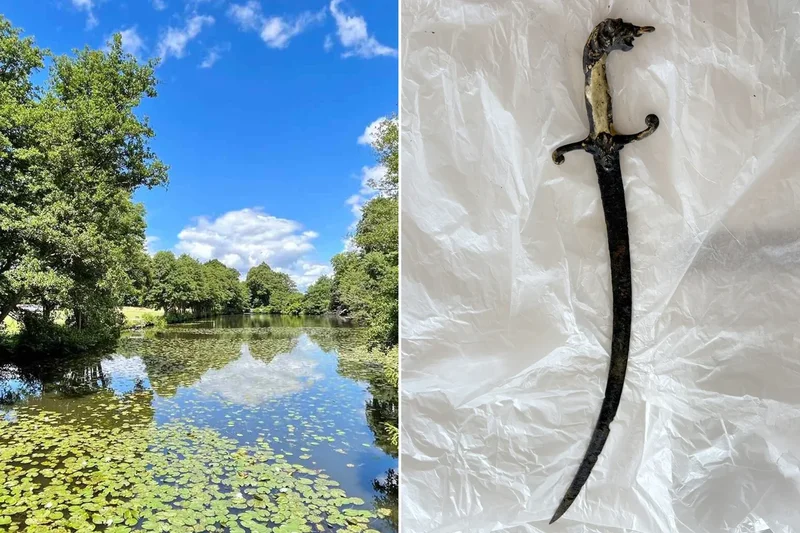
An ‘Excalibur’-esque sword has been discovered poking out of a castle lake after scorching weather caused water levels to drop.
The blade, which was found by volunteers in the lake at Chiddingstone Castle, Kent, resembles the renowned magical sword featured in the legend of King Arthur.
Castle curator Naomi Collick said that it might be a Victorian bandsman's sword dating back to the early 1800s.
Ms Collick said: “Our volunteer team were out here clearing some fallen branches around the edge of the lake, where the waterline has gone down quite significantly, and they spotted a blade poking out of the water.
“When they pulled it out they realised it was a sword, which is such an incredible discovery and potentially may have been in the lake for a very long time.”
The sword was found by volunteers who were clearing branches near the shoreline by the bridge using a grappling hook.
The discovery was reported to the staff team and Ms Collick then wrapped the sword in acid-free tissue to protect it.
Its curved blade is covered with mud and heavily corroded, with several chips missing along the cutting edge.
A gleam of gold can still be seen on the hilt, which appears to be made from gilded brass and features a lion on the end.
Ms Collick said there were several theories about how the sword could have ended up in the lake.
She said: “The last owner of the castle, Denys Eyre Bower, did collect swords but the lake itself was built in the 1800s.
“So it could have been any time from the 1800s onwards.
"It could have been, for example, troops who were stationed here during World War Two.
“It could have been the Streatfeild family who originally lived here in the 1800s, so there's plenty of different theories to try and investigate further.”
The lake was built in the late 1700s, when the Streatfeild family lived at the property and transformed their house into the castle-style building seen today.
The sword could have belonged to the family or to tenants who lived in the building after they moved out in the early 1900s.
Another possibility is that it ended up in the lake when the castle was taken over by the army during World War Two.
Denys Eyre Bower, who lived at the castle from the 1950s to the 1970s, was an antiques dealer and collector who did collect swords, although mainly Japanese and Jacobite examples.
Further research has identified several swords online with almost identical hilts, strengthening the theory that the discovery could be a bandsman's sword from the early 1800s.
The castle team has contacted its local Finds Liaison Officer for advice on reporting the discovery and is waiting for a reply.
They also plan to contact experts and other museums for help identifying the sword.
For now, the fragile weapon is not on display while the team waits to hear from the Finds Liaison Officer and decides what to do with it next.