analysis
East Asia
‘Blow to China's pride’: Fallout extent from Long March 7A rocket failure hinges on what went wrong
A Long March 7A rocket exploded shortly after liftoff on Monday (Aug 10), bringing its half-decade run of successful missions to a fiery end. The extent of the fallout on China’s space programme will hinge on what investigators uncover, say analysts.
BEIJING: A fiery explosion ended the Long March 7A rocket’s run of successful missions stretching over five years, but the real measure of the setback for China’s space programme will depend on what exactly went wrong, say analysts.
They add that whether Monday’s (Aug 10) failure proves to be relatively contained or reverberates through China’s busy launch programme hinges on a crucial distinction: Is the fault specific to that model, or does it involve hardware and systems shared with other rockets?
“If it is specific to the 7A, the effects could remain quite contained,” Svetla Ben-Itzhak, an assistant professor of space and international relations at Johns Hopkins University’s School of Advanced International Studies (SAIS), told CNA.
While failure is part and parcel of spaceflight, the latest mishap raises fresh questions over the reliability of the Long March 7A, considering its established track record, experts said.
“Is it a basic design flaw and they were just lucky and near the edge of failure on the previous … launches, or was it an assembly process error or software error that is easy to remedy?” Jonathan McDowell, an astrophysicist and veteran spaceflight observer, told CNA.
A STUMBLE IN THE LONG MARCH
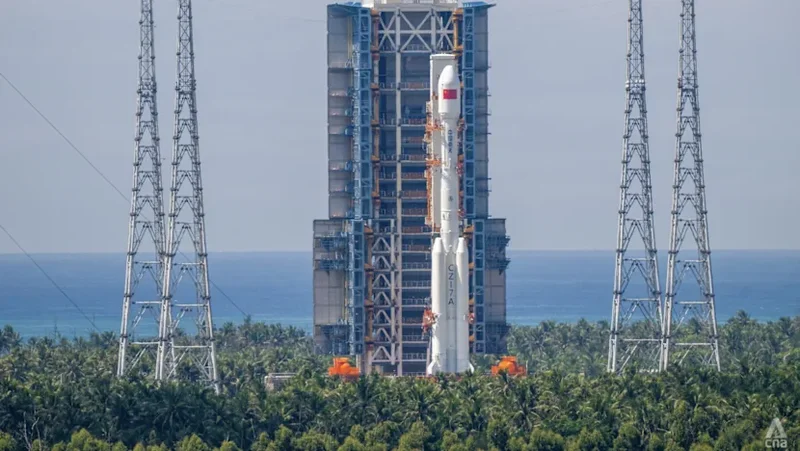
The Long March 7A - a medium-lift rocket primarily used to send satellites into high orbit - is a new-generation member of the Long March family of rockets that has long propelled China’s national space programme.
Monday evening marked the Long March 7A’s 18th mission - and its second failure since an unsuccessful maiden flight more than six years ago.
The rocket erupted into a huge fireball on Monday less than 90 seconds after blasting off from the Wenchang space launch site in Hainan province. Its payload, the ChinaSat-4B communications satellite, was lost.
“The rocket experienced an anomaly during the flight and the launch mission failed,” state news agency Xinhua reported late on Monday. It added that the cause of the failure is being investigated.
After the failed maiden flight in March 2020, it successfully made it to space a year later. The 7A’s previous mission before Monday took place on Jul 29, when a Tianlian data-relay satellite was sent into orbit.
A failure at this stage in the rocket’s operational history therefore carries greater significance, analysts said.
“It is very significant. A failure on (the) first launch is not unexpected. A failure on launch number 18 raises doubts as to the rocket's reliability,” said McDowell, who is also an honorary professor at Durham University.
Ben-Itzhak from Johns Hopkins University-SAIS said the incident interrupted a “fairly long period of demonstrated reliability” for the Long March 7A. The failure occurred “relatively early” in the flight, she further noted.
“(Because of this), investigators may be particularly interested in the vehicle's propulsion and structural integrity,” she said.
FAILURE COMES WITH THE TERRITORY
As dramatic as Monday’s mishap was, analysts noted that occasional failures are an inherent risk of spaceflight, with even established space programmes suffering periodic setbacks.
In December 2025, Japan’s flagship H3 rocket failed during a mission, losing a navigation satellite, before bouncing back with a successful launch in June this year.
In July 2024, SpaceX’s workhorse Falcon 9 broke apart in space, resulting in the loss of 20 Starlink satellites. It was the rocket’s first mission failure in more than seven years.
United States aviation regulators temporarily grounded the Falcon 9 before clearing its return to space 15 days later.
Before Monday, China’s most recent launch failure was in April this year, when the Tianlong-3 commercial rocket did not complete its maiden flight. In January, separate missions by a Long March 3B and the commercial Ceres-2 rocket also went awry.
“For more mature programmes, such as China’s, spacefaring nations plan for absolute success but risk-manage for failure,” said Ben-Itzhak.
“Launch failures are an unavoidable part of operating a space programme, especially at the scale and tempo that China is conducting them.”
China conducted a record 93 space launches in 2025, up sharply from 68 in 2024 and 67 in 2023, the state-run People’s Daily reported.
IMMEDIATE CONSEQUENCES
Regardless, Monday’s failure is likely to have immediate consequences, with analysts expecting a temporary halt to Long March 7A launches.
“I expect we won't see another CZ-7A until the end of the year,” said McDowell the astrophysicist, using the abbreviated designation for the rocket.
Other Chinese rockets could potentially be grounded even as investigations continue, said analysts.
“I would expect to see a significant pause on the launch of a variety of CALT-built rockets using similar engines,” Clayton Swope, deputy director of the Aerospace Security Project at the Center for Strategic and International Studies (CSIS), a US-based think-tank, told CNA.
CALT (China Academy of Launch Vehicle Technology) is a subsidiary of state-owned China Aerospace Science and Technology Corporation and a key developer of the Long March family of rockets, including the 7A.
“China is going to want to understand what caused this issue before launching another Long March 7 and, possibly, before launching a rocket that uses the YF-100 engines or a variant,” said Swope, who is also a senior fellow in CSIS’ Defense and Security Department.
The YF-100 is a liquid-fuel engine used across several newer-generation Long March rockets, including models in the 5, 6 and 7 series.
Ben-Itzhak from Johns Hopkins University-SAIS said broader implications for other Long March rockets will depend on what investigators find.
“(That is), whether this is a problem involving hardware or systems shared across the rocket family,” she said.
At the same time, Monday’s incident is likely to prompt heightened scrutiny across the industry as operators take stock of their own systems and procedures.
“When there’s ever an anomaly like this, an explosion, every company and state enterprise and entity will be looking very carefully at everything and double-checking,” Quentin Parker, professor emeritus at the University of Hong Kong (HKU), told CNA.
Against this backdrop, the much-anticipated launch of commercial rocket Zhuque-3, originally slated for Tuesday morning from the Jiuquan launch site in northwest China, was reportedly postponed.
No official reason has been given for the delay. Had it proceeded as planned, the launch would have taken place barely 12 hours after the Long March 7A failure.
Developed by Chinese private company LandSpace, the Zhuque-3 is one of China’s most advanced efforts to build a reusable launch rocket. Its maiden test in December last year ended in failure after the rocket was not able to complete the crucial controlled landing.
LONG MARCH ROCKET MISHAPS
Nov 5, 1974 | Long March 2
The rocket’s maiden flight from Jiuquan Satellite Launch Center fails.
The National Space Administration cites a “failure of a wire in the control system".
Dec 21, 1992 | Long March 2E
The rocket is launched from Xichang Satellite Launch Center carrying an Optus B2 satellite.
A report published by the US government states that an unspecified failure occurred 48 seconds after liftoff.
Jan 26, 1995 | Long March 2E
Carrying an Apstar 2 satellite, the rocket explodes about 50 seconds after liftoff from Xichang Satellite Launch Center.
Falling debris results in several casualties, according to media reports.
Feb 15, 1996 | Long March 3B
The rocket crashes shortly after liftoff from Xichang Satellite Launch Center, losing its US-built Intelsat 708 satellite payload.
It crashes into a nearby hillside, exploding and damaging a nearby village, according to reports.
At least six people are killed and dozens injured, reports state, although other accounts suggest the toll may have been higher.
Aug 18, 2011 | Long March 2C
Carrying an experimental satellite, the rocket malfunctions shortly after liftoff from Jiuquan Satellite Launch Center.
The incident results in the delayed launch of Tiangong-1, China's first space station module, China Daily reports.
Dec 9, 2013 | Long March 4B
The rocket takes off from Taiyuan Satellite Launch Center, carrying a Ziyuan-1-03 remote sensing satellite jointly developed by China and Brazil.
It suffers malfunctions during flight, China Daily reports.
Sep 1, 2016 | Long March 4C
The rocket is launched from Taiyuan Satellite Launch Center carrying the Gaofen-10 satellite, according to Chinese media reports.
But the mission ends in failure after the satellite fails to enter orbit, eventually crashing in Shanyang county in Shaanxi province.
Jul 2, 2017 | Long March 5 Y2
The launch of the heavy-lift carrier rocket from Wenchang Space Launch Center is unsuccessful after “abnormality” is detected during flight, Xinhua reports.
May 23, 2019 | Long March 4C
The rocket, carrying a remote sensing Yaogan-33 satellite, suffers a failure during launch at Taiyuan Satellite Launch Center.
The first and second stages of the rocket worked normally, but there was "abnormal operation" during the third stage, Xinhua reports.
Mar 16, 2020 | Long March 7A
The rocket’s maiden flight proves to be unsuccessful, with a malfunction occurring after it takes off from Wenchang Space Launch Center.
Apr 9, 2020 | Long March 3B
The rocket takes off from Xichang Satellite Launch Center carrying an Indonesian communication satellite.
It suffers a launch failure, with Xinhua reporting “abnormal conditions” during the third stage.
Jan 17, 2026 | Long March 3B
The rocket takes off from Xichang Satellite Launch Center, carrying the Shijian 32 multirole satellite.
Its third-stage booster malfunctions during flight, preventing the satellite from reaching its intended orbit.
Aug 10, 2026 | Long March 7A
The rocket takes off from Wenchang Space Launch Center, carrying the ChinaSat-4B communications satellite.
It explodes less than 90 seconds following liftoff after experiencing an anomaly during flight.
By Lakeisha Leo
SPACE AMBITIONS STILL IN ORBIT
For all the questions Monday’s failure raises about China’s rocket readiness, analysts said its implications for Beijing’s broader space ambitions are likely to be limited unless investigators uncover a more systemic problem.
“It is a meaningful technical setback … but not a major setback for China’s space programme as a whole,” said Ben-Itzhak, stressing the need to distinguish between the fate of an individual launch vehicle and the wider national programme.
China’s space programme has grown increasingly large and diversified, spanning a permanently crewed space station, lunar and planetary exploration, satellite constellations such as Beidou and a rapidly expanding commercial launch sector.
Recent years have brought a string of milestones.
China completed its Tiangong modular space station in 2022, while its Chang’e-6 mission made history in 2024 by returning the first samples from the far side of the Moon.
In May 2025, Tianwen-2 lifted off on China’s first mission to retrieve samples from a near-Earth asteroid. Success would make it only the third nation, after Japan and the US, to achieve the feat.
China is also pressing ahead with even more ambitious plans, including landing astronauts on the Moon before 2030 and launching a mission tentatively around 2028 to retrieve samples from Mars.
Beijing has also made strides in reusable rocket technology, which allows parts of a rocket to be recovered and flown again, potentially lowering launch costs and improving the efficiency and frequency of space missions.
In July, it successfully recovered an orbital-class rocket booster for the first time, using a sea-based system that caught the returning stage with a net above a floating platform.
Furthermore, aerospace development has been designated a strategic priority in China’s 15th Five-Year Plan - which spells out the country's national economic and social development goals - signalling the sector’s growing importance to the country’s economic ambitions.
The bigger test for China will be maintaining launch reliability as its space programme continues to expand, Ben-Itzhak said.
“As China accelerates its launch cadence and deploys increasingly large numbers of satellites, maintaining quality control and launch reliability becomes more difficult … and, of course, more important,” she said.
China has demonstrated “considerable institutional resilience” in recovering from past launch failures, Ben-Itzhak added, citing the Long March 5 as a notable example.
The rocket suffered a launch failure in 2017. It successfully returned to flight in late 2019 and was subsequently used for major missions, including the Tianwen-1 Mars and Chang’e-5 lunar sample-return missions in 2020.
Monday’s mishap involving the Long March 7A could ultimately prove another test of that ability.
“The failure is a blow to China's pride,” said astrophysicist McDowell.
“But if the failure investigation is carried out well, the eventual result will be to make China's rocket industry stronger and more reliable, as long as the correct lessons are learned.”