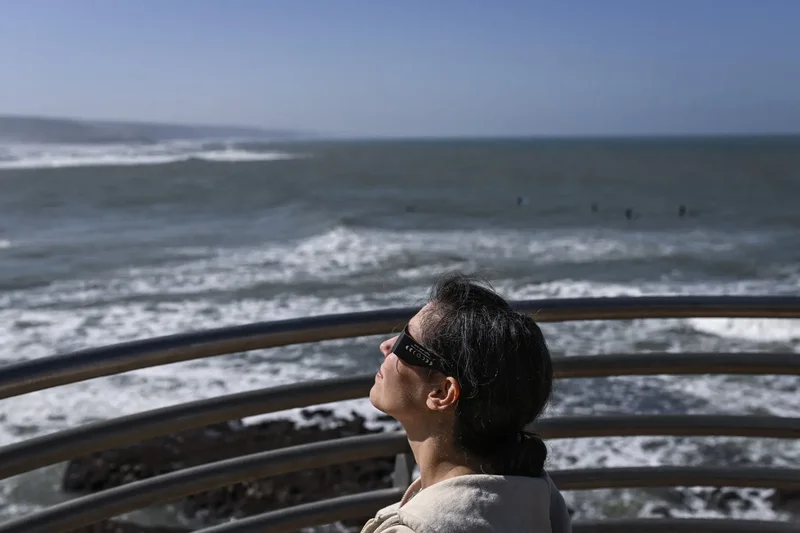
It's been 27 years since a comparable solar event was visible from Italy, and it's fair to say that eclipse fever has gripped the country.
The eclipse will happen when the Moon passes between the sun and the Earth, blocking part of the Sun’s disk from view and casting its shadow on the ground.
In order to see a total eclipse you will need to travel to Spain, Greenland or Iceland, but in northern Italy the sun will be around 90 percent obscured, depending on where you are.
READ ALSO: FACTS: What to know about Europe's total solar eclipse
Some of the best views will be in Ventimiglia in Liguria, with almost 95 percent obscured, followed by Belluno in Veneto, at 91.5 percent, dropping to 80 percent in Rome.
The latest weather reports predict mostly clear skies, though northwest Italy and central regions including Tuscany and Lazio could be hit by scattered thunderstorms.
Here's how to make the most of the spectacle.
Times
In good news for those who are still working in August, the eclipse takes place in the evening, as the sun is setting, so most people will not need to negotiate time off work.
The eclipse begins at around 7.30pm in Italy and is expected to reach its peak between 7:52pm and 8:22pm depending where along the Italian peninsula you’re watching from.
Weather site Meteo.it has put together a list of the precise times to see the eclipse at its peak in major Italian cities.
Place
You will want to view it from somewhere that has a good view to the west – anywhere that you can normally see the sun set should work, bearing in mind that as the eclipse ends the sun will be low in the sky. Sunset in Italy at this time of year falls between around 8-8.45pm, depending on where you are.
Some towns are hosting special events for the viewing, often at observatories, while others have published lists of good viewing spots – check out the website for your local comune, or the local newspaper.
Glasses
Looking directly at the sun is dangerous, so you will need special protective glasses.
Due to the aforementioned eclipse fever many places in Italy have sold out, but some still have stocks available.
READ ALSO: Where in Italy to find protective glasses for Wednesday's eclipse
If you're not able to find any, there are alternative ways to view the eclipse such as creating a pinhole camera or watching via shadows.
Heat
Most of Italy is currently in the grip of a heatwave, so be careful to protect yourself during the viewing. During a heatwave, the early evening often records the day's highest temperatures, especially in cities due to the 'heat sink' effect.
Make sure you are wearing sunscreen when you go outside to watch and take water with you, as well as a hat.
READ ALSO: 'Gelato for lunch': Italy's official advice for keeping cool in summer
Meteors
Wednesday's celestial dance does not end with the eclipse – the Perseid meteor shower is expected to peak during Wednesday night, when observers could see up to 150 meteors per hour under favourable conditions.
This will happen later in the evening – the best time is usually after midnight. You will get a better view of this one if you are in a place with dark skies, in more rural parts of Italy.
Conditions this year are ideal for seeing the peak as it occurs during a new moon phase, making this “one of the best opportunities of the decade to witness the spectacle of shooting stars”, according to the Italian Amateur Astronomers Union.
“For the entire night the sky will be completely free from the disturbance of moonlight, allowing even the faintest meteors to be observed”, they told reporters.
Eclipse-fest
A total solar eclipse, in which 100 percent of the sun is covered by the moon, will not be visible in Italy until September 2081.
But Wednesday's almost-total spectacular is the first of three similar events in less than two years.
A partial solar eclipse will be visible on August 2nd, 2027 – 78 percent coverage in Naples and 75 percent in Rome; and an annular eclipse, which occurs when the moon is further away in its elliptical orbit around the sun, creating the famous 'ring of fire' so popular with photographers, is due on January 26th, 2028 (though you’ll need to travel to Spain or Portugal for this one).