Cabinet had robust discussions when devising the elected presidency, GRC, NCMP schemes: Jayakumar
SINGAPORE - Cabinet ministers had robust and candid discussions when coming up with novel laws such as the elected presidency and group representation constituency (GRC) schemes, said former deputy prime minister S. Jayakumar.
Various options and angles are explored by the ministers, and different perspectives heard before a final decision is made for all major policies and laws, said Jayakumar, 87, who was also law minister during his 31-year-long political career.
Through his new book, he gave readers a glimpse of the debate behind these laws that had not been made public previously.
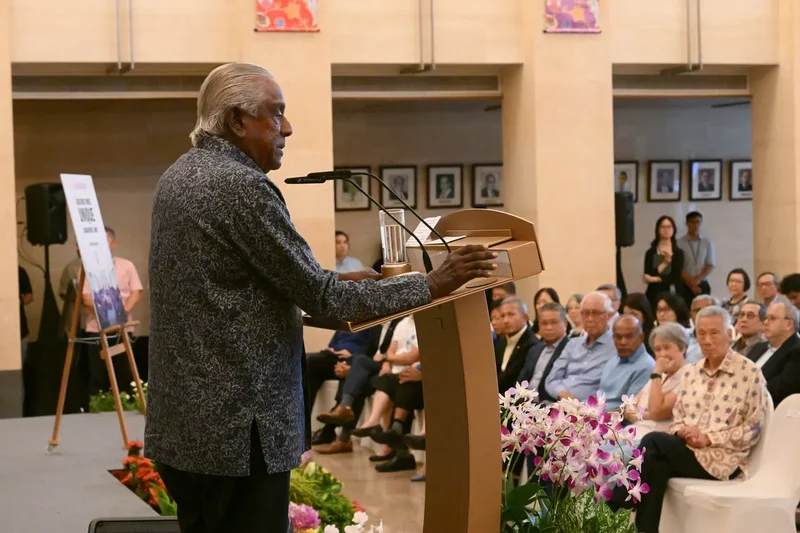
The processes behind these two laws, along with the Non-Constituency MP scheme, are the subject of the book Creating Three Unique Singapore Laws: An Inside Story by Jayakumar, launched on Aug 12.
“In government, before the die is cast, and you announce the law, announce the policy, all possible options ought to be looked at,” he said in an interview with The Straits Times and Lianhe Zaobao on Aug 5.
“For sound decision making, you’ve got to explore all angles before the final decision is reached.”
He hopes that the book will help readers understand that there is a “fairly detailed discussion of important issues, (which) might give them some sense of comfort that things are not rushed through at a railroad speed”.
The former minister, who joined politics in 1980, was involved in the process of developing all three laws from conception to enactment.
Jayakumar acknowledged that the laws were deemed “controversial” and said: “I’ll be the first one to admit that all three, at various stages, different opposition quarters said it was to fix the opposition.”
But the specific mechanics of the laws are not sacrosanct and can be adapted by future generations, he said.
What matters, he added, is whether people agree on the underlying doctrines of the laws.
In the case of the elected presidency, it is the need to provide a custodial check on the government’s power to spend the reserves and make key public appointments.
The GRC and NCMP schemes are to guarantee minority and opposition representation in Parliament respectively, he added.
If there is agreement on these underlying doctrines, then the laws should be seen as the “modalities” arrived at to address these problems, he said.
If future generations feel the laws are not the appropriate mechanism, then they may come up with something else, said Jayakumar.
However, these laws are still relevant today, he said when asked.
The EP was enacted in 1991, while the NCMP scheme was enacted in 1984 and the GRC scheme was enacted in 1988 – all years after they were first discussed in various forms around 1981 and 1982.
His new book elaborates on how the ministers disagreed, discussed and came to a consensus when forming these laws, through his own recounts of what happened then supported by newly declassified Cabinet papers.
Jayakumar said that when he first joined Cabinet, the robustness of the discussions fascinated him and left an imprint.
“I had not known the depth of details which ministers discuss,” said Jayakumar, who was an academic at the National University of Singapore Faculty of Law before entering politics in 1980.
He was minister of state for home affairs and law in late 1981 when he was asked to look into possible constitutional safeguards that would protect Singapore’s reserves from a profligate government.
Then prime minister Lee Kuan Yew had broached the idea of what would eventually become the elected presidency.
There was a perception by the public and people not in Government that Lee was someone who brooked no dissent, but he was instead very prepared to engage in discussions with the younger ministers, hear what they had to say, and was even prepared to change his mind, Jayakumar said.
Under Lee’s first conception of the Elected Presidency, the president would be a “wicket-keeper” with very wide powers, including dissolving Parliament, holding a national referendum and declaring a state of emergency.
The eventual law was vastly different from Lee’s initial proposal and came after robust debate, with many of the younger ministers pushing back on the original proposal, Jayakumar recounted in his book.
Quite a few of the younger ministers had, in fact, proposed alternative methods of protecting the reserves, such as having an upper house, or an independent central bank, he said.
Eventually, the scheme set out that an elected president would have veto powers over the withdrawal of Singapore’s financial reserves and over the appointments of key positions in the civil service, government companies and statutory boards.
The same collegiate approach to decision-making – encouraging people to speak up and to question – continued in subsequent Cabinets with different PMs, said Jayakumar, who also served in the Cabinets of Singapore’s second PM Goh Chok Tong and third PM Lee Hsien Loong.
Goh also introduced another layer, a pre-Cabinet meeting where all the ministers, save for the elder Lee, would meet in an informal lunch for free-wheeling discussions.
Jayakumar added: “And although I’m not a member of the Lawrence Wong cabinet, from what I hear, the same tradition is continued.”
Laws remain relevant today
On the elected presidency, the retired minister said that the Covid-19 pandemic proved right the instinct to safeguard the reserves for both current and future generations, citing how the Government was able to draw on it to save lives and jobs.
Singapore drew some $40 billion from past reserves to support Covid-19 public health and job measures.
As new global challenges such as climate change arise, the reserves will continue to be vital, said Jayakumar.
Even in non-crisis periods, the law remains relevant as the Government has to remain financially disciplined and prudent and work within its budget, he added.
But the EP “has still to be worked out and evolved” for it to work as intended, he said.
The electorate has to understand that presidential candidates must possess the financial and administrative expertise to challenge the Government.
But they must not mislead the electorate and promise to do things beyond the custodial powers of the role, such as changing policies on the cost of living, he added.
On the GRC scheme, Jayakumar said that while its mechanism is not “sacrosanct”, it does guarantee today that whatever the result of a general election, there will always be a racially representative Parliament.
He described a potential scenario without the scheme where the full slate of elected MPs could be from the majority Chinese race.
“I’m willing to agree it is not likely, but if it’s possible that zero minority candidates are returned, or maybe just one or two, is that good for Singapore, or not good for Singapore?” he asked.
“Now, if you take the view, ‘doesn’t matter, the electorate has spoken. So be it, we accept the result’, (then it) doesn’t matter - four, five years we’ll have no minority in Parliament.
“But if you take the view that that Government took – and I agree with it – that’s bad for Singapore’s domestic population and our social harmony, and for international reputation.”
In the Cabinet discussions on the schemes, three possible mechanisms were contemplated initially to address Malay representation, reflected Jayakumar in his book.
These included designating certain SMCs where the MP must be Malay and ‘twin constituencies’ to be formed by merging two SMCs, where at least one MP must be Malay.
Following feedback from other Cabinet ministers, including contention on what the mechanism should be by the likes of Jayakumar himself, the GRC system was formed as a development from the twin constituencies idea.
There was also a shift from focusing on Malays to also ensuring representation from the Indian and other minority communities.
While there has been criticism from some quarters that the GRC system existed to ‘fix the opposition’ by making it difficult for them to find enough candidates, Jayakumar pointed to the two GRCs won by the Workers’ Party – in Aljunied and Sengkang – and said the system “doesn’t prevent an opposition from fielding a good team with a minority and winning a GRC”.
When asked how far away race relations in Singapore are from making the GRC system redundant, Jayakumar said race, language, and religion are “gut primeval instincts” that cannot be completely eradicated.
While there may be evolution in thinking, it may be useful to have a system that ensures minority representation, he said.
Said Jayakumar: “If you ask me, I’m 87, right - the advantage of young people… is that you can be idealistic, and you can be far more hopeful than older people.
“It’s in my living memory that as a young man I saw the racial riots. Ten years I was in charge of Ministry of Home Affairs, and I’ve seen and dealt with issues with race and religion being undercurrent.
“I wish I can tell you that I agree with you that we have arrived, and race, language, and religion are no longer issues. I would caution against that conclusion.”
Jayakumar cited the 2025 General Election campaign when Prime Minister Lawrence Wong “had to make an important statement, reminding everybody to be mindful of (playing) the racial card”.
This came after Singaporean Islamic preacher Noor Deros had put up online posts about certain candidates’ views on Malay/Muslim issues, and the Government moved to block access to posts by foreigners for attempting to interfere in the election.
Said Jayakumar: “There are racial undercurrents; they have not disappeared. (In) countries in Europe and elsewhere, which are far more advanced and the greatest in the history of civilization, race, language, religion still operate.”
His book also covered the NCMP scheme, mooted a year after the Workers’ Party’s J.B. Jeyaretnam became the first opposition MP voted into the Parliament at the 1981 Anson by-election.
Lee Kuan Yew said then that a system where best performing opposition candidates would return to the House would satisfy the younger generation who want to see some public check on a PAP Government.
An alternative to the NCMP scheme that was considered was a “two-ballot approach”. After the initial votes were cast for constituency seats, a second ballot would take place where voters – knowing which party had formed the government – could vote for their preferred opposition party to fill the non-constituency seats.
Other approaches that were looked at included the system in Mauritius, which provided for a number of parliamentary seats that were not filled by the first-past-the-post method, with the other seats intended to ensure adequate representation of different communities and defeated candidates.
While robust internal discussions continue to this day, Jayakumar said lawmaking has also changed considerably in today’s political arena, with the advent of the Internet and social media.
Instead of just physical town hall meetings for example, technology has enabled governments and ministers to have online discussions, he said.
He said: “Communication and engagement with individuals, groups of individuals, and the electorate at large today has completely changed from my time.
“Both the government as well as the opposition need to try to harness (that) and be skillful.”