Sign in. It’s quick, free and it’s up to you.
An account is an optional way to support the work we do. Find out more.
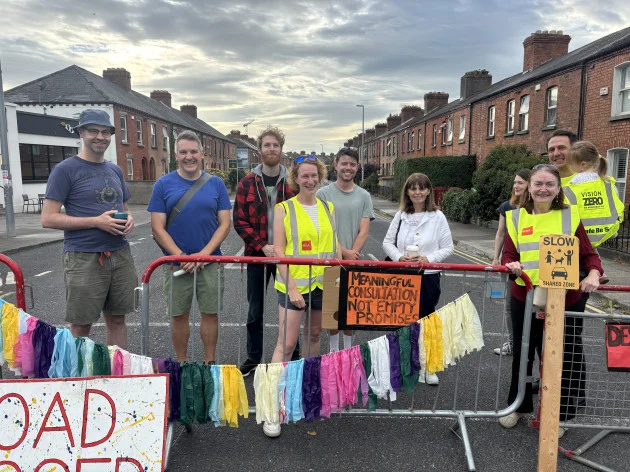
RESIDENTS OF RICHMOND Road in the north inner suburb of Drumcondra in Dublin this morning closed their road to traffic for an hour in protest against what they say is the city council’s inaction to tackle the high volumes of traffic that transit the road.
A small group placed barriers at the road’s entrance from the regional road R123 from 7.30am to 8.30am. They manned the barriers and were accompanied by two gardaí as traffic streamed along the main road.
The Journal headed down this morning to speak to those gathered about their concerns.
Many of those on the road have been living there for years, and while they say it was always a busy road, the volume of traffic has increased exponentially.
Residents have been fighting for the council to take action on the volume of traffic that travels down the road, which is almost entirely made-up of homes. Tolka Park, the home of Shelbourne FC, is on this road.
Weekly footpath protests were held for close to a year. In October 2025, residents held a similar protest and occupied the road.
Some 5,500 vehicles pass through the road each day. The community funded a Telraam device, which counts the number of cars, HGVs, cyclists, and pedestrians using the road. It showed that over 1.3 million vehicles used the road last year.
Those living on the road have detailed extensive damage to their own parked vehicles, safety concerns over their children walking along the footpath, aggression from drivers, loud noise from traffic, and constant gridlocks.
Speaking to The Journal on the empty road this morning, resident Kate van der Merwe said they’ve “been let down so many times” by the city council.
“Essentially, we don’t trust what they say any more,” van der Merwe said. “They make promises and placate us, and then we step back – and then it goes quiet again, radio silence.”
Van der Merwe has lived on the road since 2017, and she and the others gathered on the road this morning spoke of the community’s joint frustration with the issue.
Eilish O’Connor first moved to Richmond Road as a young woman in 1994. She said when she first moved into her home, the road experienced significant traffic, as many roads in Dublin do.
Since the end of the Covid-19 pandemic, however, this has worsened considerably, she said.
“The traffic is far worse than it ever was,” she told The Journal. “It’s very disconcerting because the level of noise: you can hear the traffic, you can hear shouting on the street, you hear honking, you experience aggression.
“This is the last road where there’s free access, and that’s why [it's so busy]. The biggest issue we’re dealing with is those big HGVs.”
The road has a weight limit, which residents say the city council has ignored in their reports on plans for traffic management.
The damage done to residents’ vehicles has been costly as well. There are parking bays on the street for homeowners to park their cars, but the narrowness of the road and the volume of traffic has seen these parked cars experience repeated damage.
“People have had up to seven or eight thousands euro in damage to their car,” O’Connor said. Another resident said between car owners on one part of the road, damage has totalled over €100,000.
Emma Taaffe, a resident with a young child, said she would love for her child to be able to cycle to school at some point, but it’s absolutely not an option due to safety issues with the road.
Taaffe has been among a smaller number of residents who are directly engaging with the council on plans for Richmond Road. She last spoke to The Journal in October 2025, since which the only change has been the installation of flexible bollards on one part of the footpath to stop motorists from mounting the path.
She and others are frustrated that their appeal for a trial run of filtered permeability on the road has been repeatedly shut down by the council.
Filtered permeability is an urban planning concept that filters out car traffic on selected streets, but allows for emergency vehicles. This can be achieved through the installation of bollards or other obstacles like planter boxes.
It’s a policy that’s been endorsed by the National Transport Authority for urban communities.
“It’s been so disappointing and so frustrating,” she said. “We’ve been incredibly lucky with the support that we’re getting. All we need now is Dublin City Council to actually take some action.”
The area’s councillors have been “extremely supportive” and all present at the protest this morning spoke warmly about the community spirit.
The latest update residents have received is the development of a revised Area Action Plan Document, which was agreed by the council on 1 April. Even this document has had little progress, they said.
“The reality is, if you want to build sustainable communities within the city, you have to be able to tackle those trickier roads. You can’t just do the easy roads all the time, because you won’t make any impact,” Taaffe continued.
“You have to do the hard roads. This is a perfect place for a trial. That’s all we’re asking for now. We’re not asking for a permanent intervention. We’re asking for a trial.”
At 8.30am, those protesting removed the barriers. Immediately, cars queued up at the traffic lights flicked on their indicators and turned down the road.
Dublin City Council has been contacted for comment.
To embed this post, copy the code below on your site