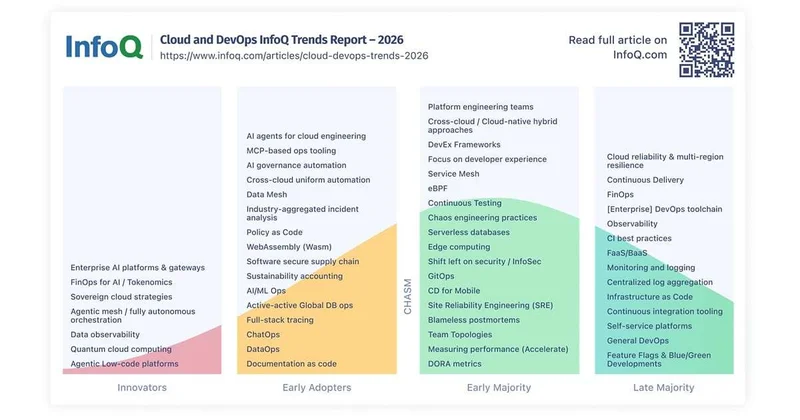
In this episode of the podcast, members of the InfoQ editorial staff and friends of InfoQ will discuss current trends in the cloud and DevOps domains as part of our annual trends report. These reports provide InfoQ readers with a high-level overview of key topics to watch and also help the editorial team focus on innovative technologies. In addition to the report and the trends graph available on InfoQ.com, this podcast offers a chance to hear our raw conversation and the stories shared by our expert practitioners.
Key Takeaways
- AI has moved from experimentation to enterprise execution, and this directly affects cloud strategy. Organizations are shifting from individual coding assistants to team- and enterprise-level AI systems, with agents, AI platforms, and model infrastructure becoming strategic priorities.
- Cloud reliability is back in the spotlight. Recent outages across major cloud providers have reminded architects that resilience, multi-region design, and operational readiness remain just as important as adopting the latest cloud services.
- Platform teams are evolving from builders to enablers. Rather than simply provisioning infrastructure, they're standardising AI capabilities, governance, and developer workflows while reducing shadow platform initiatives.
- FinOps must evolve beyond cloud costs. AI token usage has become a major operational expense, but organizations still lack effective ways to connect AI spending with developer productivity and business outcomes.
- Digital sovereignty is becoming an architectural concern. European organizations are increasingly evaluating sovereign cloud strategies, although balancing regulatory requirements with reliance on global cloud platforms remains a significant challenge.
Subscribe on:
Watch the video:
Transcript
Welcome and introductions [00:39]
Daniel Bryant: Hello, and welcome to the InfoQ podcast. My name is Daniel Bryant and I'm going to be your host today. Now it's that time of the year where we look at the InfoQ cloud and DevOps trends. There's lots going on in this space, plenty of AI, of course, plenty of non-AI developments. Now I've managed to assemble an amazing panel of folks from all walks of life, going to be talking about what they think as their most interesting trends, the challenges we're seeing, and also reporting on their experiences working within enterprises and a bunch of other organizations too.
So without further ado, let's get to the introductions. Matt, could you introduce yourself, please?
Matt Saunders: Absolutely. My name's Matt Saunders. I am one of the veteran editors at InfoQ on the DevOps queue. In my day job, I'm the VP of DevOps for Adaptivist, which is a big solutions and services partner, mostly of Atlassian stuff. I'm spending most of my time in DevOps and platform engineering and spending lots of tokens.
Daniel Bryant: Well done, Matt. Thank you very much. And Mark, over to you.
Mark Silvester: Great. Hi, I'm Mark Silvester. I'm one of the newer InfoQ editors. I've actually been involved now for just over a year. It's gone fast. Also taking part in the DevOps queue led by Matt. My day job, I work for Griffiths Waite based in Birmingham, which those in the video will be able to see behind me. I work as a platform and architecture manager in largely regulated and very enterprise customer base, but it keeps me very busy.
Daniel Bryant: Fantastic. Thanks, Mark. Shweta, over to you.
Shweta Vohra: Thank you. Everyone, I'm Shweta Vohra, in industry from 24 years in technology and somewhere along the way I think I started understanding a bit thing or two about technology, enough to file a few patents and write two books. The areas which are closest to my heart are technology transformation, platform engineering, software architecture, and recently designing AI-native systems.
What I love is connecting strategy with hands-on engineering, so that's the reason I'm really looking forward to our conversation today.
Daniel Bryant: Fantastic. Thanks, Shweta. We already got a mention of AI there and tokenmaxxing. We're more on brand already, aren't we? Renato, over to you.
Renato Losio: Hi, I'm Renato. I've been InfoQ editor since 2021, I think. I'm in a cloud queue. Day job working mostly with cloud technology, mostly AWS stuff, trying to break things, try to put them back together. I'm based in Berlin, in Germany. I'm Italian and looking forward to go back for the summer to Italy tomorrow.
Daniel Bryant: Fantastic. Steef-Jan, over to you.
Steef-Jan Wiggers: I'm Steef-Jan Wiggers, probably getting close to 10 years working for InfoQ. Last couple of years I've been managing the cloud queue, so writing about stuff, Azure, AWS, Cloudflare these days as well, Google. In my day job, I'm a domain architect, as they call it, on technology. I work for the second largest health insurance company in the Netherlands. Like Shweta, also starting to design some of the more AI-native solutions, so I also now work with AI, next to also working on building up and running an integration platform for a company. I also unfold some of the data initiatives in general. So, it's AI data and integration.
Daniel Bryant: Fantastic. Thanks, Steef-Jan. And my name's Daniel Bryant, I'll be your host today. I'm the InfoQ news manager and also a QCon tracker, so I'm super excited that Shweta is actually going to be talking on my track at QCon San Francisco. So, there's always already overlap here between the guests and the stuff we're doing at QCon. And in my day job, I work as a product manager at Syntasso and we do a lot of focus on building platforms, so my focus is very much on building platforms for AI at the moment, just to continue that brand. A lot of our customers are understanding how developers should interact with the platform and how agents are interacting with the platform. I'm sure I'll share some thoughts on that too.
What cloud and DevOps trends surprised the panel most? [04:18]
But without further ado, let's kick off. I know we had a great discussion last year with some of the folks here and some other folks as well, but I'd like to start by saying which cloud and DevOps trends surprised you the most in the last year? I'm going to start with you, Shweta, because I know you had some great opinions last year as we were wrapping up the previous podcast. What surprised you the most in the last year?
Shweta Vohra: Now this might be very unexpected for you, Daniel, but what surprised me the most is not AI chips, not the agents, but the AI infrastructure spending is the largest build-out in the technology world ever. What I know from some of the facts, till 2025, we were around $450 billion-ish, but this year, some of the deals which have happened are really surprising and sometimes shocking also, that the amount of electricity we are burning and on top of that chips we are building up, that is most surprising.
Because if you have heard about SpaceX plus Anthropic, SpaceX plus Google and various, and similarly AWS and Microsoft and everyone is spending so much amount of money in AI infrastructure. That's in the AI space surprises me the most.
Daniel Bryant: Thanks, Shweta. Steef-Jan, what about yourself? You mentioned, like Shweta, you're in the AI space at the moment. What's your biggest surprise?
Steef-Jan Wiggers: I would say the agent infrastructure arms race basically going on. You see a lot of hyperscalers investing in products already, but then more from an AI perspective. I would say agent registry, DevOps agents with AWS, I think even Microsoft has DevOps agents, and you see Google shipping a GKE Agent Sandbox, new Cloudflare shipping, dynamic workload, just some of the examples of some of those hyperscalers that they're really putting the AI infrastructure in their products, I would say. Or even building up frameworks like Microsoft [Foundry Citadel Platform], I think that's something with AI Foundry to set a complete governance layer. So, there's a lot of investments there and races of products, I would say.
And then, that's a surprise because before we're just talking about AI elephant in room and looking at what we're going to do with AI. That's a completely different story today, even what Shweta told about the spend as well.
Daniel Bryant: We're going to definitely come back to governance and compliance and sovereignty. It's something I hear a lot about in my day job and I know we talked about that last year, so we'll definitely come back to that. Great points.
Mark, can I throw it over to you? What surprised you, do you think, over the last year? And of course, you were at QCon London earlier in the year. You got to learn from all these amazing folks there. What surprised you the most?
Mark Silvester: I wish I had a surprise that wasn't related to AI, but unfortunately it is. And I think what I've noticed is how fast it's gone from AI being something that teams were encouraged to experiment with, create something that's more efficient, to it being an absolute must from leadership level and the board. And I think this is potentially something that exposes teams that aren't quite set up for it.
QCon in London, I covered Matty Skelton's talk about Team Topologies and how that relates to it. It does really show how some teams aren't quite set up for it just yet. So, I think it's come as a surprise to a lot of teams and to me.
Daniel Bryant: Yes, very interesting. That talk from Matthew, I really enjoyed actually at QCon London. It got me thinking about agents to people and the bounded context and not having one kind of agent to rule them all and these kind of things. There's lots to break down in that talk, so I think great coverage on that.
Let me throw it over to Renato. What's your thoughts on surprises in the last year?
Renato Losio: Well, I think I want to be the negative in the room and I don't want to mention AI. Let's say that what really surprised me is how poor reliability of the major cloud services have been the last year. If someone had told me one year ago we would have had a region of AWS off for six months due to a war or something I could not have forecasted, but as well US, Virginia down for quite some time last October with quite some repercussion of half of the internet.
Let's go back now to AI and let's talk about GitHub.
Daniel Bryant: Indeed.
Renato Losio: If someone had told me one year ago that we'll see this kind of number due to of course the pressure of new servers, new workload, whatever, I would have not believed.
Daniel Bryant: Very interesting. Very interesting, indeed. Matt, wrapping us up for what surprise, and then we'll probably move on to some more AI chat.
Matt Saunders: Well, all of the surprises that people have said already have been surprises to me too, which leaves me with my fifth best one. I think I've got a decent one, which is the splits of the naysayers around AI and especially in terms of software delivery. We've got a lot of people who seem to be going hard on bigger, better, faster models, Fable, et cetera. Let's use all these massive models to solve all of our problems and we can give them ever increasingly big problems.
But then there's another side of people, and again, people who I've known and trusted in the industry, some present company here. Now looking at ways where instead of going bigger and faster, we're going smaller and smaller. Like agentic infrastructure, not only agents having a coding agent and a testing agent and a CI agent, but having running agents and getting some real microservices-type thinking over there. Seeing that there's two piles there has been really interesting. Whether those two piles will come back together again or not, whether one just turns out to be a whole load of hype and the other one turns out to be how we adopt agentic and AI in general into what generally fairly well though-out human processes is, is going to be really interesting.
Daniel Bryant: That's great, Matt, super interesting. And folks listening to the podcast, we are going to talk about other things in AI as well, as Matt had cautioned there. But I think it's really interesting again, because it is dominating all the conversations I'm having. It's the elephant in the room we talked about last year, as Steef-Jan mentioned. And I did want to quickly deep-dive into the agentic space, and then we'll back up and have a look at platform engineering and FinOps and all those kind of good things.
Are AI governance and compliance slowing enterprise adoption? [10:27]
But in 2025, we positioned AI agents for cloud engineering in the Innovators category of the Diffusion of Innovation. We love Geoffrey Moore's classic Crossing the Chasm book. I want to pitch out to you all now, and I'll pick someone in just a moment, but has enterprise adoption moved forward or are things like compliance, security, and governance still the primary blockers? Mark, I'm going to throw it your way because you work in a regulated industry, but you mentioned it's now a board level concern. People are pushing on, "Hey, you got to be adopting AI, you've got to be moving faster." But do you bump into any compliance-governance type issues?
Mark Silvester: Hugely. We are trying to help our clients to adopt AI, but obviously when you're in an enterprise environment, you have many different teams that all have a piece of the pie and they all have their own involvement. What they're accustomed to is receiving tickets to do a particular task. And what they're also used to is some big project being done. They'll receive that information really, really late and then they'll be put on the critical path to do that.
And I think we've also run the risk a few times of certain teams moving forward with AI without really considering the wider organization. They're working on their own personal or their own team's needs without actually sharing that knowledge. So, you've got team A who just got live with something and then team B are already 50% doing something very similar, and there's a lot of wasted time. I think we've largely run into compliance issues with security and we're trying to build those teams into the systems that we're using from the start so all teams begin with a solid base.
Daniel Bryant: Love it, a little bit of a... I see a lot of conversation actually. PlatformCon happened recently of shifting left, shifting down, all these kind of things, which I'm sure will come up later. Steef-Jan, any thoughts? I saw you nodding along as Mark was speaking there.
Steef-Jan Wiggers: Yes, because as a health insurance, we are quite regulated as well because we're a financial institution because we get a lot of money coming in, but also declaration of people that need healthcare and such. Besides heavy regulated, also run into quite some of the compliancy things as well, with DORA and some of the other things that the European Union come up. We're facing that, so that's a blocker also for our AI initiatives. There's quite a few of them. And like Mark, there's also ones that are pretty similar or like, "Hey, do we really need to solve this with AI?"
And also, the general, overall, arching view of architecture and controlling a lot of these initiatives, because the classic ML people are doing is different than the generative AI solutions that are building, or even the ML people are using Databricks, saying, "Hey, but we can also use language models and we don't need any of the other services, in this case Foundry, or if you were in an AWS environment, Bedrock, to get those models from that service, because we are hosting our own language models, I'm going to use those."
It's a bit of a coordination problem as well, I see, because everyone does its own thing of, oh, we're doing great stuff with AI. Well, hey, wait a minute, if you look overall, they're doing the same thing or maybe this is already done with input management so you don't really need to translate foreign declarations or invoices towards the Dutch things we need to do. Because that's already placed in input management, you don't need to use AI for it. But then again, everyone wants to do AI and they want to move forward and the business asking for, hey, you need to do AI, AI.
Daniel Bryant: I've got to do my obligatory. Simon Wardley mentioned at this point in terms of mapping the ecosystem. There's some fantastic videos if folks want to check it out on InfoQ.com. He's been prescient on this stuff for years, but his stuff in terms of identifying duplication and balancing the innovation with commoditization is gold. I recommend that stuff all the time.
Shweta, I know you're very much in this space and you've been writing some books on these kind of topics as well. Any thoughts in terms of the challenge of things like security in this space?
Shweta Vohra: I'll start with the change. I mean, for me, it was very evident to see after our... I think we did recording last year at the same time or August, but the moment we reached November, December, there were so many things happened that January, February, it was evident that we are no more talking about personal productivity. We are talking about team level productivity, as Steef said. So, there is huge improvement from AI at individual level to AI at team level, but we have more problems to solve at enterprise level.
In terms of security and compliance, I think putting the compliance and security around the models, because we have now open models, proprietary models, cloud-provided models, and everybody wants to use everything, so there is definitely security required in that space, plus security in terms of how much of MCP you would be exposing the tools through. That was a big check which I've seen where companies put a check that, okay, we cannot have everything, every tool be open to everyone. That is the second place which I saw.
And of course, I saw some synergy coming in terms of tools that while there is a crazy amount of tools still there, but some consolidation around the Claude or Cursor or Codex or these kind of tools which has started happening and most of the companies are leaning toward two or three of combinations of these tools. Those are the checks and compliances which I have seen. And for me, it was like coming out from Christmas and New Year, and suddenly you have new hackathons, new events coming in.
And of course, I don't want to leave saying that Agentic AI Foundation, which also was formed in November and December, it was also a very good initiative, which is in this direction. I mean, standardization is always a piece of security and compliance, though we are not fully yet, but it's a very good initiative it started.
Daniel Bryant: I love that, the show notes, Shweta. That's a great call-out for that foundation. My buddies, for example, are talking about how they've joined the steering committee there. Great stuff.
Renato, any thoughts on the security? I know you're very much in the AWS space, right?
Renato Losio: Yes, I'm really in the AWS space and I think I'm quite skeptical about platform like Bedrock and similar. I really think they have a huge intake at the moment as a first wave where people really need to have... For compliance, security, whatever they tick all the boxes. Of course, it's much easier to get that.
But I wonder if in the long term people will start to... They will use it just as a very first step, but then the complexity of managing an extra layers, it doesn't really solve problem as the very first managed service, at least from my side, where you could see the big advantage to use a managed service for say a database versus do it yourself. Here I see it more as a quick way to start. When you then see your cloud bill, you start to think that maybe there are other ways.
Daniel Bryant: Yes, I think that's very well said. I was reading one of Steef-Jan's articles actually on the InfoQ recently saying that you're often trading off cost and security. As an architect now, you've got to do that analysis. You've got to be like, "Hey, this is a great piece of functionality, but it's going to cost me 5X more than if I do my stuff myself." What's the TCO, total cost of ownership, these kind of things?
Matt, I'd love to get your thoughts on this kind of stuff as well.
Matt Saunders: Yes, absolutely. And I'll try and tie in with some things that have already been said, particularly by Shweta and by Renato. I've talked to a decent number of CTOs in enterprises and we're on this fulcrum point now with the whole governance piece between lots of people doing all-over experiments, for example, in Bedrock. We've got a massive AWS infrastructure. Other cloud providers are available and so it's natural to just use those for our experiments. We've got something running in Bedrock, which is helping doing a whole load of Jira migrations and using an AI assistant to do that. It's brilliant, it's fantastic.
When you get into the bigger enterprise scenarios, then you hit the problems from the momentum of individual developers doing a whole load of things, for example, developers hooking up an AI through MCP to some internal systems, and you see things like, well, that's using the permissions of the user that set them up, which is causing a whole load of governance and compliance strife. We're not anywhere near solving that. I mean, a lot of the people I talk to really want to, and it's changed over the last year, people are a lot more gung-ho about exploiting AI, hopefully for good, and using it, if nothing else, because everybody else is going to be and you're going to get left behind.
All is not lost. Actually, I just put an article on InfoQ quite recently about MCP having centralized auth now. So, there's a plugin for centralized auth, which means that you can actually... I mean, I have perception of MCP coming in and just running roughshod over permissions and IAM that you have in your internal organization. And that inevitably has led to it not being as adopted as much as it might have been.
The uncool enterprise level tooling that isn't yet another model that's going to send all of your data to a country you don't want it to go to, but it's actually solving some real world enterprise problems, I think we're seeing more of. And it's going to help us with compliance and governance and take a lot of those issues that we've been seeing with the early adopters in big companies, take them off the table a bit.
Daniel Bryant: I love that, Matt. Definitely I'm seeing in my day job, a lot of folks now are asking as we're building platforms, if they're getting exposed by MCP, what does the security constraints, what do they apply? A lot of people are driving it through portals and using the Kubernetes model of RBAC through the portals, but you don't get the same thing with MCP, for example. I would just shout out, Jim and Andrea did a fantastic talk at QCon London where they said focus on the API layer first, make sure your governance, your compliance, your security, your AuthN and AuthZ are all baked into that layer. And then you can put another layer on top in terms of portals, MCP, ServiceNow, Jira, whatever you like.
But they really made this argument for strong API governance, which is that we've been doing that for years. I think it's a really good point. I definitely saw a lot of YOLOing with MCP over the last year, but now folks coming to me are like, how does the auth model work in this? Great shout-out, Matt, for some stuff I'll put in the show notes of centralizing some of this stuff too.
How is platform engineering evolving in the AI era? [20:55]
I'd like to move on to something I just mentioned there, platform engineering now. So in 2025, we moved platform engineering teams to early adopters. I think hat tip to Team Topologies. Matthew, Manuel doing amazing work and many others in the community as well. I'm curious, are folks seeing product teams? What's the state of internal developer platforms? Are folks still building these things out? Is it now internal agent platforms? What are people hearing out there in the world?
Who should I first do first? I throw this to Renato. Are you bumping into anything in this space?
Renato Losio: Nope. And I don't really have an answer. What's the future of platform engineering? I have no idea. I'm going to moderate next month InfoQ Live roundtable about platform engineering in the AI age, so I hope to find the answer for them.
Daniel Bryant: Amazing. That's a great answer. We'll definitely add that in the show notes as well.
Mark, going across to you, do you have any experiences of the IDPs, Internal Developer Platforms, and agents and things?
Mark Silvester: Yes, I think from what I've seen, it's become probably the main focus of the platform engineering teams with the clients that we're working with to become AI-native enablers to ensure that they don't always become a bottleneck. Because as I mentioned in my earlier answer, it's becoming important that certain standards are in use for the whole company. And what you'll find is if the platform isn't good enough, then teams will think they'll want to do it themselves in a complete different way. I think there's a lot of pressure as well to do that in a cost-effective way.
Daniel Bryant: Well said. I definitely see people like the Shadow platforms effectively. Used to be Shadow IT, now Shadow Platforms. Bump into that a lot on my day job. Steef, are you bumping into the IDP space at all?
Steef-Jan Wiggers: Well, I have with integration, but that's all set up. And then I think talked about previous episodes as well of this trend report. But I also see now that we're trying to set up a platform also for agentic AI, so that's more for the language models and stuff. The way you approach it, I'm not so sure either than in this case, Microsoft, because where a Microsoft house has put out something like a Microsoft Citadel that enables you to set up a platform.
How is this going to flesh out? How's this going to work? I'm not sure yet. It's a hub-spoke model where you have your centralized AI gateway, so it's basically your API management you talked about, but then for your AI. I think Apigee has it, Microsoft has its API management, but then you can position as an AI gateway as well. And then behind it you have your centralized model catalog, so the ones that are allowed to be used. And then they're going to go to what they call a spoke, so that will be your team building up on the platform because that spoke is provisioned as well, enabling you to build up your AI solution.
But how is that going to work or fan out? Probably I'll tell you next year. I'm not sure how.
Daniel Bryant: I'm definitely moving to a lot of folks building out AI platforms, running stuff in-house for sovereignty reasons or doing model routing, in terms of being able to do cost control on easy questions, easy prompts versus the frontier models, these kind of things. I think that's going to be a topic definitely for next year exploration.
Matt, over to you. Any thoughts on the agentic space in the IDPs?
Matt Saunders: Well, I was going to start by saying I think platform engineering as a whole I think is in a bit of a holding pattern now. We've made a whole load of progress. Like Mark said, we've got used to delivering platforms where if people don't want to use it and they go off and shadow it or they skunk-work something else, that's accepted. And the reason I say it's a holding pattern is because the world has changed. Platform engineering teams adapt to this.
We're not talking about how best to Terraform stuff out or where to host your WikiPages or if GitHub is up or down anymore. It's all about data sovereignty. It's about hosting models. It's about access control around the frontier models and working out how we best add value from a platform level so that a hundred people don't make their own decisions on that. I don't think we've figured it out yet. I think we're still experimenting with it. But the good thing for me is that we're not really... I mean admittedly, this is just my own small segment of the world that I'm looking at. We're not really doing anything particularly innovative in platform engineering anymore which isn't AI related, and the world hasn't fallen apart, which vindicates the approach, I think.
And yes, we've still got people off skunkworksing things, especially in the agentic world where the platform team is finding out about these things at the same time as the developers are, so they can't possibly be ahead. We were doing the right things in platform engineering. It's one of those things. I think we said it last year, it's not that exciting anymore. And I don't mean that as a dis. It's good and rubbered in.
Agentic changes it all. We are doing a whole load of experiments on that, what that actually looks like, but ultimately struggling to keep up with what the devs are wanting to do, which is very much early days of where we started with platform engineering, I think, and is not necessarily a bad thing. We've got a whole load of lessons from how we did it well for building out clouds, for example, and we can carry those on.
Daniel Bryant: I'll do my obligatory shout-out to a lot of what's new is old and old is new, and definitely look back there, only a shameless plug, but the InfoQ back catalog is there. I'm referencing old articles. Yes, it talks about cloud, yes, it talks about DevOps, but same principles apply. I do like the what's old is new, what's new is old.
Shweta, any final thoughts on this topic before we move on to perhaps some FinOps and other things?
Shweta Vohra: I'll tell you two examples. This year when I went for KubeCon, there were around 1,500-plus people registered, and strangely, 1,000 people at least were in the room. I had one slide that, "Is platform engineering Kubernetes? Is platform engineering DevOps? Is platform engineering portal?" So, four options I had put. And to my surprise, at least 70% of hands went up when I said platforms engineering is just the rename of DevOps, at least 70%. If I look at that, I want to say that still platform engineering is maturing.
But if I look at my own experience, I would put it in early majority now because, like Matt said, we are no more talking about there should be one IaC vendor or one IaC type or two, or we are not talking about PKS, this Kubernetes as a Service, where Kubernetes everybody is... We have less of options, let's put it that way. If I look at AWS, we have serverless Lambdas. But when you start using Lambdas, you have whole lot of thing to put together to really make Lambdas to work and achieve what you want to achieve, then you fall back to... You can't go to EC2s so you have Kubernetes. So, then the Kubernetes service plus the engine has matured. And with that, quite a few things have matured and we are no more talking about those basic stuff. So, I think I would lean towards stating that early majority.
And when it comes to IDPs, yes, that space also has matured. Internal development portals I'm talking about where people have played around, many have sticked around backstage, somebody have taken the vendor portals, et cetera. But it is required because it is still complex. The engine is still there and that's where it might... Now, my next statement might surprise you, but I've started putting a distinction between and I'm stating it to our teams as well that there has to be a difference between a platform engineer and a developer now.
Developer has to be on the higher abstraction layers and platform engineer can still stay grounded with the engines where we are having, infrastructure and Kubernetes and whatnot. If that distinction comes and we understand that if you're building platforms we are closer to platform engineering and more of the raw stuff, if we are closer to the upper layers, we need not be worried about it. That's how we will give the user experience, which is quite new in this space as well.
And quickly on the Agentic developer portals, this is new thing. Now everybody's playing with skills, plugins, hooks, you name it, so many things I might not even be doing those all things. People have started putting it in various forms, which is early days of IDPs, like we have all seen. But this time it'll mature faster, I hope, as a overall industry is maturing faster.
How important is FinOps today? [29:34]
Daniel Bryant: Love it, Shweta. I like your concept of the abstractions there. And I always go back to the classic one of Martin Thompson, Mechanical Sympathy. I, as a developer, always strive to know just one layer down how the memory is managed, how the CPU works, just so I could build better systems. But these days there's so much to it as in where do you draw the line abstractions?
And where I want to go with that next is I do think finances are really important here. With my architect hat off And I'm often advising folks of cost is a big consideration on how you build the system, what third-party systems you integrate. We've moved FinOps across last year, I think, into a later category, and we said that this is a strategic thought. What's people's thoughts in general? I mean, AI is costing a lot of money these years. I don't know if we're bumping into that at all. Do we have now good tooling in this space for FinOps?
Matt, can I throw it across to you first?
Matt Saunders: Yes. Yes, this is a bug bear of mine because... I mean, I'm having a discussion at work right now. Once we've used our token budget, should we just go home? Is our work done? And I'm like, well, what have you achieved here? Troll face. Can you go home? Is the tooling there? No, it's not. But I don't think all hope is lost, because we're starting to bottom out that thing where it's almost like a presenteeism thing, where I've got people who are just absolutely tokenmaxxing. They're spending huge amounts of money on this now.
It's almost like we had a free pass for a couple of years where we've got this magic tool. Some of us used to be a bit... It felt like a guilty secret using these tools where you're spending a little bit of money and getting all this massive amounts of productivity. And now suddenly, the zeitgeist feels like tokens are expensive. You throw stuff at Opus or Fable and it's expensive. Other LLMs are available. We're coming back towards, well, surely if you're spending all these tokens, then you are productive, and starting to dismantle these ideas of things like number of lines of code that you've written are good metrics. Frankly, we left that behind five years ago, but it's made a comeback because we're trying to work out how to measure productivity.
I think there's light at the end of the tunnel because... Just looking at Shweta, what you were saying about the abstraction, and Daniel as well about the abstraction between developers and platform engineers and how we seem to be actually getting that right now. And that's become more of a thing that people accept. And what's also becoming more of a thing is it's a bit of a straw man, but you can throw any gnarly problem into AI and it'll go and solve it for you. Where are you as a developer adding the value? I don't mean that in an accusative way because the people who are making the best at this are leveling up even further with the abstractions. So, we're looking more at outcomes.
Sorry, I've meandered to my point, which is that the FinOps tools can tell you that Matt Saunders spent X, Y, Z dollars on tokens in Opus, in Fable, in Sonnet, et cetera. But none of them that I know of can actually relate that back to outcomes. But then again, outcomes of this weird, nebulous concept of... You can get back to DORA primitives. How quickly are you getting an idea for lead time on these things and getting these code actually into production and being used by users?
Can the tools keep up with this? Probably, but we're going to have to look some more at how we actually measure them. And we've also got that problem we haven't really solved, which is just as soon as you start shining a light on costs, then there's just an instinctive pressure to try and reduce those costs without justifying that.
Daniel Bryant: There's food for thought there, Matt, food for thought.
Renato, going to throw over to you. Any thoughts on this one?
Renato Losio: I think I just add on what Matt just said. If I look back one, two years, two years ago definitely the focus was use some tools that were deterministic to find your cost, try to optimize them. Usually try to reduce your storage costs, try to find best storage class, colder, not colder, whatever. The same for data transfer, the same for CPU. Two years on, that is still there, but reality is the major new expense is AI. And all those AI component from models to Bedrock to anything else you're using, any agent, managed service you use based on agent, you don't have a full visibility on it. They go up. You probably even use now even not any more deterministic tools to cost-control them, so you use a FinOps agent to control your AI spending or hoping for the best, basically. That's the direction, I think.
I don't know. The visibility then is not there as well, but as Matt said as well, most of those costs is a proxy of something else. So, it's pretty hard to optimize on that. If I have to optimize on data transfer, I have some numbers, I have some figures I can optimize. On token or how much a specific developer or a specific team has used is much harder because it's harder to determine the value of that. As well, the elephant in the room is as well I can try to optimize those costs, but are those costs subsidized right now by the big provider to lock you in or are the real costs that I'm going to sustain long term? That area became such a big uncertainty that all the rest almost feels like not negligible, but the focus has shifted somehow.
Daniel Bryant: I totally hear you. That's great. Great points from both of you there. Steef-Jan, you got any thoughts on this one as well?
Steef-Jan Wiggers: I must agree what Renato and Matt are saying. Although, I do see that there's ways to control the costs if you would be using something like an AI gateway policy. You can set policies on consumption, you can have some of the metrics policies in place as well. They can show you what team is using what type of cost. And then with some of the other policies, you can also direct into the right model instead of using, let's say, a big model like a Fable to do something simple, so you're not using a Formula 1 car to do your groceries. That makes no sense.
So in that way, I do feel that there's ways to control somehow the cost, but then if you have to tie it to a certain value outcome towards the business, then it comes a bit, mm, I'm not so sure, because the tools will not tell you that. The tools will definitely tell you cost. I've seen improvements with Azure and AWS putting out a console. The AWS console can do some of the sustainability as well. So, if you look in that aspect on green computing, those tools can definitely tell you a lot. But in general, generating costs and then tying them to a certain business outcome and then it's valuable, so your investment does create a lot of value, that's pretty subjective and tricky as well because I don't think there's tool out there. Maybe you can ask, what Renato was saying, some kind of FinOp agent tell you, "Hey, spend this, and this is the value it's creating. Is it really valuable for the business? Yes or no?"
It's not deterministic, so it will predict more yes or no based on the parameters you give or the information it will give you.
Daniel Bryant: Super interesting. Shweta, you got any thoughts on this one?
Shweta Vohra: I think in addition to what all you have said, I'll just put the perspective from the FinOps foundation side of things, because there also we have seen all these problems exist. And somewhere in their article I had read that... Beautifully put, I don't know exact words, but it goes like this, that we have hit already the big rocks of wastage around AI and cloud optimizations. But now we have smaller opportunities in form of agents, so many agents. But effort required to put it together to make use of it is the next set of challenge we all are going through.
So, everybody have coding agents to use and producing something, but instead of those big models, big investments, MLOps, et cetera, we have now reached to these small, lots of pebbles around. We need to gather them and make sense out of it. Almost every company is going through the same challenge and that's why FinOps Foundation has also forked out the Tokenomics, or something like that, Foundation. Hoping that will also accelerate the work in this direction. But clouds, as usual, are difficult, if we use Corey Quinn's...
Daniel Bryant: Yes, a bit of Corey Quinn's...
Shweta Vohra: He always gives us good analogies, that you have made the whole bill so complicated and now if you give all these FinOps agents, et cetera, why not to solve it in first place?
Daniel Bryant: Indeed. Fantastic. Mark, you got any thoughts on this one?
Mark Silvester: Yes, just a quick one. I think the FinOps tools do exist to get to teams like the engineering teams. We have the information they need. But what I've seen in enterprises is that they're almost not quite visible to the engineering teams. It's almost between the finance departments and the asset owners potentially. But the engineering teams absolutely do care. And I think there's the added risk now with computing and similar that a small change in a model could 10X your costs, whereas we didn't have that problem before.
But engineers definitely do care. I saw that firsthand on the 1st of June when GitHub changed their model and-
Daniel Bryant: Indeed.
Mark Silvester: ... the Pro power taken away might be an issue. It'll become more and more important, in my opinion.
How are organisations approaching digital sovereignty? [39:14]
Daniel Bryant: As a final topic, I'd love to dive into sovereignty. I'm bumping into this a lot when I was at KubeCon and QCon recently and this topic came up a lot, absolutely in the EU space. I'd love to pick your brains, folks, on where you think this trend is going, what the difference is perhaps around the world now, but I know we're probably going to look at this probably from an EU lens.
Steef-Jan, can I start with you? What's your thoughts on the digital sovereignty we're seeing?
Steef-Jan Wiggers: It's quite interesting, because the company I work for, almost all the applications and systems and even hyperscalers, it's all American. Even our policy system is American, so it's based on Oracle and so forth. Although in the architecture room, you have these talks about sovereignty too, but if we want to completely be sovereign, then we have to rebuild and re-engineer everything. So, that's hard also because... And I think Renato's done it in Munich, talked about some of the stuff around sovereignty.
The European cloud providers can provide IaaS, the storage and that kind of stuff. But when it comes to platform service, it's going to be a little bit tricky. And also when it comes to Software as a Service, so some of the servers we use as well, for instance, Salesforce as a CRM system. I don't really know the alternative for that one, for instance, and we already heavily invested in that one, so completely... Or being sovereign in some parts, it's tricky.
I know it's popping up everywhere and I've written about and seen it. From my perspective in the industry I work for at least, a lot of the health insurance get pretty much invested a lot in, I would say, American applications and systems. To be sovereign, it's going to be tricky, I would say.
Daniel Bryant: Yes, yes, Steef-Jan.
Mark, can I go to you on this? I know, again working with regulated companies, I'm sure it's a topic that you bump into quite a bit.
Mark Silvester: All of our clients are within Europe and they're absolutely adamant on keeping everything within Europe. And I'll just say quickly, about half of our clients are actually gradually migrating back on-prem. It's absolutely a trend that I've seen.
Daniel Bryant: Fascinating. I’m bumping into this as well. Folks on calls I'm on now are like, "Do you support sovereign platforms?" Yes, we do. It's definitely a thing.
Matt, have you got any thoughts on this one?
Matt Saunders: I mean, I haven't got too much more to add to what Steef-Jan and Mark have said, but it feels a lot like that thing where everyone moved to the cloud a few years ago. It was like, "Oh, we're a bank. We can't possibly move to the cloud. We have to run our stuff in our own data centers." And the cloud providers eventually managed to do that right. Taking the example of Salesforce, there's obviously a problem there with people who can't use US companies, but those companies will start to solve these problems so that European companies can use them.
The other danger here is, and I'm seeing less of this now, which is where people are like, "Well, we can't use that services in the US. Well, let's just vibecode one, we can run it under my desk." That seems to be going away again. Also, the political climate seems a little bit better, unless you're a fan of red card suspensions and all that. It doesn't seem to be as big an issue as it ever was, (A.), because the political climate's a bit better and, (B.), because I think we are solving some of these problems as an industry.
Daniel Bryant: I love that, Matt.
Renato, you got any thoughts now?
Renato Losio: That's a big topic, Steef-Jan already covered it. You cannot be 100% EU-based. I mean, yes, even if you put it in your own data center, you can argue about software, you can argue about hardware, you can argue about many pieces. Some way is a journey somehow, even the fact that the cloud provider themselves provide now new regions that they call European one, I saw a different taking on that. One side, a lot of arguments if they are really European. The other one is basically they raised the point to people that didn't think about that before. So, people that used to deploy to, let's call them standard region in Europe from Azure, from AWS and say, "So what was wrong with that?", that didn't really realize the challenge before and they see it now.
I don't know where we are going. I hope there will be more option. I'm not super skeptical, but I still think that in Europe we are most of the provider that provide an alternative is mostly marketing. And at least they don't offer the kind of services to the level that they should provide to be a real alternative. It reminds me a bit the early day of S3 when everyone was claiming to have a S3 backend that was basically just one single server running with a S3 API. Yes, you have the API, but you don't have the scalability, you don't have anything else. I think we are still far from being able to be really sovereign in Europe and I find that to be sad.
Daniel Bryant: That's an interesting point, Renato.
Shweta, any final thoughts on this topic?
Shweta Vohra: It is like Renato said, that it's double-edged sword. We don't know where it is going. What is that sovereignty we are trying to create? Data was always a thing which we secured through GDPR and boundaries and what can be shared across boundaries. So data intelligence, the only problem which I see is the models, because models are trained on Internet's data. Internet's data is about everybody's data, which is already in open, which is already shared.
So I'm not too sure, but I know it's a double-edged sword. One side I want to say that these efforts, because of political, socio-technical reasons, this needs to be increased. Effort definitely need to be increased. And AWS has already come up with this. So when cloud in Europe, I've heard about GCP is also doing that and same thing, I think, Azure as well. They're not there yet.
But ultimately what is that they're trying to achieve is not clear to me. So, what will they secure boundaries from? Is it data? Is it model? If it is model, it's already at a stage where it is challenging. How would you secure it? So, if it is only about security across boundaries, would be very difficult to tap it now, but let's see.
Which cloud and DevOps trends are overrated? [45:37]
Daniel Bryant: Great. Thank you for your point, Shweta. I think we have more questions than answers there, which is great because this is a very early stage for all of us, I should say. I think we all were raising very good questions.
Let's do a quick wrap up, folks, as we come to the end of this podcast. I'd like to get a quick rapid fire round of the one trend that you think is overrated or that listeners should be cautious in adopting over the next year. And I'm going to go around the room as I see it on the board here. Matt, afraid you get the least thinking time.
Matt Saunders: Right. Think, think, think. Overrated. I think it's the death of either the junior engineer or the senior engineer or whatever roles you think that some magic AI thing is going to replace. I think that's dying down at the moment. And I think in the best companies, we're starting to have great conversations around not just like, oh yes, humans have feelings too, no, or agents have feelings too, but around how we're actually doing things in this newly empowered world where your feedback loops are almost instant because you're getting an AI to do the thinking.
Overstated is the predictions of what the world might look like in 5, 10, 15 years and how radically different it's going to be.
Daniel Bryant: Fantastic. Thanks, Matt. Good one.
Mark, up to you.
Mark Silvester: Probably say fully autonomous agents in enterprise environments. I still think there's a place to keep humans in the loop. I think it's overrated for now.
Daniel Bryant: The listeners will be so happy. The agent listeners, maybe not so much.
Shweta, what do you think?
Shweta Vohra: I would say stay conscious about the agentic side of things. People are worried about the fancy stuff on top of it, what we are seeing, and there is a lot more influencers and things going on. But there is deeper problems to it because when we are moving from microservices to agentic world, it's like you have a system to manage taxis where taxi go from A to B stand, it's predictable. But here, agentic world is more AI-native way if we handle that'll be more manageable. So, agentic harness and agentic meshes and more deeper problems are there.
Whereas stay away from the sophisticated portals and things and fancy stuff on top of that, or skills or this or that. This is I would ask people to stay conscious about, not fall into that.
Daniel Bryant: Keep it simple was the vibe there.
Renato, over to you.
Renato Losio: Well, we haven't talked about developer experience, but I'm thinking as we're looking at what the cloud provider like AWS has done in the last year, killing, renaming their service 10,000 times, I'm thinking most of them are overrated. I will bet at least two, three of the major one will disappear in the next 12 months, and developer will start to care less about which models is running behind them and more about what they do. It would be just a normal assistant, the way I see it.
Daniel Bryant: Love it. Love it. Steef-Jan?
Steef-Jan Wiggers: I think a lot has been said, I think in general, the agent washing, that agents can do everything and all that stuff, in a regulated environment like in health insurance, we cannot have any autonomous agents, certain ways. Decision-making always has to be a human or a doctor, so we can't have that. Probably a lot of products, if it's platform or SaaS from any kind of vendor that has agents in them, you have to wonder what's the added value of all that AI in your platform or solution, I would say, because some of the stuff doesn't bring any value. Some of the stuff that you can do yourself in other ways, some of it is just covered in a different service in a better way.
That I would be wary of staying. Think about where agents can add value or not add value, I would say.
Daniel Bryant: I love that.
Steef-Jan Wiggers: And pick that at the right tool or serve as a pattern or architectural guidance for it as well, I would say.
Daniel Bryant: Yes, I'll double-down on that. I think the AI washing, I definitely saw this with the DevOps when I was really into the DevOps brand, is you had to buy all new tools, but basically they were just the same tools with a DevOps veneer on top. I think I'm seeing the same already with the AI stuff. So, my caution to folks is fundamentals. That's definitely my InfoQ career. Very lucky with InfoQ 10-plus years now. Just reminded constantly of the amazing folks, like yourselves, talking about fundamentals. And I'm like, I must not forget fundamentals. I like the shiny tech. We all do, right? But the fundamentals are really core. So, that's my advice.
Thank you so much, everyone, for taking part in this. I've learned a bunch of stuff. I'm sure the listeners have as well. We'll wrap this up. We'll share this in multiple formats. Folks can consume it to their heart's content. But I'll first say a big thank you to all of you for participating. Thanks so much.
Shweta Vohra: Thanks for making it easier.
Matt Saunders: Thank you.
Shweta Vohra:... Daniel, as always.
Steef-Jan Wiggers: Yes. Thank you, Daniel.
Mentioned: