Libya reels from assassination, oil strikes and central bank turmoil
Libya was plunged into fresh turmoil this week after a car bomb killed eastern military intelligence chief Fawzi al-Mansouri in Benghazi, drone attacks struck the country’s largest operational oil refinery and the central bank governor resigned from his post.
Mansouri, the military intelligence chief for forces controlling eastern Libya, was leaving a mosque on Monday night when an explosive device attached to his vehicle detonated, the Libyan National Army (LNA) said on Tuesday.
Khaled Haftar, the son of the LNA renegade commander Khalifa Haftar who controls eastern Libya, said authorities had opened an investigation, adding that "indicators point to a despicable terrorist tactic".
"Terrorism is a project targeting the entire region, not just Libya," the statement added.
While no group has taken responsibility for the attack, Hamish Kinnear, principal Middle East and North Africa analyst at risk intelligence company Verisk Maplecroft, told Middle East Eye that "it is a reminder that security in eastern Libya remains fragile despite the domination of Khalifa Haftar’s LNA”.
The killing also challenges the Haftar family’s efforts to present eastern Libya as stable after years of conflict.
The LNA said it would "not cease fighting terrorism and will continue our struggle for the stability and security of Libya, as well as for the unification of its institutions".
'Drone attacks on oil infrastructure in Zawiya, a car bomb assassination in Benghazi and the resignation of one of Libya’s top officials underline how quickly Libya’s fragile political and security situation can deteriorate'
- Hamish Kinnear, analyst
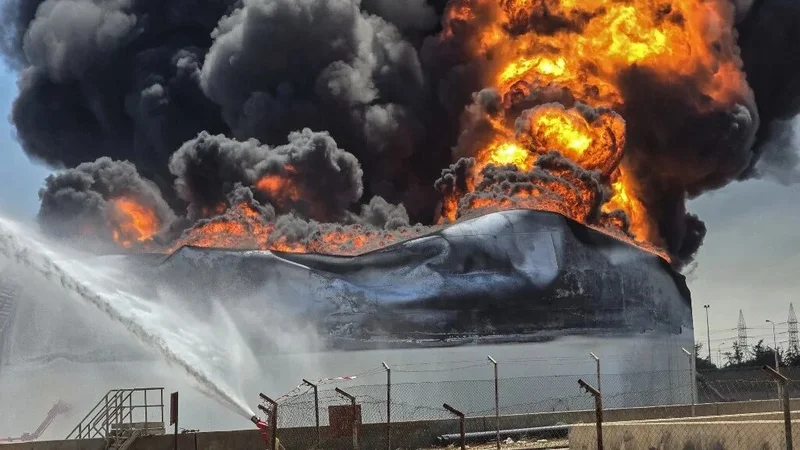
The assassination came as emergency crews fought a major fire at the Zawiya oil refinery, west of Tripoli, following a drone attack on Monday evening. It was the third strike on the facility in two days.
Libya’s National Oil Corporation said a drone directly struck a tank holding about 4.5 million litres of fuel. The resulting fire caused the tank to collapse and prompted the company to warn that further attacks could force it to suspend operations.
Emergency services reported no serious injuries, although medics treated several people for smoke inhalation.
Zawiya is Libya’s largest operational refinery and can process 120,000 barrels of oil per day.
“No group has claimed responsibility for the drone strikes, but they came amid an armed confrontation between rival militias in Zawiya and are likely intended as pressure on the Government of National Unity headed by Prime Minister Abdul Hamid al-Dbeibah,” Kinnear said.
The turmoil deepened after a letter attributed to Central Bank of Libya Governor Naji Issa circulated widely on social media and local news outlets.
Addressed to the heads of the House of Representatives and High State Council, the letter said Issa would not remain in his post. He declined to explain his decision, citing the “sensitivity” of the reasons.
“Drone attacks on oil infrastructure in Zawiya, a car bomb assassination in Benghazi and the resignation of one of Libya’s top officials [in a space of 24 hours] underline how quickly Libya’s fragile political and security situation can deteriorate,” said Kinnear.
Libya remains divided between the internationally recognised government in Tripoli and an eastern administration backed by Haftar.
The hydrocarbon-rich country produces more than 1.3 million barrels of oil per day but continues to suffer prolonged electricity cuts.
Blackouts have triggered protests in Tripoli, Zawiya, Misrata and other cities, where demonstrators have demanded reliable power and called for Dbeibah to resign.
“Libya’s energy infrastructure often becomes the target in these confrontations, as it is the easiest means by which pressure can be placed on political leaders and concessions demanded,” Kinnear said.