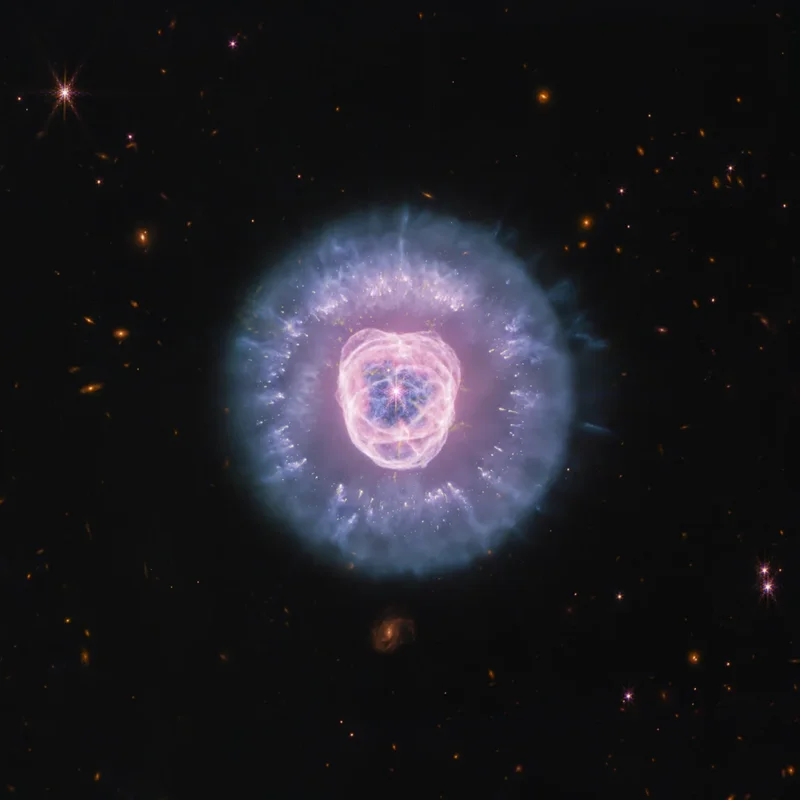
Imagine a lion with the nose of a dying star, a mane of space dust and a habitat 10,000 light-years away from Earth. On its infrared galactic safari, NASA’s James Webb Space Telescope (JWST) just captured it on camera.
The planetary nebula NGC 2392, nicknamed the Lion Nebula for its resemblance to the animal, was previously viewed in 2000 by the Hubble Space Telescope. Now astronomers have captured an even clearer view of it.
Planetary nebulae like the Lion Nebula are glowing shells surrounding a dying star, or white dwarf, at their center. The white dwarf emits radiation and produces a giant gas bubble—the lion’s face—that destroys dust in its path. And the border, or “mane,” of the planetary nebula is a shell of dust surrounding the white dwarf.
On supporting science journalism
If you're enjoying this article, consider supporting our award-winning journalism by subscribing. By purchasing a subscription you are helping to ensure the future of impactful stories about the discoveries and ideas shaping our world today.
The new images reveal the ionized gas and clumps of dust surrounding the white dwarf more clearly than the older Hubble pictures. The structure formed by the gas and dust, visible in the new observations as complex rings and shells, is an astronomical phenomenon researchers still don’t totally understand.
The star will eventually die, destroying the lion and dispersing all the gas and dust into interstellar space. Astronomers estimate that its final roar will occur around 10,000 years from now.