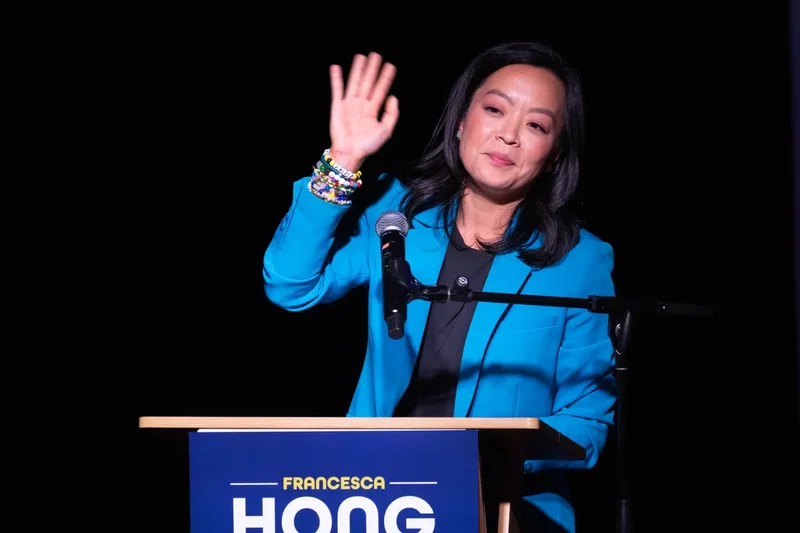
The Democratic primary for governor in Wisconsin ended in the narrowest of victories for David Crowley, the Milwaukee county executive, on Wednesday as far-left progressive Francesca Hong came up short.
Her defeat was a sour pill for the newly energized left wing of the Democratic Party, but one that followed a smashing victory by Wisconsin Lt. Gov. Peggy Flanagan over the far more centrist Rep. Angie Craig in the state’s race for U.S. Senate, giving progressives their second victory in a Senate contest in a week.
Neither wing of the Democratic Party will come away from Minnesota’s race feeling anything close to dominant. Crowley appeared on track to best Hong by just over 3,000 votes, less than half a percent dividing the two. With 95% of the vote counted Crowley had 313,321 votes to Hong’s 310,110 as of Wednesday morning.
Centrists will breathe a sigh of relief knowing that the party’s general election candidate for the Minnesota gubernatorial race this fall won’t be directly saddled with the political baggage of a self-imposed “socialist” label or the comparatively fringe positions on policing and other issues held by the Democratic Socialists of America, of which Hong is a member. Republicans are still aiming to paint all Democrats as socialists, but Crowley’s defeat of Hong will make that label harder to stick with many voters.
But at the same time, the strength of Hong’s campaign can’t be ignored, especially given her near-total lack of national support outside of endorsements from two far-left House members, Ro Khanna and Ilhan Omar.
Neither have the same kind of pull as Sen. Bernie Sanders (I-Vt.) or Rep. Alexandria Ocasio-Cortez (D-NY), both of whom declined to endorse in the race. Sanders did not endorse gubernatorial candidates this cycle, while Ocasio-Cortez has played a selective game with her own endorsements as she charts her own potential future ambitions.
Tuesday’s results were especially disappointing for the DSA and many progressives in large part due to the polling suggesting that Hong was running away with the vote beforehand.
Supporters of the assemblywoman were excited heading into Tuesday, only to see Crowley (who’d only resumed his suspended campaign weeks earlier) quickly reaching his required benchmarks as Hong failed to take the lead.
It wasn’t just the two most prominent progressives in American politics who left Hong’s campaign on read. Playbook reported that ahead of Tuesday’s primary, none of the rising progressive stars who descended on Michigan to support Abdul El-Sayed traveled further west to help Hong cross the finish line, with the exception of Twitch streamer Hasan Piker, who focused his national, mostly male audience of younger progressives on Hong’s campaign in the final weeks.
His presence may have energized the left, but also conceivably could have contributed to the image of the candidate as a left-wing firebrand.
Hong’s success and failure can both be linked in part to the DSA brand. Concerns about the label and her electability clearly played into the ability of Crowley, who’d previously dropped out of the race, to martial such support for his bid in such a short time after Hong’s closest rival, Mandela Barnes, dropped out.
Her struggle to explain a past comment dissing Thanksgiving as a “colonizer” holiday that gained national media attention only accelerated the pace of questions about her electability in a purple state.
DSA volunteers were crucial to the success she did have, however, and her coming within inches of the nomination speak to the ability of candidates like Hong to remain truly competitive even when abandoned by the growing progressive coalition in Washington.