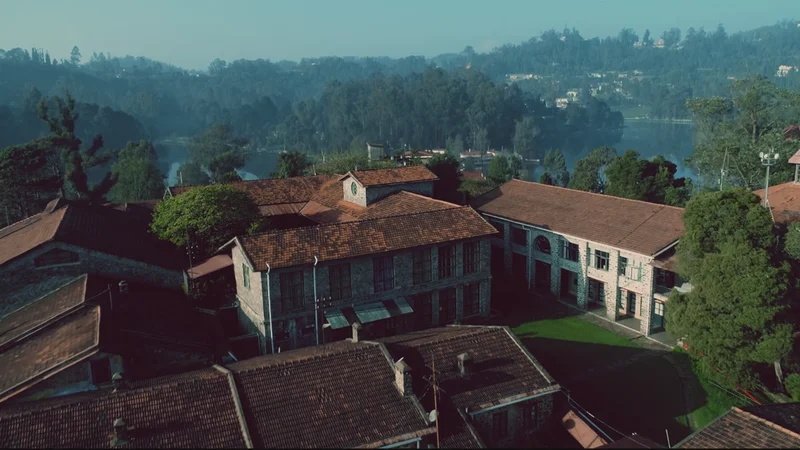
“It’s been incredibly nostalgic to return to Kodaikanal International School after 17 years of graduating,” saysTaira Malaney, alumna and documentary film maker from Goa. Kodaikanal International School (KIS), one of the earliest IB schools in Asia, has occupied a distinctive place in the Palani Hills as a multi-cultural, multi-national institution that has shaped generations of students from India and across the world. This year, as it completes 125 years, celebrations have begun with a host of events.
Established in 1901 as Highclerc School under the leadership of Margaret Eddy, the institution began with a practical need: an English-medium residential school where children of missionary families working across South India could study in the pleasant weather of the hills. In 1900s when Margaret traveled to India to visit her son Sherwood, who worked as a missionary in Batlagundu, she saw that children of missionaries suffered from tropical illnesses and lacked a proper local school. But over the decades, the school’s vision expanded to empowering young people from diverse backgrounds.
“Kodaikanal is not simply where KIS happens to be located; it is part of our identity,” says Keith Ribeiro, director of Admissions and Advancement, adding that the Western Ghats provide an extraordinary living laboratory. “Hiking, camping, field studies, environmental research, outdoor sport and service have taught generations of students resilience, independence, teamwork and stewardship. Our 135-acre Poondi wilderness campus expands that learning even further,” says Keith.
In 1976, it became the first school in India to offer the International Baccalaureate Diploma Programme. Taira returns to the campus to screen her award-winning documentary The Turtle Walker as part of a nationwide campaign to take the film to educational institutions, with KIS being the first stop in this initiative.
“As I walk through the campus, I am flooded with memories of my time here, and am truly grateful to have studied at the oldest IB school in our country, a space where I always felt nurtured and safe to learn, explore and create,” she says adding that her connection with Nature began here. “I was exposed to social and environmental issues in our immediate surroundings through experiential programmes. I still remember when Mr Plymale took us to a shola forest and taught us about invasive species such as the eucalyptus tree, which was brought to the Kodai forests almost two hundred years ago. We planted our own shola saplings while learning about this.”
Keith reiterates that Nature is a teacher, a classroom, and a responsibility. Increasingly, however, the environment is teaching something more urgent. “The Palani Hills are ecologically fragile, and issues such as biodiversity loss, waste, water, land use and climate change are no longer abstract classroom topics. Students engage with biodiversity conservation, regenerative agriculture, waste management and climate action alongside researchers and local communities,” he explains.
Today, learning at KIS can happen in a classroom, laboratory, forest trail, residence, music room, service project or through an encounter with someone from another culture. “Modernise the tools without losing the purpose,” says Keith, describing what he sees as the institution’s enduring approach to change. “Environmental education, service, residential life, music, sport and learning beyond the classroom remain central to the experience. Perhaps the real milestone is KIS’s ability over 125 years to keep changing without losing its identity.”
That expansive view of education becomes relevant as the institution steps into its next century. “Artificial intelligence, climate change, technological disruption and an increasingly interconnected yet polarised world will require young people to think critically, adapt, collaborate across cultures and combine technological ability with empathy and judgement,” explains Keith.
Another star alumna, author, musician, and journalist Zac O’Yeah, who conducted a three-day creative writing workshop with the students, stresses the importance of giving young people space to explore language creatively. Writing, he says, can transform language from a functional tool into “a world in itself”. For him, creative writing is also about opening up possibilities. A writer need not simply aspire to publish novels; there are paths through journalism, translation, literary criticism, theatre, cinema, editing and lyrics.
Tara Menon, alumni and development coordinator, says the most representative alumni stories are not necessarily those of people who have achieved conventional professional success, but those who have followed unexpected paths with curiosity and purpose.
She points to alumni such as Joy Morshed of ’99, who moved from molecular biology and genetics into the food industry and entrepreneurship; architect Ketsa Jerome of ’13, whose childhood experiences at KIS influenced her approach to design; and Ruth Mabry of ’86, whose career in global public health reflects empathy, service and bridge-building. “The common thread isn’t the profession; it’s the person they become,” she adds.
The school’s emphasis on curiosity finds resonance in the journeys of people who have taken unconventional paths later in life. Actor, author and cancer-care advocate Viji Venkatesh, who will interact with students at KIS in September, discovered acting only after more than three decades in cancer care and patient advocacy. She was 70 when cinema entered her life.
“Acting discovered me,” she says, describing how she initially resisted the opportunity before taking the plunge. Now, with seven films behind her, she sees the experience as another chapter in a life defined by learning and reinvention.
“I found true joy in learning at KIS,” Taira recalls, particularly through subjects such as Psychology, English and Visual Arts. The school, she says, changed not just what she learnt but “how I think, problem-solve, and ideate overall.” Those experiences eventually became part of the foundation for her career in environmental filmmaking.
For Ribeiro, the question is not how KIS can prepare students for university or employment, but how it can prepare them for an unpredictable future. The ambition, he says, is to nurture young people who can ask a larger question: What does the world need from me?
Published - August 12, 2026 06:10 pm IST