The Cambrian explosion may have been fueled by poop.
The first animals on Earth emerged about 600 million years ago, and 60 million years later, those simple early animals evolved into wildly different directions, branching out into a diverse menagerie of complicated new forms and conquering new ecological niches. Known as the Cambrian Explosion, this flurry of rapid evolution produced most of the animal phyla and ecosystems we see around us today.
And it may have taken off because some of those early animals evolved a bizarre new ability: pooping. According to a recent study, the first poo pellets helped spread nutrients to deeper parts of the ocean, fueling the evolution of bigger animals in more diverse ecosystems.
Powered (partly) by poop: The ocean’s biological pump
Karlsruhe Institute of Technology paleontologist Julien Kimming and Flinders University paleobiologist Russell Bicknell recently dug through the scientific literature for every fossilized digestive system and Cambrian-period coprolite (fossilized fecal matter) they could find, plotting how digestive tracts and feces evolved over time. They also examined the nutrient cycles that support life in today’s oceans and compared them with what—based on simulations and geological evidence—the oceans’ chemical makeup would have been 540 million years ago. All that data pointed to something we’ve overlooked: the raw nutrients that fed the ancestors of today’s animal phyla may have reached the ocean depths thanks to feces.
In today’s oceans, the water is chock-full of poop from everything from zooplankton to blue whales, and it’s a key part of a system called a biological pump, which moves nutrients like carbon, iron, nitrogen, and phosphorus around the ocean. Without that biological pump, the deeper reaches of the ocean would be much less habitable than they are now. And “less habitable” was pretty much the case before about 540 million years ago, toward the end of what’s called the Ediacaran Period. Kimming and Bicknell argue that when animals evolved the first digestive systems, they sent the first poop drifting down through the depths, which gave the early biological pump a sort of kickstart.
“The advent of fecal pellets,” wrote Kimming and Bicknell, “provided an additional source of organic carbon, as well as iron, nitrogen, and phosphorus, to deeper waters. … In this framework, fecal pellets significantly boosted support for marine animal life and possibly supported the diversification and increased Cambrian biomass.”
This coprolite still contains remnants of an unlucky trilobite, dating to somewhere between 520 and 506 million years ago in what’s now Australia.
Kimming and Bicknell 2026
This coprolite still contains remnants of an unlucky trilobite, dating to somewhere between 520 and 506 million years ago in what’s now Australia.
Kimming and Bicknell 2026
This 520-506-million-year-old coprolite from what’s now Greenland contains some shell fragments. All things shall pass.
John Peel
This 520-506-million-year-old coprolite from what’s now Greenland contains some shell fragments. All things shall pass.
John Peel
Macroscopic coprolite preserving shell fragments and organic matter from the Wulongqing Formation (Cambrian Series 2, Stage 4) Yunnan Province, South China. YPM IP 421925.
Kimming and Bicknell 2026
Macroscopic coprolite preserving shell fragments and organic matter from the Wulongqing Formation (Cambrian Series 2, Stage 4) Yunnan Province, South China. YPM IP 421925.
Kimming and Bicknell 2026
This 520-506-million-year-old coprolite from what’s now Greenland contains some shell fragments. All things shall pass.
John Peel
Macroscopic coprolite preserving shell fragments and organic matter from the Wulongqing Formation (Cambrian Series 2, Stage 4) Yunnan Province, South China. YPM IP 421925.
Kimming and Bicknell 2026
This 520-506-million-year-old coprolite from what’s now Nevada looks more like familiar, modern poop, with a distinctive pellet shape.
Kimming and Bicknell 2026
Macroscopic coprolite preserving unidentified organic matter from the Paseky Shale Member, Holšiny-Hořice Formation (Cambrian Series 2, Stage 4), Czech Republic. I261.
Petr Kraft
These coprolites are arrayed around the exit of a burrow at the Raven’s Throat River site, suggesting they may have been the work of the burrowing creature.
Kimming and Bicknell 2026
These microscopic pellets of poo are rich in phosphate. They were dropped by an unknown defecator 520-506 million years ago in what’s now Greenland.
John Peel
More phosphate-rich fecal pellets, this time from what’s now China, seen under an electron microscope.
Xi-guang Zhang
This phosphate-rich microscopic poop from Cambrian China is made up mostly of bits of shell.
Xi-guang Zhang
This pair of carbon-rich coprolites came from what’s now Canada. Note the difference in shape, suggesting they came from creatures with very different digestive tracts and probably different diets.
Tom Harvey
How defecation changed the world
The first animals on Earth were mostly simple creatures that lived in the sunlit upper layers of the ocean or on the shallowest parts of the seafloor. Depending on which set of scientists you ask, those early animals were similar to either sponges or jellyfish. Organs hadn’t been invented yet, so “eating” just meant waiting for tiny particles of food, like bits of plankton or bacteria, to float into the only opening in the animal’s body. Its cells would then engulf the food particle and break it down into its constituent molecules.
What these early animals released back into the ocean were mostly just chemical byproducts of their cells’ metabolism, not nutrients most other animals could use. So the deeper reaches of the ocean were largely unoccupied, because they didn’t offer enough nutrients to keep animals alive. Digestive tracts and poop changed everything.
By around 580 million years ago, some animals had started to evolve simple organs. Suddenly, these animals could swallow macroscopic chunks of food and digest them in their very simple—but still revolutionary!—guts, outside their cells, which probably really scandalized the sponges. That meant animals could eat more at a time, to support more complicated bodies, but it also meant they needed to dump the parts they couldn’t digest or absorb. Hence the advent of poop.
So far, paleontologists have unearthed Cambrian coprolites from about 35 sites around the world, spanning a period from around 540 to 494 million years ago.
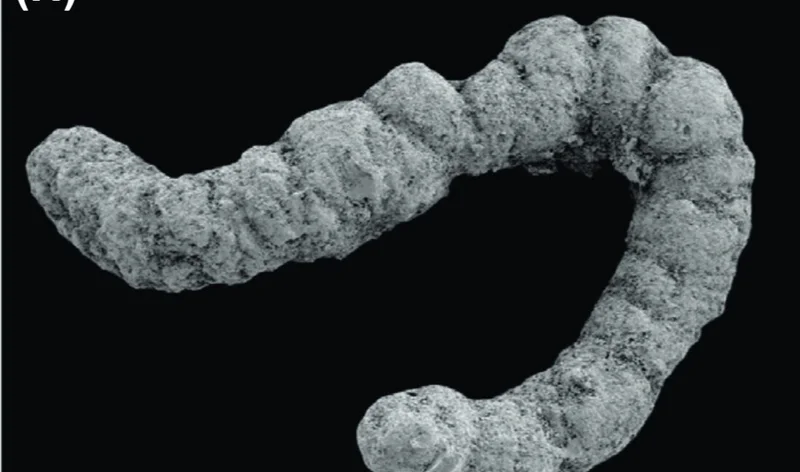
“They range from microscopic to several centimeters in size and include forms such as elongated, cylindrical, ellipsoid, circular, and ‘exploded’ fecal ‘carpets,’” wrote Kimming and Bicknell, rather evocatively. Some of the larger coprolites contain bits of shell or exoskeleton, revealing a bit about the diets of whatever produced them. The sheer diversity of the size and shape of all that fossilized feces suggests that the animals that produced it must also have been diverse (although scientists haven’t yet managed to match very many Cambrian fossil animals to the corresponding coprolites).
Mats of bacteria thrived on this fecal feast, and some animals came to graze on the bacteria. Other, larger animals show up to eat them, converting at least some of their biomass back into poop. (Ah, the circle of life.)
At a fossil site in northwestern Canada called Raven’s Throat River, the mudstone still holds 500 million-year-old coprolites, some as wide as five centimeters, along with complete fossils of trilobites and mollusc-like hyoliths with conical shells. “In many cases these associated fossils are preserved fully articulated and appear to be in feeding position,” wrote Kimming and University of Saskatchewan paleontologist Brian Pratt in a 2016 paper about the site. The researchers concluded that the Cambrian animals were probably snacking on either the coprolites themselves or on the microbial communities growing on them.
Behold the single greatest science graphic ever created. We can all go home now.
Russell Bicknell
Behold the single greatest science graphic ever created. We can all go home now.
Russell Bicknell
Everybody poops, including these animals fossilized in the Burgess Shale formation.
Smithsonian Institution
Everybody poops, including these animals fossilized in the Burgess Shale formation.
Smithsonian Institution
Hyoliths were mollusc-like creatures (which may or may not be actually related to today’s molluscs) with two long, curving spines and narrow, cone-shaped shells.
Danielle Dufault/(C) Royal Ontario Museum
Hyoliths were mollusc-like creatures (which may or may not be actually related to today’s molluscs) with two long, curving spines and narrow, cone-shaped shells.
Danielle Dufault/(C) Royal Ontario Museum
Everybody poops, including these animals fossilized in the Burgess Shale formation.
Smithsonian Institution
Hyoliths were mollusc-like creatures (which may or may not be actually related to today’s molluscs) with two long, curving spines and narrow, cone-shaped shells.
Danielle Dufault/(C) Royal Ontario Museum
Evolving bigger and better BMs
As Kimming and Bicknell looked at how coprolites changed through the Cambrian Period, they noticed a definite trend: Over time, feces got bigger and came in a wider array of shapes. That matched what they saw in fossilized guts, which started as simple, straight tubes; over 40 million years or so of evolution, animal guts developed twists and turns, specialized foreguts (the ancestor of the esophagus and stomach), and digestive glands. All of these innovations made it possible to digest larger and tougher morsels, a process we just carried on through the invention of cooking.
It’s a sign that animals in general were getting larger and more complex, and species were branching out into more and more diverse descendants. Bigger animals meant bigger poop, but bigger poop also helped support bigger animals, Kimming and Bicknell argue.
“The rapid acceleration of organism size during the Cambrian radiation increased coprolite size, which yielded a positive feedback loop, further accelerating the establishment of these ecosystems,” they wrote.
In other words, we’ve been dramatically underrating poop.