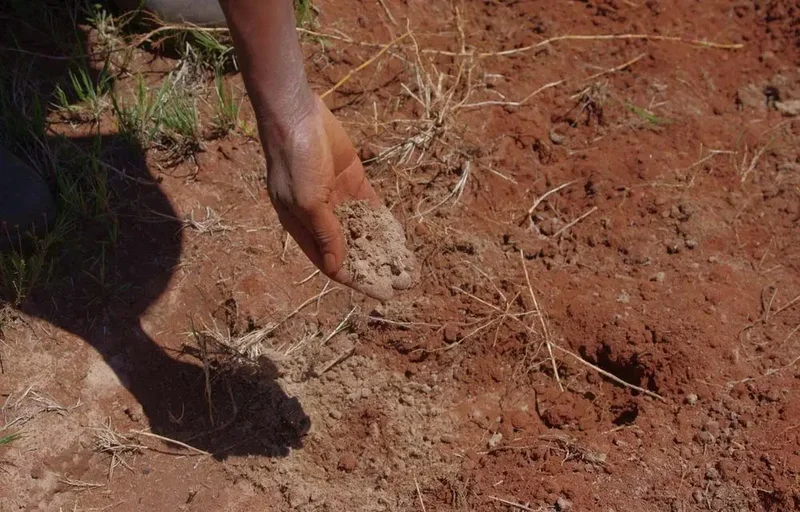
While South Africa’s attention is fixed on water shortages, pollution and climate change, scientists warn that another crisis is unfolding beneath our feet.
Healthy soils underpin food production, store carbon, regulate water and support biodiversity, yet more than 70% of South Africa’s land surface has experienced some form of degradation.
Scientists say protecting and rebuilding healthy soils could be one of the country’s most important climate adaptation strategies.
Soil is anything but inert: it is a living, largely unexplored ecosystem. The Food and Agriculture Organisation (FAO) says soil is home to more than a quarter of the planet’s biodiversity, encompassing an extraordinary web of microorganisms, fungi, invertebrates and other organisms.
“For most of the history of science, we have allowed soils to gather dust,” it said in a 2023 soil publication. “When not using them as somewhere to grow our food (admittedly the most vital of functions), we have largely treated soils as dirt.
“An impediment when digging for water, for coal, for metro lines. Something to cover over as we built cities and factories. At best, something to play sports on.
“We now know there is much, much more to soils … What we know for sure is that we only know about a tenth of what soils have to offer. That soils act as carbon sinks. That they are brimming with biochemical promise. That buried under our feet are no doubt the new frontiers of medical prowess. That we are, in effect, treading on treasures.”
Only about 1% of soil microorganism species are known. These microscopic communities drive nutrient cycling, support plant growth, influence carbon storage and help regulate water and other ecosystem processes.
But this hidden world is vulnerable. When soil is repeatedly tilled, left bare, compacted or stripped of vegetation, the biological processes that keep it functioning can be disrupted.
The result is not simply poorer soil: degraded soils hold less water, allow more runoff, lose nutrients and become less capable of supporting productive ecosystems.
According to the Agricultural Research Council, South Africa loses an estimated 12.6 tonnes of soil per hectare a year, while natural soil formation occurs at a rate of less than five tonnes per hectare. Soil erosion affects more than a quarter of the country.
The issue has gained renewed attention through the global Save Soil movement, which calls for greater awareness and policy action to halt soil degradation. In South Africa, the campaign recently brought together stakeholders to discuss soil health and the need for local action to restore degraded soils.
While South Africa does not have a dedicated national soil health strategy, the spokesperson for the department of agriculture, Moses Rannditsheni, said soil conservation and management are addressed through existing legislation, policies and programmes.
The main legislative framework is the Conservation of Agricultural Resources Act (Cara), which provides for the conservation of soil, water and vegetation.
The department, too, promotes sustainable soil management through its LandCare Programme, including its SoilCare and conservation agriculture focus areas, as well as initiatives such as agroecology and long-term soil monitoring, he said.
The country takes part in international and regional initiatives including the UN Convention to Combat Desertification’s (UNCCD) Land Degradation Neutrality programme, the African Union’s Africa Fertiliser and Soil Health Action Plan and the SADC’s Regional Fertiliser and Soil Health Programme. South Africa is also a member of the Global Soil Partnership.
These measures, Rannditsheni said, demonstrate that soil health is a national priority, even if it does not always receive the same public attention as more visible environmental issues.
“Healthy soils do feature in South Africa’s climate, biodiversity and water policies, although they are generally integrated as a cross-cutting component of natural resource management.”
This approach, Rannditsheni said, reflects the recognition that healthy soils underpin multiple national priorities including food security, agricultural productivity, climate change adaptation and mitigation, biodiversity conservation, water resource protection and sustainable economic development.
The FAO’s 2025 State of Food and Agriculture report found that about 1.7 billion people live in areas where crop yields are declining because of human-induced land degradation, describing it as a largely silent crisis threatening agricultural productivity and ecosystem health.
Across Africa, the challenge is particularly acute. The UNCCD estimates that nearly three-quarters of the continent's land is degraded, with drought and heavy dependence on natural resources adding to the pressure on land and soils.
South Africa’s soils are highly diverse, with conditions varying considerably between regions and farming systems, according to Dr Adornis Nciizah, an ARC specialist researcher in soil science, and Dr Goodman Jezile, the ARC’s soil science research team manager.
But the country faces particular challenges because it is naturally semi-arid, only about 13% of its land is classified as arable and many soils are inherently fragile and contain low levels of organic matter.
Nciizah and Jezile pointed out that the scale and nature of degradation varies. National assessments show that the largest areas affected by sheet and rill erosion occur in the Eastern Cape, followed by the Free State, Northern Cape, Limpopo, KwaZulu-Natal and Mpumalanga.
The highest erosion risk is concentrated in the eastern parts of the country, where steep slopes, erosive rainfall and land-use pressures often coincide.
The most vulnerable farming systems include overgrazed rangelands, communal grazing areas with high stocking rates, cultivated fields on steep slopes and croplands with inadequate soil cover.
The ARC researchers said major forms of degradation include erosion, declining soil organic matter, overgrazing, compaction and nutrient imbalances.
Soil erosion is particularly damaging because it strips away topsoil, which contains much of the soil’s organic matter, essential plant nutrients and beneficial biological activity. This can reduce soil fertility and agricultural productivity, while recovery of severely eroded soils can take decades.
Nciizah and Jezile said current farming practices are, on average, still depleting soil organic carbon.
Cultivated lands generally contain up to 11% less soil organic carbon than natural ecosystems, although losses vary according to climate, soil type, land-use history and management. In some areas, reductions of up to 75% have been recorded following long-term cultivation and intensive use.
Intensive tillage, poor residue management and overgrazing are among the main drivers of soil carbon loss. Repeated monoculture production and leaving fields bare between harvests can also reduce organic inputs and leave soil vulnerable to erosion.
But there are ways to rebuild soil health. Conservation agriculture practices such as reduced tillage, crop rotation, cover cropping and retaining crop residues can improve soil carbon levels while enhancing water infiltration, nutrient cycling and soil structure.
Converting land to perennial pastures can also rebuild soil organic carbon, with increases of up to 25% recorded under some management interventions.
They said that the challenge is that rebuilding soil organic carbon takes years, while losses can occur relatively quickly under poor management. Protecting existing natural vegetation and adopting sustainable agricultural practices are therefore critical to preventing further losses.
The consequences extend well beyond agriculture. When this living system is degraded, water infiltration declines, runoff increases and crops become more vulnerable to moisture stress.
The ARC researchers said that in a water-scarce country such as South Africa, “healthy soils are one of the country's most important climate adaptation tools”. Improving soil organic matter can significantly enhance water-holding capacity and reduce vulnerability to both drought and floods.”
Degraded, compacted or bare soils are less able to absorb heavy rainfall, increasing surface runoff and the risk of further topsoil erosion. During dry periods, they also have a reduced capacity to retain moisture, leaving rain-fed crops such as maize and wheat more vulnerable to moisture stress and crop failure.
The researchers argued that soil health should therefore be viewed not simply as an agricultural concern, but as a foundation for food security, water resilience, environmental sustainability and climate adaptation.
The growing international attention to soil is reflected in a proposal endorsed in June by the FAO’s Global Soil Partnership for a UN Decade on Soil Health from 2031 to 2040, aimed at strengthening efforts to protect and restore the world’s soils.
For something so fundamental to life, however, much of soil’s most important work remains hidden beneath our feet.