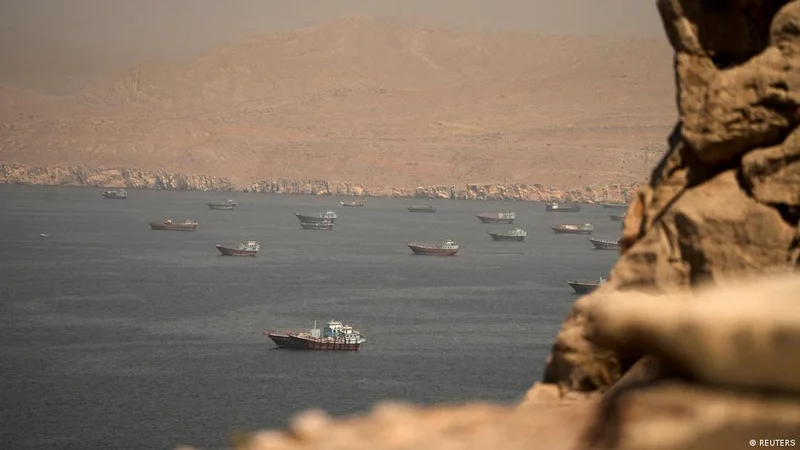
Months of blockades and uncertainty around the Strait of Hormuz have pushed energy exporters to look for ways to bypass the key shipping lane.
Iranian officials insist the waterway would remain closed and negotiations would not resume unless the United States complied with a June framework agreement and offered compensation to Tehran for alleged violations.
US President Donald Trump, however, said on Monday that the US Navy already controls the Strait of Hormuz.
"We've mine-swept the entire strait," he told reporters.
The narrow waterway between Iran and Oman is one of the world's most critical oil shipping routes. Before the Iran war, it carried around 20% of global crude exports from the Persian Gulf to markets in Europe, Asia, and North America.
Facing the prolonged disruption, however, Saudi Arabia demonstrated that it can redirect substantial volumes away from the Strait of Hormuz. The United Arab Emirates (UAE) has had less success, despite possessing ports and pipelines specifically designed for that purpose.
Saudi Arabia shows what is possible
The US-Iran war has placed greater importance on alternative shipping lanes through the Red Sea.
Saudi Arabia is sending its crude through the East-West Pipeline from the kingdom's eastern oil fields to the Saudi Red Sea port of Yanbu, enabling it to keep up shipments to global markets by circumventing Hormuz entirely.
During April and May, Saudi cargo shipments from its Gulf coast fell from 47.5 million tons a year earlier to just 6.3 million tons, according to data from IMF PortWatch.
Over the same period, exports through the Red Sea rose from 29.6 million to 54.8 million tons. That additional 25.3 million tons replaced roughly 61% of the volume lost on the Persian Gulf side.
The shift shows that the East-West Pipeline is not merely an emergency backup, but also an important tool to keep Saudi oil flowing during a Hormuz closure.
The Iran-backed Houthi rebels in Yemen recently declared a maritime blockade on Saudi Arabia, but its impact was not immediately clear.
While Saudi Arabia is working to remove bottlenecks in its East-West system, its eastern neighbor UAE is looking at adding parallel capacity alongside its Abu Dhabi Crude Oil Pipeline (ADCOP).
The UAE exposes the limits
On paper, the UAE is well prepared. ADCOP carries crude from Habshan in Abu Dhabi to Fujairah on the Gulf of Oman, outside Hormuz. Fujairah and nearby Khor Fakkan also provide major deepwater facilities on the eastern coast.
However, while these ports may sit outside the Strait of Hormuz, they remain close enough to Iran to be vulnerable to drones and missiles. During the fighting, the Emirati port of Fujairah came under attack and vessels operating near the UAE's eastern coast were also struck.
UAE Persian Gulf coast traffic during April and May 2026 fell to 12 million tons from 68.5 million tons in the same period of 2025, according to IMF PortWatch vessel-tracking data. Traffic through alternative UAE ports also declined, from 13.7 million tons to 6.3 million.
In other words, rather than picking up cargo diverted from the Persian Gulf, the alternative ports also saw a decline in shipments.
One problem is physical capacity. Fujairah cannot quickly replace the enormous throughput of major Persian Gulf facilities such as Jebel Ali.
But war risk is at least as important. A bypass route is of limited use if shipowners and insurers consider its destination almost as dangerous as Hormuz itself.
New pipelines will not solve today's crisis
Governments and industry experts are also discussing bigger alternatives.
Economist Hassan Mansour told DW that suggestions include new pipelines connecting Iraq with Oman and Jordan, as well as longer sea routes around the entire African continent via South Africa's Cape of Good Hope. But these projects would be expensive and take years to build.
Mansour estimates that a Basra-Aqaba pipeline could require five to seven years and cost around $8 billion to $10 billion (€6.9 billion to €8.7 billion).
A Basra-Oman connection could cost $10 billion to $15 billion, while broader Iraq-Kuwait-UAE-Oman concepts would also require major investment, Mansour suggested.
He noted that rerouting ships around the Cape of Good Hope can add hundreds of thousands of dollars in transport costs to every single voyage.
"The bottom line is that these projects cannot solve the oil market's immediate problem," Mansour told DW.
The Red Sea route also has its own security weakness. Ships moving toward the Suez Canal must pass Bab al-Mandab, where Houthi attacks have repeatedly threatened commercial shipping.
In other words, avoiding one bottleneck can mean becoming dependent on another.
Could Israel become part of the bypass?
Israeli Prime Minister Benjamin Netanyahu has argued that the region needs "alternative routes instead of going through the chokepoints of the Hormuz Strait and the Bab-al-Mandab Strait in order to have the flow of oil."
According to The Times of Israel, he said this could be achieved through "oil pipelines, gas pipelines going west through the Arabian Peninsula right up to Israel, right up to our Mediterranean ports."
Netanyahu said such a network would mean "you've just done away with the chokepoints for forever" and insisted the vision "is definitely possible."
Qatar, Kuwait and Bahrain have no easy escape
Rahman Ghahremanpour, a Tehran-based political analyst, said that efforts to bypass Hormuz are not new. But he argues that the war has exposed their vulnerability.
"These pipelines can reduce the impact of the Strait of Hormuz, but in wartime they are themselves vulnerable," Ghahremanpour told DW, noting that Iranian and Houthi drones can reach both Fujairah and the Red Sea.
Ghahremanpour said the problem is more serious for Qatar, Kuwait and Bahrain.
"Unlike Saudi Arabia and the UAE, they do not have coastlines outside the Persian Gulf. Any alternative route would require cooperation with other countries, potentially involving Iraq, Syria, Jordan or Israel."
Ghahremanpour told DW that, as a result, they will remain dependent on Hormuz in the short term.
Strait of Hormuz remains difficult to replace
Alternative routes can make Gulf energy exports less vulnerable, as shown by Saudi Arabia's experience. Also, expanding existing pipelines could further reduce the impact of the current crisis.
Before the conflict, however, roughly 20 million barrels of oil and petroleum products passed through the Strait of Hormuz each day. Existing bypass capacity represents only a fraction of that volume.
Ghahremanpour also warned that "pipelines alone cannot solve the problem."
"Ports, terminals and pipelines can also come under attack," he said..
At the same time, the impact of the Hormuz closure also creates a constraint for Tehran, according to Ghahremanpour
"If Iran keeps Hormuz closed for too long, the assumption that the disruption is temporary could disappear and a much broader international coalition could form against Tehran," he told DW.
"Iran's objective is to prevent such a coalition from taking shape," Ghahremanpour said.
Edited by: Keith Walker