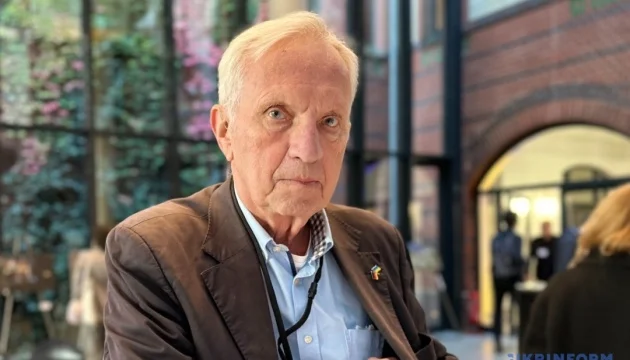
Klaus Wittmann, a retired Bundeswehr brigadier general and lecturer in contemporary history at the University of Potsdam, said this in an interview with Ukrinform.
"I am prepared to go so far as to say that, from a military-strategic and moral perspective, this was a legitimate target," Wittmann said, commenting on whether Nord Stream could be considered a legitimate target if the German investigation's theory of Ukrainian involvement is confirmed.
At the same time, he stressed that he was not offering a legal assessment of the case and was not questioning the independence of the judiciary.
"I am not a lawyer and, of course, I do not want to question the independence of the judiciary. But if you look at the background, I was among those who strongly opposed Nord Stream 2," the retired general said.
Read also:Allies still have Patriot missile stocks that could be supplied to Ukraine – German expert
According to him, the decision to build Nord Stream 2 was made after Russia had already occupied Crimea, despite warnings from Ukraine and Central and Eastern European countries.
"The decision on Nord Stream 2 was made when Crimea had already been occupied for a long time. Despite this, people continued to believe that Russia could be relied upon as a reliable supplier of cheap gas and called it a purely economic project. At the same time, they turned a blind eye to what the Baltic states, Poland and, of course, the Ukrainians had repeatedly told us: from Russia's perspective, it was a geopolitical project," Wittmann said.
He also recalled the position of Polish Prime Minister Donald Tusk.
"Here I would like to quote Polish Prime Minister Donald Tusk, who said that the problem was the construction of Nord Stream 2, not its destruction," Wittmann said.
At the same time, he acknowledged the seriousness of destroying someone else's property but urged that the case also be viewed in the broader political context of Russia's war.
"Of course, destroying someone else's property is a serious matter. But we also need to look at it from a political and psychological perspective and ask whether it is in Germany's interests for the first conviction for a 'war crime' in the war in Ukraine to be handed down against a Ukrainian – and in Germany, of all places?" Wittmann said.
He noted that he did not know how much room for maneuver Germany's Federal Prosecutor General's Office had in the case or "whether it was obliged to seek extradition."
"But given the scale and horror of Russia's war crimes, I do not consider it acceptable for the German justice system to focus primarily on a 'Ukrainian war crime,'" Wittmann said.
On September 26, 2022, explosions damaged three of the four pipelines of Nord Stream 1 and Nord Stream 2 in the Baltic Sea. In June 2026, Germany's Federal Prosecutor General's Office charged a Ukrainian citizen, identified as Serhii K., a former Ukrainian serviceman, with, among other offenses, aiding and abetting a war crime through an attack on a civilian object. According to the prosecution, the group acted on the orders of Ukrainian state bodies, with the aim of halting Russian gas supplies and depriving Russia of revenues that could be used to finance the war. The arrested Ukrainian has denied involvement.
In July 2026, Ukraine's Prosecutor General's Office said that its investigation had found no evidence of involvement by Ukrainian state bodies or officials in organizing the explosions.