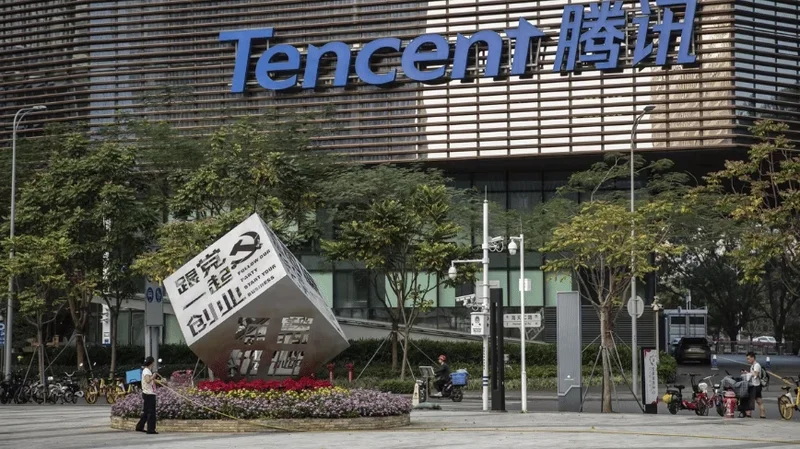
Tencent reported second-quarter revenue of 204.8bn yuan ($30.4bn) on Wednesday, up 11% and ahead of forecasts. Net profit came in at 56bn yuan against the 61.8bn analysts expected, CNBC reports. Capital expenditure rose 176% on the year to 52.8bn yuan, about $7.8bn. Free cash flow swung to an outflow of 13.8bn yuan.
Those four numbers describe one decision. The company is spending its profit on compute and telling investors to wait.
The number worth doing by hand
Put the two cash figures side by side. Tencent spent 52.8bn yuan on capital expenditure in the quarter. Free cash flow landed at minus 13.8bn yuan, Bloomberg reports. So operations did not generate enough to cover the infrastructure bill and the company’s other outgoings.
That is the quarter in one line. WeChat, the games, the advertising and the cloud between them did not cover the compute. A company that has printed cash for two decades just spent more than it made.
Two ways to say the same figure
The 176% figure is a year-on-year comparison, and the South China Morning Post led on it. Against the previous quarter, capital expenditure rose 65%. Both come from the same release. Most coverage picked one or the other, and the gap between them is the story of how fast this accelerated.
Operating costs climbed 22.6% in the quarter, according to Bloomberg Intelligence. Adjusted operating profit growth slowed to 9.2%. Adjusted net income reached 68.4bn yuan, up 9% and roughly in line with expectations.
The fallback plan is becoming a landlord
Analysts spent the call asking about returns, and the answers were unusually specific. Chief strategy officer James Mitchell said Tencent could get a “decent return in an immediate timeframe”. It would only have to rent out all of its compute capacity. It is choosing to build its own models instead, for what he called “superior economic returns over the longer term”.
President Martin Lau made the same point as a floor rather than a ceiling. In the worst case, which he said the company does not expect, that infrastructure can be rented out at cost recovery. “There is also clear downside protection,” he told analysts.
Read that plainly. The downside case for a $7.8bn quarterly compute bill is that Tencent becomes a neocloud. That is a real business. It is also a very different company from the one selling game skins and advertising.
Punished for spending, punished for not committing
Here is the bind. Alibaba has pledged more than $50bn over three years for AI infrastructure. Tencent has set no multiyear target at all, saying only that its investment in AI products will double this year.
So the market gets to have it both ways. The stock is down 26% this year and roughly $170bn of market value has gone. Part of that is the spending looking reckless. Part of it is the spending looking insufficient. Tencent is the only one of China’s biggest tech names without a flagship model at the frontier.
The competition has been loud. Moonshot’s Kimi K3 matched industry leaders on far fewer resources. Alibaba’s Qwen3.8-Max topped several charts. Tencent hedged by joining DeepSeek’s debut funding round and wiring its V4 model across its own products.
What is actually working
The operating business had a good quarter. Domestic games revenue rose 17% to 47.3bn yuan on Delta Force and Valorant. That accelerated sharply from 6% in the first quarter. Marketing services rose 22% to 43.6bn yuan, which Tencent credits to AI-driven ad targeting. Cloud grew in the low twenties and the company raised prices.
International games slipped 0.8% on currency, or grew 4% in constant terms. WeChat and Weixin reached 1.44 billion monthly users, up 2%. QQ Mobile fell 2% to 520 million. Tencent has also been cutting studio investments in Japan and trimming staff at LightSpeed and TiMi.
Its own AI products are early but not nothing. WorkBuddy is now China’s most popular AI office tool with 21 million monthly visits in June. Xiaowei, the assistant inside WeChat, is still in what Tencent calls a small-scale prototype test.
Why Amsterdam cared
The result moved a European stock. Prosus, the Amsterdam-listed group that holds a large Tencent stake, fell 6% on the day. A quarterly report from Shenzhen is a European market event. That link is rarely visible until a day like this one.
Tencent has been buying the hardware for a while. It struck a reported $3bn memory deal with CXMT. Founder Pony Ma told analysts the company is “making substantial progress toward building a new AI-empowered Tencent”.
The test arrives in about three months. Tencent says Hy4, a larger successor to the Hy3 model it shipped last month, lands later this year. Either that model competes with the best from DeepSeek and Moonshot, or the compute bill bought a seat at someone else’s breakthrough.
Get the TNW newsletter
Get the most important tech news in your inbox each week.