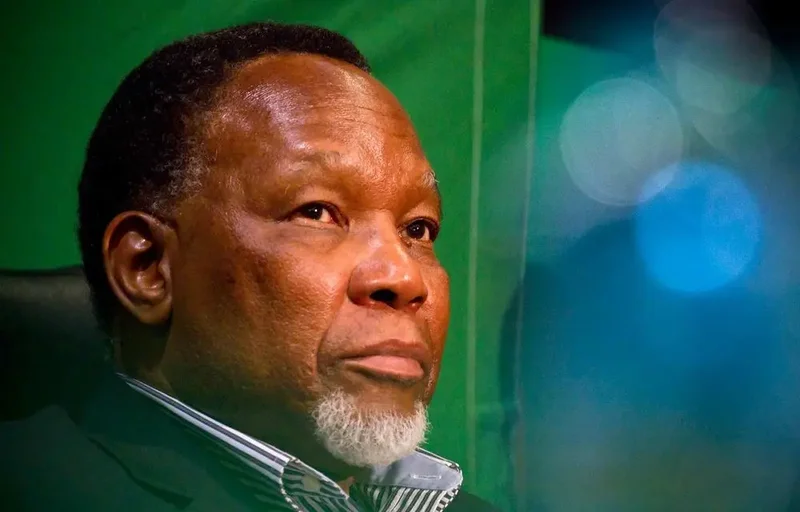
While the dawn of democracy over three decades ago has pointed to significant political transformation achieved, the ownership and control of productive capital remained profoundly asymmetrical, former South African president Kgalema Motlanthe has conceded.
Addressing a packed two-day Black Business Council (BBC) annual summit at the Radisson OR Tambo Hotel and Convention Centre in Kempton Park on Wednesday, Motlanthe, frank about key economic challenges facing the country, said the core question lay at the enlargement of the economic base.
“The question before us is not merely on whether previously excluded persons have been empowered.
“The deeper question is whether we have enlarged the economic base upon which empowerment can be sustained and reproduced across generations,” Motlanthe maintained .
“There exists a familiar critique of black economic empowerment (BEE) – that it has sometimes enriched a narrow cohort of the politically-connected, with certain transactions having yielded limited broad-based transformation.
“The critique has also gone on to claim that the empowerment has in places, become a ritual of compliance, rather than a practice of productive capability.
“While elements of the critique contain truth, we must resist the inference that the project of empowerment itself has failed.
“Perhaps the more fundamental failure is that we have not sufficiently grown the economy.
“Where growth is sluggish, productive investment weak, manufacturing capacity eroded, domestic demand constrained and new industries scarce, the space for genuine empowerment contracts.
“We are then reduced to contesting the distribution of the economy that does not expand.
“The problem is not solely that too few have been empowered – it is that we have not generated sufficient new capital, new enterprises, new industries and new markets to reproduce empowerment across successive generations.”
Motlanthe said the economic crunch facing South Africa required “a shift in orientation”.
He added: “The BBC and the broader community of black enterprise must think beyond the transaction.
“We must move from the acquisition of ownership stakes to the formation of capital – from empowerment deals to industrial development, from the status of beneficiary to that of producer, from consumption to investment, from individual accumulation to the construction of institutions capable of reproducing black productive capital across time.”
He called on delegates to refute “the narrative that African economic development begins with colonialism”.
“As historical enquiry has shown, pre-colonial Africa sustained sophisticated commercial networks linking societies across regions and into wider international circuits.”
Africa, he said, possessed extraordinary assets: a young and expanding population, vast mineral endowments, agricultural potential, renewable energy resources, strategic geography and rapidly growing digital markets.
“Yet these remain underutilised, with one structural weakness being scale.
“Fifty-five sovereign states, each with distinct regulatory, fiscal, monetary and legal regimes, produce fragmentation that inhibits economies of scale – weakening collective bargaining power.
“African integration must become an economic project – rather than a diplomatic aspiration.
“We require integrated value chains, continental manufacturing platforms, shared infrastructure, financial institutions capable of mobilising African savings for African development and increasingly, an African digital and technological ecosystem.”
The Summit aims to create a platform for enhanced engagement and is themed “Growing the South African Economy through Economic Empowerment, Re-industrialisation and Localisation in the era of Artificial Intelligence”.
On Thursday, the gathering will focus on the political economy in South Africa, with the theme “Growing and Transforming the Economy in a Local Government Election Year”.