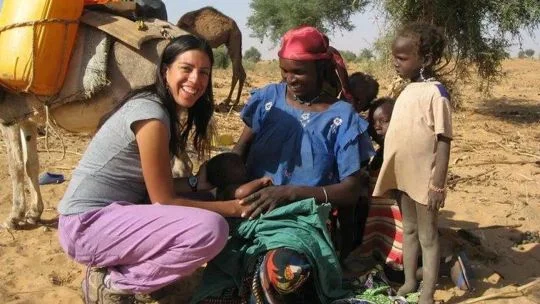
María José Cáceres embodies the profile of a professional going far beyond the technical – she masters languages, knows public health and epidemiology in depth and, above all, is prepared to act in scenarios of extreme violence from outbreaks of cholera or Ebola to nursing the wounded in war zones.
Her current mission is as a medical coordinator in Mexico, constructing circuits of holistic attention for migrants and communities affected by the violence of the cartels, even collaborating with the state to integrate her work with the local health system.
Her testimony is a reminder that nursing is a deeply felt profession lacking hands ready to take on its challenges. Cáceres, like her colleagues, is an example of those WHO Take their vocation beyond the frontiers to the most hostile corners of the planet.
What does it mean to you to be a qualified nurse today and in the concrete cases of being a nurse in conflict zones?
I think that when you train and study, you really see that qualification is via knowledge, that force which can bring change. Because it is a woman’s profession, a role which has been given to women for thousands of years and continues so today. I believe that this struggle is much more than a profession – it is an empowerment of women which speaks of what women can give the world.
I’ll always remember when I was in a hospital in Buenos Aires and a doctor said: “If you make me choose between a good nurse and a bad doctor or the reverse, I’ll always choose the good nurse and the bad doctor because the nurse is the one there from day to day and will realise what is going on with the patient.” That day to day, that invisible background work is the most important.
Where did your vocation for going to conflict zones come from?
Conflict zones have always greatly drawn my attention and, above all, the massive poverty in Africa. Ever since I was small, I heard about all those problems of malnutrition and why people died of causes which do not exist here, that social and geographic injustice always drew my attention. And on the health side, it was all about getting to know the Médecins Sans Frontières organisation. When I discovered it, I said to myself: ‘That’s for me.’
But you have to learn how to live on a shoestring. The rewards are something else, it’s all about helping forgotten populations, something which fulfills you in human terms.
For example, my next mission takes me to Congo to work in very complex zones which have frontiers with other countries in conflict where nobody wants to go. And of course, with all the political changes at global level, the funds aren’t arriving to Congo so that there is much more pressure on the organisations trying to bring their resources.
This year’s International Nursing Day underlined the need for safe and fair working environments. What improvements do you think are urgent for protecting nurses, in particular in conflict or disaster zones?
As for the protection of nurses on the front line, we also need to look after ourselves a lot more. Most of us who choose this profession do so because we somehow love dedicating ourselves to other people but we often forget to look after ourselves.
On the one hand, it is a profession which gives you a lot but on the other hand, you give so much that many nurses end up exhausted, above all, after seeing much of Covid-19. Being worn out not only comes from many hours of work but it also has to do with everything you see from day to day, not graduating from the faculty and already being ready to dedícate yourself to that.
[We should highlight] the worldwide importance of nursing and tries to make us feel sensitive to the lack of nurses in many parts of the world, the lack of recognition suffered by the profession and I also think they will talk of us becoming more professional. Many hours of study are indeed required. Working in health is very complex because it is an area which advances very quickly and we do not stop training day after day. It also consists in realising that we live with people between life and death and that one has to be prepared professionally but also personally. For me all that represents our role.
According to a World Health Organisation (WHO) study in 2023, the world is short of 13 million nurses. Why do you think we have not succeeded in making nursing a vocation of the future?
Firstly, it has to do with the imbalance between salaries and all the years of dedication we put into this profession. That also happens with other professions such as doctors or any profession in the health or education sectors, not just nursing. So, faced with this deficiency, international organisations come along to try and cover that gap like Médicins Sans Frontières. But the health needs are so great that they cannot cover everything.
Covid-19 made us more sensitive and showed society the key role played by nurses in our society. Has that been translated into concrete actions to improve the conditions of nurses?
Within my work much more effort is placed in accelerating personal training, which is sometimes what is missing. So they work hard on ensuring that the nurses on the ground can have all the means of working but obviously that does not happen everywhere in the world. Much more could really be done. I still do not think that there has been a very great change in the world and I think we’re still a long way from being given a bit of recognition.
What would you say to a person who perhaps wants to work as a nurse but has their doubts?
That this profession gives you a lot, being able to help people and also understand the world, get out of your country and understand humanity far beyond your culture and community. I believe that fulfills you, not only at a professional but also human level in being able to understand what is going on at the other side. And I think that when you get stuck into this, the motor of wanting to change things that there is a possibility of change, that will fulfill you. The nice thing about working in this is no timetable but dedicating yourself to it and feeling happy to be able to help.
For example, I had to go to Haiti after the earthquake. Unfortunately, the health system collapsed and many outbreaks of cholera commenced. There were people who had never had cholera and did not know what it was. So my work was to organise a circuit of attention to save lives, detect the most serious cases and send them rapidly to hospital for treatment. I remember one of them grasping my hand, telling me: “I’m afraid of dying” and having to calm him, help him, look after him and show him that we were on his side. In the following days we could see the recovery with a grateful people telling me: ‘Thank you for having been here’ In such moments you know you have chosen the best profession.
I also remember South Sudan where we had to arrive with helicopters to a zone of displaced persons on the River Nile where the people had to take refuge and there was no hospital. I remember a high-risk pregnancy with complications and a dying woman. I had to find a rapid transfer, contain her husband and cross a river in a zone of much armed conflict. I recall a man hugging me in the hospital corridor without understanding what was going on until he said ‘You saved my wife.’ That’s something which fulfills your life.
related news
by Léopold Rannou, Perfil