Astronomers have found the earliest example of a black hole rapidly bulking up in the universe — and it may finally resolve a long‑running cosmic dilemma.
The object appears just 660 million years after the Big Bang. Using NASA's James Webb Space Telescope, researchers found that almost all of its light comes from a central black hole wrapped in a tight shell of stormy hydrogen gas, rather than from stars in a surrounding galaxy.
That alone is striking. But what really matters is the clarity of the signal. After using computers to simulate different possibilities, the team was able to rule out stars and dust as the main sources of its incredible light.
That makes this object, dubbed MoM-BH*‑1, the strongest evidence yet of a newly proposed type of space object — a so-called black hole star — giving scientists a firm blueprint for a whole population of puzzling objects Webb has spotted near the beginning of time.
"You have something that looks a bit like a star but is 100 billion times brighter," said Rohan Naidu, lead author of the study and an MIT fellow at the time, in a statement. "That means you can't be powering this by nuclear fusion, which is the energy source that sits at the heart of all the stars we have."
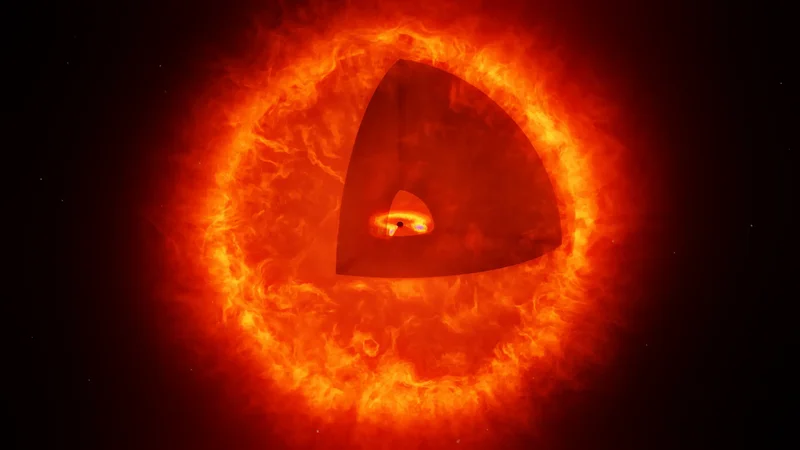
The object is mind‑boggling: a black hole that is about 100,000 times more massive than the sun, sitting at the center of an enormous ball of gas. Through Webb's eye, it looks like a star the size of our entire solar system.
To put it bluntly: "It's huge," said Naidu, whose team's findings were published in the journal Nature.
Since Webb opened for business in 2022, the observatory has spotted hundreds of "little red dots" like MoM-BH*-1 scattered through its deepest images. They've been labeled "little" because they show up as tiny sources of light too compact to tease apart into clear galaxies. They're "red" because they shine much more strongly in Webb's red‑sensitive views, a sign that we're seeing extremely distant objects whose light has stretched on its long journey across the universe.
The puzzle is that many of these dots look even redder and more dense than expected, suggesting something in or around them is changing their appearance in an extreme way. The debate has divided astronomers: Are they freakishly fast‑growing galaxies, or something stranger?
Early on, many teams thought the intense color of the dots was due to dust. In most space images, dust makes things look redder by blocking blue light. If little red dots were just young galaxies buried in dust, that could explain their color and brightness — though it still wouldn't jibe well with how fast galaxies are known to grow.
Others argued that a black hole powered the dots. In that scenario, hot material falling into a black hole releases energy, but a surrounding orb of gas and dust mangles the light before it can escape, turning the system into a concentrated, reddish beacon. This is where the term "black hole star" comes in: It's not an actual star, per se, but a stage where a black hole sits at the center of a star‑size ball of gas, feeding rapidly on material.
Earlier Webb studies, including detailed work on an object called GLIMPSE‑17775 and another known as The Cliff, made the black hole idea look increasingly plausible. They revealed dense gas, odd colors, and signs a hidden black hole was doing much of the work. But those studies still couldn't fully rule out more conservative explanations, where stars, dust, and a black hole all share the credit.
They also featured objects that weren't nearly as ancient, existing around "cosmic noon" time versus MoM-BH*1's "cosmic dawn."
When scientists split MoM‑BH*‑1's light into a spectrum — a measurement of brightness at each wavelength — they found a dramatic drop between redder and bluer light. In ordinary galaxies, that feature can come from the surfaces of certain types of stars. Here, though, the drop was more than twice as strong as any realistic combination of stars could produce.
Light from the material falling in toward the black hole tries to escape, but gets processed over and over again within the gas shell, which reshapes the spectrum and pushes energy toward redder wavelengths.
"We started to ask: Could you make something that red using just hydrogen, without any dust?" said Robert Simcoe, an MIT co-author, in a statement. "To our surprise, it turns out you can."
If dense gas — not dust — is doing most of the work in objects like MoM-BH*‑1, then some of those black holes could weigh much less than earlier estimates, simply growing at extraordinary rates while wrapped in gas. That would ease a major tension in cosmology, where some suspected early black holes seemed way too massive for how little time had passed since the Big Bang.
The black hole star also seems to live in a tiny, dim galaxy, parked next to a much bigger one. In this arrangement, strong radiation from the larger galaxy could disrupt normal star‑forming processes in the smaller one.
That could eventually leave behind a huge cloud of gas that collapses more directly into a heavyweight black hole, the authors say, a shortcut some scientists think helped build the first supermassive black holes in the universe.
"We argue that Black Hole Stars may be powering all of JWST's Little Red Dots that are found almost everywhere in the early Universe," Naidu told Mashable in an email. "Which is to say, this channel of making massive black holes must be very common, to the point where every massive black hole (like the Milky Way's) may have gone through this phase."