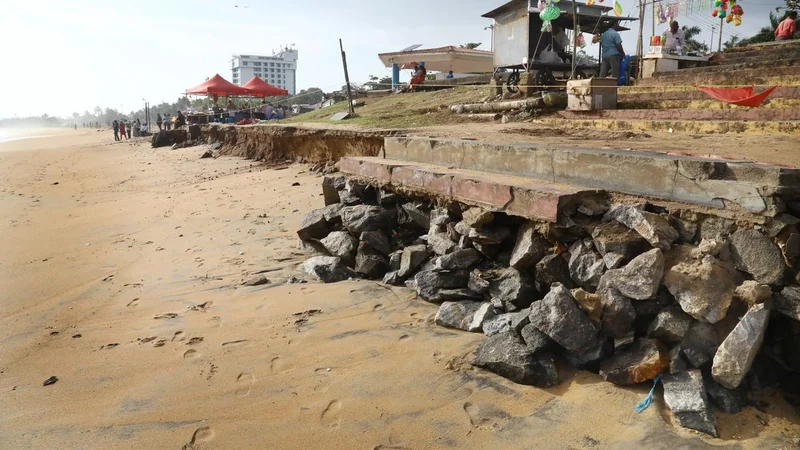
Severe coastal erosion driven by heavy monsoons, tidal surges, and intense sea roughness—locally known as Kallakkadal phenomenon—is rapidly swallowing large stretches of the Kollam beach.
In the most critical sections near Mahatma Gandhi Park and the stretch leading towards the port, a sandy shoreline that once extended up to 110 m towards the sea has shrunk drastically. The advancing waves have pulled public amenities, pedestrian walkways, parking zone stone steps, and coastal land directly into the ocean, leaving the popular destination battered and visibly diminished.
Beyond the destruction of tourism infrastructure, the relentless sea surge poses an immediate threat to residential structures in adjacent fishing villages. Local livelihoods are under severe strain as the vanishing shoreline disrupts beachside vending, drives down tourist footfall, and prevents fishermen from safely launching or landing traditional boats.
Despite the escalating crisis, a multi-crore coastal protection initiative designed to halt the erosion remains caught in administrative limbo. Initiated four years ago by the Kerala Coastal Development Corporation, the project relies on offshore geo-tube technology to break wave energy underwater and promote natural sand accumulation. Although a Detailed Project Report based on an extensive technical study by IIT Madras was submitted to the State government several months ago, official administrative sanction is yet to be granted.
The scientific mechanism involves anchoring specialised synthetic geo-textile tubes underwater, positioned roughly 250-400 m off the shoreline, and filling them with sand dredged directly from the seabed. By reducing the force of incoming waves far offshore, this submerged barrier reduces wave velocity and allows floating sediment to settle along the coast. Experts estimate that the system could help reclaim nearly a kilometre of lost beachfront over time, though complete sand deposition and natural shoreline stabilisation would take up to four years following installation.
The administrative delay has also stalled broader ambitions for the region. While authorities had previously announced a major redevelopment plan to transform the beach, long considered one of the State’s most dangerous shorelines, execution of the tourism upgrade remains strictly on hold. Officials maintain that no permanent infrastructure can be built on the shore until the geo-tube project successfully secures the coast against ongoing sea surges.
Published - August 12, 2026 09:10 pm IST