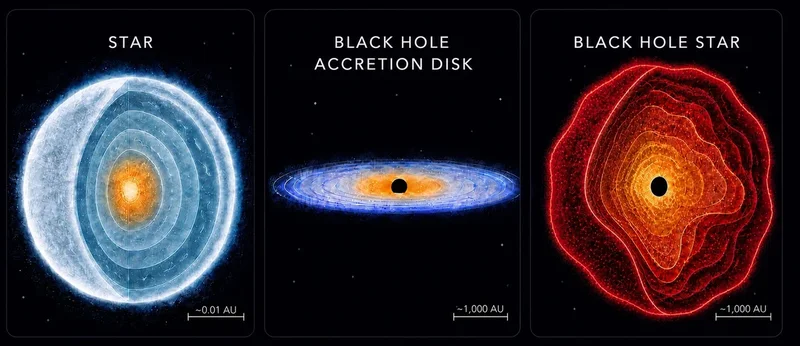
For four years, little red dots (LRDs) have been the hottest topic in astrophysics. Astronomers first noticed them in observations that NASA’s James Webb Space Telescope (JWST) made in 2022. The LRDs weren’t exactly subtle—each is at least 100,000 times larger than our sun. And they exist in almost every swath of sky that JWST has surveyed as it peers at the universe’s first 1.5 billion years or so. Since their discovery, theorists have raced to explain what LRDs really are, how they came to be so ubiquitous and why they’re mostly absent from the modern-day universe.
That debate is far from over—but many researchers are increasingly convinced that LRDs merit a different name entirely: black hole stars.
According to this theory, LRDs are actually black holes enshrouded in and feeding on cocoons of hot, ionized gas—radiating much like stars as they grow. The crimson color stems from that outgoing light being reddened by the overlying layers of gas, much as sunlight scattering through Earth’s atmosphere can tint a sunset red.
On supporting science journalism
If you're enjoying this article, consider supporting our award-winning journalism by subscribing. By purchasing a subscription you are helping to ensure the future of impactful stories about the discoveries and ideas shaping our world today.
The prevalence of LRDs in the early universe would align with the emergence of supermassive black holes, each weighing millions to billions of suns apiece, which astronomers spy at the hearts of large galaxies. According to the hypothesis, a black hole star would be embedded in a growing galaxy, too, but its light could easily outshine and obscure the surrounding stars. As the black holes eat their way out of the gassy cocoons, becoming almost invisible as their feedstocks dissipate, they would naturally fade.
One of this model’s best exemplars is an object known as MoM-BH-1, first found in JWST images from 2023 and the subject of a paper published today in Nature*.
Observed a mere 660 million years after the big bang, MoM-BH*-1 is among the earliest of these objects known. A careful analysis of its spectrum shows a very strong “Balmer break”—this is a telltale sign of dense, turbulent clouds of hydrogen absorbing higher-energy radiation, and it’s a smoking gun of sorts for a growing black hole cocooned in gas.
Rohan Naidu, an astrophysicist at the University of Hawaii and the study’s lead author, says the result is, in some respects, “old news” because it first appeared in an online preprint more than a year ago. But in the intervening time, “everyone has now had longer to grapple with this picture,” further fleshing out the black hole star model and its implications, he says. “We’re getting really close to figuring out how these black hole stars form!”
In an accompanying commentary also published in Nature, two astronomers who were not involved with the paper—Dominik Schleicher and Rodrigo Herrera-Camus—note with considerable understatement that “this discovery provides an important clue about the nature of LRDs.”
Naidu suspects that black hole stars may arise from mergers of bizarre-but-plausible “supermassive stars” in the early universe, each weighing tens of thousands of suns, which themselves formed from smaller stars mashing together in quick succession in stellar swarms called globular clusters.
“We think this happens within globular clusters whose properties have puzzled us for decades,” Naidu says. If validated by further studies with JWST and other observatories such as next-generation radio telescope arrays, this “origin story” for black hole stars could help explain the lingering mysteries of weird globular clusters as well as the beginnings of the universe’s biggest black holes.