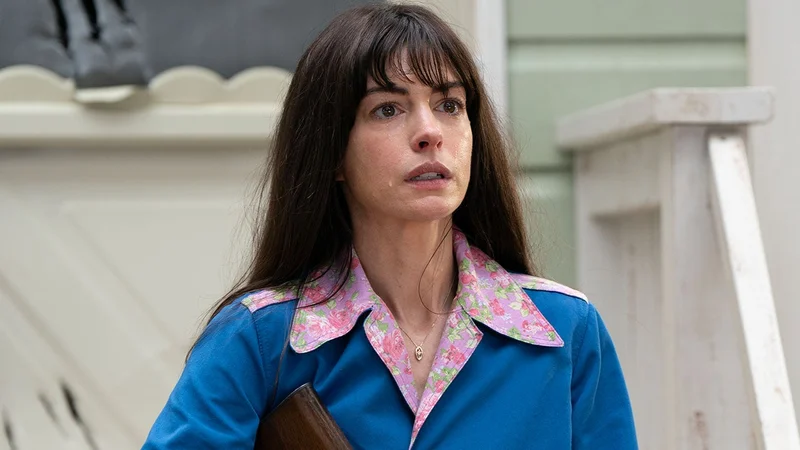
The End of Oak Street will be released in theaters on August 14.
The End of Oak Street follows a family, led by Anne Hathaway and Ewan McGregor, as their neighborhood mysteriously teleports from an early ‘80s suburban landscape into the swampy age of dinosaurs, leaving them to fight for survival against a crew of beasts that look a little more like what passes for “scientifically accurate” these days. (They’ve got feathers and fur and everything.) It’s really a blank canvas of a science-fiction conceit. As specific as it may sound, “family must survive dinosaurs” can go a million different ways. It’s an engaging premise no matter which direction the filmmakers choose, but it’s also one that’s pretty familiar. The dangers lurking in the swamp of a family-forward dinosaur adventure are the impossible to avoid comparisons to Jurassic Park. That’s the bar The End of Oak Street, intentionally or not, fair or otherwise, has set for itself.
So, how does a dinosaur movie set itself apart from such obvious influences? The answer for The End of Oak Street seems to be, don’t. Instead, lean into them.
First, I have to say this movie might have been created in a lab just for me. I’m an ’80s kid, so the setting hits all the right heartstrings. I’m always here for a good, warmhearted adventure yarn, an energy the trailer for this film has piles of. On top of that, I love indie movies, and David Robert Mitchell, whose It Follows is a creepy experiment in creating eeriness, is making his first film in eight years and bringing dinosaurs along for as Spielbergian a ride as any you’ve seen in recent memory. These are all good things.
The End of Oak Street mostly delivers on all the expectations I had for this movie. By the time the dinosaurs show up, the movie turns into a fun little creature feature pretty quickly. The dinosaurs don’t look quite the way we’re used to seeing them on screen, which effectively modernizes them in a way Jurassic Park never really has. They can be scary and campy in equal measure. There’s a sequence that includes a memorably goofy photo op followed immediately by a harrowing escape. It’s a combination that works when the movie is in its stride.
But I say Oak Street mostly delivers because the film is walking a fine line where loving and effective homage is on the right and “I’ve just seen this before” is on the left. It’s those influences and those sleeves David Robert Mitchell is wearing them on. He clearly loves adventure films of the ‘80s, you can even hear it in the score from the production logos on. This film would have been right at home 40 years ago. But the audience isn’t mysteriously teleported to 40 years ago, and there are moments in the film that left me trying to outrun some outdated cheese.
For example, the film can be incredibly sweet and earnest. There’s an honest love for the setting, the ’80s in suburbia, that’s evident in every frame of the film’s first act. But that sweetness borders on saccharine at times, feeling like an affectation that’s not totally earned. In parts, it's a script that’s being read to me, admittedly with a lot of heart, but there’s a stiffness to it nonetheless.
Among all of that sticky sweetness, though, there are genuinely terrific moments, including one that I even found legitimately shocking. I would, were I a cooler person, describe my state in the aftermath of that scene as “shook.” But the key to all of the moments that worked is a decision David Robert Mitchell clearly made early in the development of The End of Oak Street – that no matter how many feathered dinosaurs appear on screen, this movie is about the family.
Putting a family dynamic front and center is a staple of all the Spielberg sci-fi Oak Street is borrowing from. Whether it’s the harsh light and wind blowing through the curtains calling up Close Encounters of the Third Kind or all the dinosaurs (and their poop) giving Jurassic Park in sometimes very literal, one-to-one ways, family dynamics are always the more important thing happening on screen. And so, while this is a movie about a wormhole blipping an entire neighborhood into dino-times, it’s really always about navigating difficult times in a marriage. And not only from the couple’s perspective, but the children’s as well.
That a wonky science-fiction trope leading to what could easily have been a spec script for Jurassic Park 8 that was rejected for being too weird is turned into a capable metaphor for a crumbling marriage is no small task. While the writer/director deserves the prehistoric flowers for pulling that off, I do think the bulk of the credit goes to Anne Hathaway. She’s having a pretty great year, and The End of Oak Street is coasting right along on that streak. As the mother of the pack, she’s strong and fiercely protective, but also frayed at the edges in all the right ways. She’s barely holding it together as the brutally realistic yin to Ewan McGregor’s relentlessly positive “it’s just all gonna be alright” yang. She’s grounded in a way that’s crucial to pulling off the metaphor-asaurus that David Robert Mitchell is aiming for.
Another thing that can’t be overlooked is the runtime. It’s about 90 minutes, and while this may be an unfair claim to make, I bet there’s a 105-minute version of this movie that just doesn’t work as well. An obvious thing that’s missing from that runtime is an explanation. And that is great. How the neighborhood actually transports somewhere else remains a mystery that the film never even thinks about unravelling. There’s some vague talk with some science-y words, and a touch of exposition from a radio broadcast heard from off-camera, but to incorporate more of an expertise or a character that could offer a definitive scientific explanation for the mysterious events, would’ve been a film-destroying mistake. Keeping the film to 90 minutes avoids that urge to explain stuff that does not need explaining, or over-complicating what is a straightforward survival tale to the detriment of what the movie is really about, which again, is about Anne Hathaway weathering a rough patch in what to everybody else appears to be the picture of happiness.
The other thing I really like about this movie is the visual set-up and payoff. One way David Robert Mitchell pulls this off is something my film nerd side is excited to talk about, which is the use of a split diopter lens. To get technical for a moment, a split diopter is an arrangement of glass on the lens that allows for two focal lengths in the same shot so that subjects in the very near foreground can be in focus while the background is in focus as well. But it’s not like everything is just in focus, there’s also a visible line in the frame separating the two subjects, so the audience’s attention is drawn to both in a much more distinct way.
Anyway, I love seeing split diopters because you don’t accidentally use them. They’re representative of a clear choice being made. Sometimes there’s just information on screen because we need to get from one scene to the next, but when you can tell a bag of tricks is being opened, I generally appreciate the effort. So where does a split diopter relate to the visual set-ups and payoffs in this movie? To me it seems the moments where the focus is split are when a character is hiding something. There are some uncomfortably framed split focus shots seen in the trailers, which take place during a tense and important moment for the family. They happen in a few other places as well, in spots where what’s being discussed in the foreground isn’t quite jiving with what’s happening in the background. Pay attention to which moments are framed at a distance as well. Instead of just a standard two-shot, there are conversations we see through a window, or over a hedge, or in the reflection of a mirror. This is a movie that’s undeniably thoughtful in its visuals.
There’s also some great, eerie blocking at play that sets up the world our characters start in to juxtapose the world they find themselves in later. This is something that David Robert Mitchell did really well in It Follows, and he excels at it again here in The End of Oak Street. The movie’s opening act is admittedly a little slow; in spite of the brisk 90-minute runtime, there’s a methodical pace to the stretch of film leading up to the first dinosaurs on screen. But what’s happening in those lingering shots of a treeline, the edits that feel a beat too slow after a character leaves frame… they’re all set-ups. Later in the film, those treelines that the film took great pains to establish as a safe part of ’80s suburbia are no longer empty, but instead are hiding something dangerous. Those edits that take an extra beat after the kids exit the shot suddenly feel like maybe we’re waiting to see something else show up.
The high watermark for this technique is in a oner in the middle of the movie. The family is running away from a T-Rex (a chunk of this shot is seen in the trailer) and it starts with near misses and ends with, as Dr. Malcolm said in The Lost World, running and screaming. The shot is a great little microcosm for what works about this movie. It’s also admittedly a little hokey, making it a microcosm of the things that don’t work about this movie as well.
But ultimately, the movie is like an old friend. There aren’t a lot of surprises, but you still enjoy their company. Maybe you haven’t seen each other in eight years or so, but there doesn’t need to be any explanation when you get back together. You know their secrets, warts and all, so maybe they don’t impress you like they used to but damn if it isn’t nice to see them again anyway. In spite of being a little under the influence of nostalgic sci-fi adventures, David Robert Mitchell and Anne Hathaway in particular add enough plumage to the familiar so that The End of Oak Street… finds a way.