Key Facts
- Vale stayed the key Brazilian proxy and the world’s second-largest iron ore exporter, with 2026 guidance of roughly 335-345 million metric tonnes after about 335 million tonnes last year.
- China demand is still the swing factor with January-April 2026 crude steel output at 331 million tonnes, down 4.1% year on year, while broader 2026 steel demand is expected to grow only 0.3% to about 1.72 billion tonnes.
- Vale’s realised iron ore price remains firm with its average realised price for iron-ore fines reported at about $95 per tonne and up 11.6% year on year.
- The latest settled session was stronger across the board with Iron ore (Vale) at 14.85 $ (+4.21% d/d) [2026-07-22], CSN Mineracao at 1.09 $ (+9.00% d/d) [2026-07-22], and Rio Tinto at 92.28 $ (+1.91% d/d) [2026-07-22].
- Benchmark prices were still near the $100 line with Singapore Exchange contracts ending at $99.00 a ton on Monday and Reuters saying the contract had been as low as $97.63 on July 1 before rebounding to $111.91 on May 11.
- The tone is range-bound, not explosive because supply from Australia and Brazil is ample, demand in China is only modestly soft, and market reports describe a sideways market rather than a decisive trend.
Today’s Focus
Iron ore finished the latest settled session firmer, and the listed miners that most closely proxy the commodity all rose with it. For foreign readers, that matters because Vale, CSN Mineração and Rio Tinto are often the quickest public read on where the ore price is heading when the spot feed is absent.
The underlying message is not a boom, but a market holding near a psychologically important level. Reuters said Singapore Exchange iron ore ended at $99.00 a ton on Monday, while other market coverage described ample supply from Australia and Brazil and a demand outlook that is still soft rather than collapsing.
Brazil’s Vale remains the anchor name for Latin American readers because it is the region’s giant exporter and a direct lever on ore sentiment. Its own realised price data and 2026 output guidance point to a business still benefiting from healthy pricing, even if the broader market is not breaking out.
China remains the main variable. Recent figures show weaker steel production growth, but also only mild declines in downstream demand, which is why the market looks cautious rather than panicked.
What matters today. The key variable to watch is whether China’s steel demand stabilises enough to keep iron ore above the $100 line.
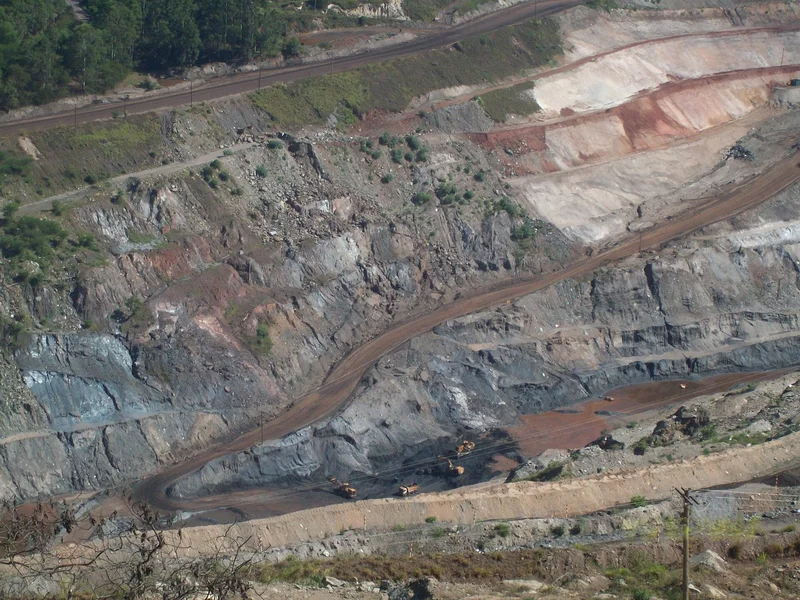
Iron Ore — the daily wrap. (Photo internet reproduction)
01 The session in one read
Iron ore ended the latest settled session higher through its listed proxies, with Vale, CSN Mineração and Rio Tinto all advancing on the day. That is a simple but important sign that the commodity tone improved, even though the market is still trading close to the $100-a-tonne area.
The move fits a broader picture of an ore market that is not booming, but is holding together better than the bearish headlines might suggest. Reuters said Singapore Exchange iron ore ended at $99.00 a ton on Monday, and other coverage described China steel losses, ample seaborne supply and a demand outlook that is soft but not broken.
Assessment — Firm session, soft backdrop HIGH
The latest move is best read as a relief bounce inside a market that is still range-bound. The miners rose, but the broader evidence still points to a commodity supported by supply discipline, a firm realised price at Vale, and only modest Chinese demand growth rather than a sharp upturn. That makes the session constructive for the names on the board, but not yet a signal of a new trend. The next leg will depend on whether Chinese steel margins and production improve enough to pull ore demand decisively higher, or whether the market slips back toward the high-90s again; variable to watch: China steel demand.
02 The board
The live board for the latest settled session shows a firmer close across all three proxies. Iron ore (Vale) was 14.85 $ (+4.21% d/d) [2026-07-22], CSN Mineracao was 1.09 $ (+9.00% d/d) [2026-07-22], and Rio Tinto was 92.28 $ (+1.91% d/d) [2026-07-22].
For readers outside the region, these shares are useful shortcuts for the ore market because they tend to move with the commodity itself. Vale is the Brazilian giant, CSN Mineração is a smaller local producer, and Rio Tinto is a global heavyweight, so a broad rise in all three usually signals a better day for iron ore sentiment.
| Asset | Level | Change |
| --- | --- | --- |
| Iron ore (Vale) | 14.85 $ | +4.21% |
| CSN Mineracao | 1.09 $ | +9.00% |
| Rio Tinto | 92.28 $ | +1.91% |
Source: EODHD close, 2026-07-22. Where a commodity has no spot feed, an exchange-traded tracker or leading producer is shown as a labelled proxy.
Live Market IntelligenceThe live market boardInside: market breadth, the sector heatmap, currencies \& rates, the Latin America scoreboard and the full instrument board.
Rio Times · Live Market Intelligence
Latin America — Cross-Market Board
Regional
Jul 23, 2026 · 01:43
Ibovespa · benchmark
177,547.57
+2.44%
+32.46% over 12 months
Market breadth · 4 names
75% advancing
3 ▲ advancing1 declining ▼
Currencies, rates \& key inputs
Latin America scoreboard
IndexLastTodayStrength
IbovespaBrazil
177,547.57
+2.44%
S\&P/BMV IPCMexico
67,298.78
+0.88%
S\&P IPSAChile
11,009.22
+0.50%
S\&P MERVALArgentina
3,379,771
+2.98%
MSCI COLCAPColombia
2,297.00
-0.19%
BVL S\&P PerúPeru
57,575.02
—
Full instrument board
| Instrument | Last | Change | YoY | Prev. | High | Low | Volume |
| --- | --- | --- | --- | --- | --- | --- | --- |
| IBOV | 177,547.57 | +2.44% | +32.46% | 173,325.65 | — | — | — |
| IPSA | 11,009.22 | +0.50% | — | 10,954.04 | 11,019 | 10,913 | 1,513,213,483 |
| IPC MEX | 67,298.78 | +0.88% | +21.23% | 66,709.60 | — | — | — |
| MERVAL | 3,379,771 | +2.98% | +68.11% | 3,281,979 | — | — | — |
| COLCAP | 2,297.00 | -0.19% | — | 9.04 | 9.05 | 9.02 | 4,133 |
| BVL PERÚ | 57,575.02 | — | — | — | — | — | — |
| USD/BRL | 5.05 | -0.01% | -9.16% | 5.05 | 5.06 | 5.05 | — |
| EUR/BRL | 5.78 | -0.36% | -11.45% | 5.80 | 5.78 | 5.77 | — |
| USD/MXN | 17.37 | -0.11% | -6.81% | 17.39 | 17.41 | 17.37 | — |
| USD/CLP | 937.27 | +0.17% | -1.36% | 935.70 | 938.15 | 937.15 | — |
| USD/COP | 3,205 | -0.70% | -21.27% | 3,227 | 3,205 | 3,200 | — |
| USD/PEN | 3.39 | -0.31% | -4.72% | 3.40 | 3.40 | 3.39 | — |
| USD/ARS | 1,482 | -0.03% | +18.06% | 1,483 | 1,482 | 1,482 | — |
| USD/UYU | 40.14 | +1.16% | +0.69% | 39.68 | 40.14 | 40.14 | — |
| USD/PYG | 6,035 | +1.38% | -19.46% | 5,954 | 6,035 | 6,035 | — |
| USD/BOB | 10.95 | +2.82% | +62.48% | 10.65 | 10.95 | 10.95 | — |
| USD/DOP | 57.99 | -0.02% | -3.43% | 58.00 | 58.34 | 57.99 | — |
| USD/CRC | 447.42 | +1.36% | -9.14% | 441.41 | 447.42 | 447.42 | — |
Largest moves today
MERVAL
3,379,771
+2.98%
USD/BOB
10.95
+2.82%
IBOV
177,547.57
+2.44%
USD/PYG
6,035
+1.38%
USD/CRC
447.42
+1.36%
USD/UYU
40.14
+1.16%
IPC MEX
67,298.78
+0.88%
USD/COP
3,205
-0.70%
The session read
The Ibovespa rose 2.44%, with breadth positive — 3 of 4 names higher. MERVAL led, while COLCAP lagged.
Live Company IntelligenceVale SA ADR — the full investor dossierInside: live share price, market cap, three-year financials, valuation, ESG and peer benchmarks — plus the latest Rio Times coverage.
V
◆ Live Company Intelligence
Vale
NYSE: VALEVALE3Basic MaterialsOther Industrial Metals \& Mining65,805 employees
$60.64B
Market cap
Analyst target $17.14
Wall Street view
3.9Moderate Buy/ 5
14 Buy12 Hold0 Sell
Avg. price target $17.14 · +17% vs 200-day
Valuation \& profitability
Market cap$60.64B
Revenue (TTM)$214.86B
P / E ratio21.3
Profit margin7.3%
Return on equity6.8%
Price \& risk
52-wk low
$8.6052-wk high
$17.94
Beta (volatility)0.73
200-day average$14.66
Revenue trend · 6y
20202025
Latest $38.23B
Ownership
Institutions21.5%
Shares outstanding4.26B
Top holderCapital World Investors
Institutional holders5+ funds
Dividend
Yield38.8%
Payout ratio1.5%
Fwd. annual$1.26
What Vale does. Vale S.A., together with its subsidiaries, produces iron ore and nickel in Brazil, Asia, the Middle East, North Africa, Europe, the Americas, and Oceania. The company operates in two segments, Iron Ore Solutions and Vale Base Metals. It extracts, produces, and distributes iron ore, iron ore pellets, briquettes, nickel, copper, other ferrous…
03 What moved it
The main support came from a steadier futures tone rather than a single dramatic catalyst. Reuters reported that Singapore Exchange iron ore ended at $99.00 a ton on Monday, and Bloomberg said iron ore had fallen earlier in the week as weakening margins at Chinese steel mills clouded demand, which suggests the market is still reacting to small shifts in China rather than to a clear new shock.
Supply remains part of the story too. Reuters said prices were being weakened by ample supply from top producers Australia and Brazil, while Vale’s own output report and guidance point to a company still producing at scale, with 2026 guidance of roughly 335-345 million metric tonnes after about 335 million tonnes last year.
04 The Latin American read
For Latin America, Vale remains the name that matters most because it is Brazil’s ore champion and the world’s second-largest exporter. That makes its share price and production guidance a practical proxy for how global buyers are reading Brazilian supply.
CSN Mineração is smaller, but it is useful because it often amplifies the same ore-price signal in a more volatile way. Its stronger percentage move in the latest session suggests investors were willing to take on more risk in Brazilian miners once the ore backdrop turned firmer.
05 The names to watch
Vale is the central name because it combines scale, export power and direct pricing exposure. Mining Weekly said the average realised price for iron-ore fines rose 11.6% year on year to $95 a ton, which shows Vale is still selling into a reasonably healthy price environment.
Rio Tinto matters because it is one of the most important global comparables for Vale. When Rio and Vale rise together, it usually means the market is responding to the commodity itself rather than to a single company story, which is exactly what happened in the latest settled session.
06 The outlook
The outlook is for a market that stays sensitive to China’s steel cycle rather than one that is heading cleanly in one direction. World Steel Association figures cited in the market coverage point to 2026 steel demand growth of only 0.3% to about 1.72 billion tonnes, which is enough to keep traders cautious even when the board turns green.
07 What to watch
- China steel demand: If output and downstream orders stabilise, iron ore can hold above the $100 line more easily.
- Vale realised pricing: Vale’s realised price shows whether the miner is still capturing strong value even if spot ore is choppy.
- Seaborne supply: Ample exports from Australia and Brazil can quickly cap rallies and pull prices back toward the high-90s.
- Proxy share prices: Vale, CSN Mineração and Rio Tinto will stay the quickest read on whether sentiment is strengthening or fading.
Frequently Asked Questions
Why do Vale and Rio Tinto matter for iron ore?
They are liquid listed proxies for the ore market, so their shares often reflect how traders are pricing the commodity even when the spot feed is not available.
Is China demand collapsing?
No. The figures cited in the market coverage show softer Chinese steel output and flat to slightly weaker downstream demand, but not a collapse.
What is the key price level?
The market remains focused on the $100-a-tonne area, with Reuters citing Singapore Exchange iron ore at $99.00 a ton on Monday.
Why did Brazilian miners rise more sharply?
Because a firmer ore session tends to lift Brazilian miners, and Vale and CSN Mineração often move more sharply than diversified global peers when sentiment improves.
LatAm Markets: Live Signals → — real-time movers, turnover leaders and FX across Latin America.
Read More from The Rio Times