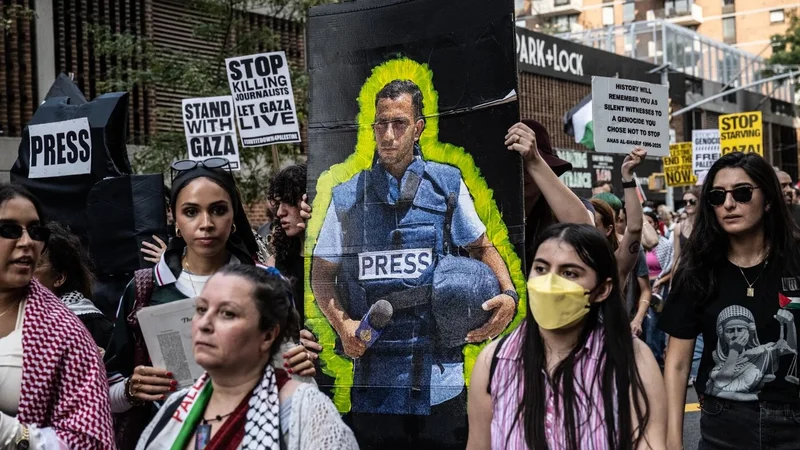
New oral history project eulogises slain Palestinian journalists via friends' voice notes
When Anas al-Sharif was killed in Gaza by an Israeli air strike one year ago, the Reuters news agency ran the headline, "Israel kills Al Jazeera journalist it says was Hamas leader".
In 2024, at the height of Israel's genocide in Gaza, Anas had helped Reuters win a Pulitzer Prize for breaking news photography.
But the outlet chose to remember the 28-year-old within the scope of Israel's unproven narrative about him - as many other news organisations have done to more than 200 Palestinian journalists killed in Gaza since 2023.
As of Wednesday, a new project called The Living Record is looking to rectify that by telling the stories of slain Palestinian journalists through the eyes and experiences of their colleagues on the ground.
The oral history site launched with eulogies for 50 journalists, with dozens more to come later in the year.
"This project is seriously - and at a mammoth scale - a record of failure," a member of the New York War Crimes editorial collective, which was initiated by the group Writers Against The War On Gaza (Wawog), told Middle East Eye on the condition that they not be named.
"[This is] a record of failure of mainstream media, of western media, of international institutions to protect individuals [as governed] by international law."
Wawog is behind The Living Record.
"What this project does is it asks you to listen to these people speaking to you as if they were your friend, and so that was one of the really big prompts of the project itself," MEE was told.
"Often when we spoke to these [Palestinian] journalists, there's a tendency for them to speak in a very formal register because they're accustomed to that being the only way that people would be willing to listen, whether on a live broadcast or in a formal interview where they're anticipating a critique or a challenge - that they must present themselves as sort of indefatigable, impossible to move."
"We didn't want that."
The result is profound.
The voice notes on the site range from journalists who sound broken but steadfast as they recount the relatable, daily habits of their colleagues, to others who speak directly to their slain friends, as if we, the audience, are listening in on a private conversation.
Who is a journalist?
Many have resigned themselves to becoming "martyrs" at any moment.
That's because, according to the Palestinian Journalists Syndicate, at least 270 Palestinian media workers have been killed by Israel in Gaza.
The Committee to Protect Journalists, however, has a significantly lower count.
The mainstream media within the US and Canada have largely defaulted to CPJ for the figures, especially as most choose not to source local organisations or the Palestinian health ministry.
In June, CPJ came under fire when it announced it was "conducting a full review of its database of journalists killed during the Israel-Gaza War after militant groups Hamas and Palestinian Islamic Jihad published obituaries identifying as combatants individuals previously listed by CPJ as journalists".
As a result, 20 Palestinian journalists were removed from CPJ's count, which now stands at 209 dead. The full review will be completed in the weeks to come, the group said.
'This project is seriously - and at a mammoth scale - a record of failure'
- Member of Writers Against The War On Gaza
In its emailed statement to MEE at the time, CPJ said it "has not changed its longstanding methodology, which applies to all conflict zones around the world", nor has it "changed the way it classifies journalists".
But journalism itself is a "porous" industry, the Wawog member told MEE, especially in the so-called creator economy where thousands of journalists globally are leaving legacy outlets to go independent.
"What you find with this project is that these are what we would call maybe 'traditional journalists', but we ask them to define themselves. In that sense, there is really no figure that we're trying to reach, but the archive is ongoing, and the expansion will go beyond just Gaza, and likely into south Lebanon."
Wawog, a group made up of writers and creatives, emerged in the weeks following Israel's bombardment of Gaza after the Hamas-led attacks on southern Israel on 7 October 2023.
The group has routinely held protests outside, and at times in the lobby of, the New York Times building in the borough of Manhattan.
Wawog calls out what it sees as the hypocrisies of the New York Times in its own publication called "The New York War Crimes".
Media analysts and human rights groups have repeatedly accused mainstream media of contributing to both the erasure and distortion of Israeli war crimes in Gaza.
Several observers have argued that the reporting on what the United Nations and holocaust scholars have called a genocide, as well as the student movement for Palestine in the US, has not merely been inaccurate but has ventured close to journalistic malpractice.
Anas al-Sharif
Israeli forces assassinated two of Gaza's leading journalists and their colleagues late on Sunday, 10 August 2025, just hours after Israeli Prime Minister Benjamin Netanyahu rejected international condemnation over his plan to occupy the Palestinian enclave.
The Al Jazeera Media Network said in a statement that its correspondents Anas and Mohammed Qreiqeh, along with three other colleagues, were deliberately killed when Israeli forces struck their tent outside al-Shifa hospital in Gaza City.
Qreiqeh contributed to several publications, including Middle East Eye, before he began working at Al Jazeera.
Anas, a father of two, had been stationed outside the hospital's main gate along with cameramen and photojournalists Ibrahim Zaher, Mohammed Noufal and Mosaab al-Sharif when their tent was attacked.
Shortly before his killing, Anas had posted a video on X showing what he called Israel's "intense" missile strikes on the eastern and southern parts of Gaza City. His final video captured the deafening booms of the attacks near where he was.
Later, the Israeli military claimed, without providing any evidence, that it killed Anas because he "served as the head of a terrorist cell in the Hamas terrorist organisation".
Since Israel launched its war on the enclave in October 2023, it has routinely accused Palestinian journalists in Gaza of being Hamas members, as part of what rights groups say is an effort to discredit their reporting of Israeli abuses.
Four months before he was killed, Anas prepared a message to be posted on his social media accounts in the event of his death.
"I have lived through pain in all its details, tasted suffering and loss many times, yet I never once hesitated to convey the truth as it is, without distortion or falsification - so that Allah may bear witness against those who stayed silent, those who accepted our killing, those who choked our breath, and whose hearts were unmoved by the scattered remains of our children and women," he wrote.
"I entrust you with Palestine - the jewel in the crown of the Muslim world, the heartbeat of every free person in this world," he added.
"I entrust you with its people, with its wronged and innocent children who never had the time to dream or live in safety and peace. Their pure bodies were crushed under thousands of tons of Israeli bombs and missiles, torn apart and scattered across the walls."
Sharif pleaded: "I urge you not to let chains silence you."