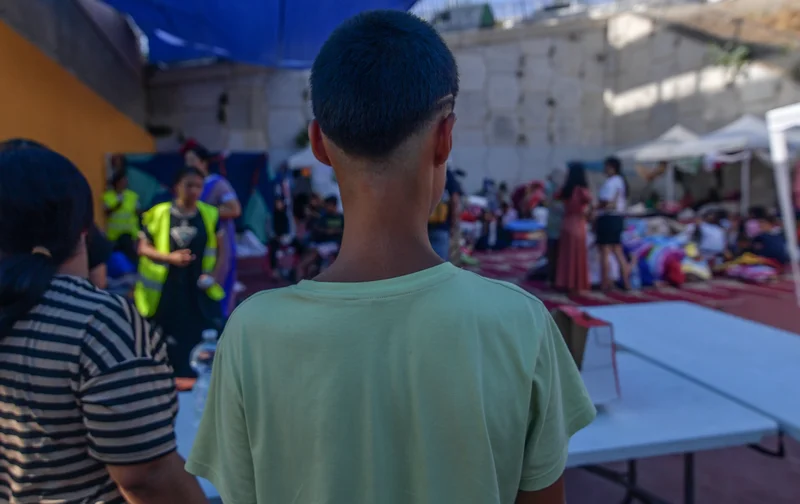
They share their dreams on an outdoor futsal court that’s been fenced off and turned into a makeshift camp by residents of the La Reina neighborhood in Ceuta. Some 350 women and children who arrived in the Spanish enclave city after swimming from Morocco 11 days ago sleep in the camp every night. They sit here waiting, on the ground, or, if they are lucky, on a rug.
They are waiting because, beyond these four fences and the two men guarding the entrance through the night, the world seems a safer place. Among them are children who dream of becoming footballers, studying technology or training as nurses. Children who have crossed the sea and who, without realizing it, have become the subject of a political debate before anyone has taken the time to listen to them.
EL PAÍS asked them to write letters so that politicians, especially those who say they do not want them in Spain, could learn about their aspirations. They do not write about borders or laws. They write about their dreams, because sometimes behind the word “migrant” there is a child who has not yet stopped imagining who they want to become.
Hello:
My name is Ismaíl. I want to stay in Spain to fulfill my dream of becoming a great footballer. If you let me stay in your country, you would help me a lot. With a bit of luck and a lot of hard work, one day I could become a talented player and represent Spain in the national team.
Ismaíl is 12 years old and completely alone in an unfamiliar country where he does not speak the language. Even so, he smiles often, proudly revealing the gaps where some of his teeth have yet to grow in. He arrived in Ceuta by swimming alongside his 20-year-old brother. He has not seen him since.
He sleeps on the ground. To wash, he goes to the vacant lot beside the camp and pours water over himself, fully clothed, using a pink beach bucket. Afterwards, the bucket passes from hand to hand among the women and children living there.
The little boy knows nothing about the controversy sparked by the arrival in Ceuta of hundreds of unaccompanied minors. He does not know that the Spanish Minister of Youth and Childhood, Sira Rego, has convened a meeting this Thursday to address the crisis in Ceuta. He also does not know that the far-right political party Vox is against receiving them. He knows nothing of the political arguments, the borders or the language others have chosen to use when discussing his future. But despite his young age, he is not surprised this is the case. He says he “knows very well that politicians in Spain do not want Moroccans to enter their country.”
Beside him sits 15-year-old Maryam. Her dark hair is tied back in a braid and she is still wearing the clothes she arrived in. With a ballpoint pen, she writes in Arabic in a notebook:
I wanted to come to Spain to work and help my family. I dream of finishing high school and becoming a nurse so I can help other people. Please regularize my status so we can build a better country together. We will show that we are worthy of your trust. We only want a better future.
She had been thinking about coming for three years. On July 30, at 4 a.m., she decided to try. She left Tetouan with a cousin and two friends. She was frightened because she is not a strong swimmer and knew that leaving her mother behind would not be easy. When she reached Spain, the first thing she did was log on to Instagram to talk to her mother. She had not warned her she was leaving and wanted to apologize. “She was very worried, but when I told her I was okay, she wished me all the success in the world because she understands that coming here had always been my dream,” says Maryam, smiling shyly when asked why she did not tell her mother about her plans.
Samia, 20, was a teacher in Morocco. Now, after arriving in Ceuta by swimming, she acts as a translator for Maryam. She explains that there are far-right parties that oppose relocating migrant minors to other regions in Spain. Maryam opens her eyes, surprised. “But why don’t they want to give us papers?” The question comes out plainly, without any understanding of political parties or political rhetoric. Samia laughs.
The hours drag on beneath the scorching heat. The ground burns when someone tries to sit down. In the vacant lot just outside the enclosure, two workers are attempting to install a portable toilet. It will be only the second for the more than 350 people taking refuge here.
The city council has just provided it after repeated appeals from the neighborhood association president, Abdellah Mustafa, who also spearheaded the idea of turning the soccer pitch into a safe haven for migrants.
Next to the toilets, a woman washes clothes beside a stroller while her baby crawls across the ground. When the mid-afternoon sun becomes unbearable, the child bursts into tears. Nearby, several girls sit exhausted on the curb, shaking out their clothes.
Despite everything, they are the lucky ones; at least they have a place to spend the night. More women continue to arrive asking whether there is any space left, but the enclosure is full. There is no room for anyone else. The volunteers guarding the site cannot take them in, and they will have to spend another night out in the open. Save the Children estimates that more than 1,000 minors in Ceuta are sleeping on the streets outside the official protection system.
Mohamed and his mother watch the scene unfold while playing clapping games to pass the time. The boy is eight years old, with large, dark-brown eyes. Whenever someone asks him a question, he falls silent for a few seconds, thinking carefully about his answer, mouth slightly open and cheeks flushed, before finally speaking.
Until they found shelter here, Mohamed and his mother were sleeping on the street, outside a house. He says he felt terrified every time he saw the soldiers deployed across Ceuta.
Like Ismaíl and Maryam, Mohamed also writes his dream on a piece of paper:
I want to be a police officer and work to help my mom. I want to get the documents I need because I deserve a chance to prove myself.
In the meantime, he waits. He cannot explain why, but he is convinced this limbo will last another two weeks. Until then, he will follow the same routine every day: have breakfast, find another child to play with, eat lunch and wait for another day to pass. “And then the same again,” he says