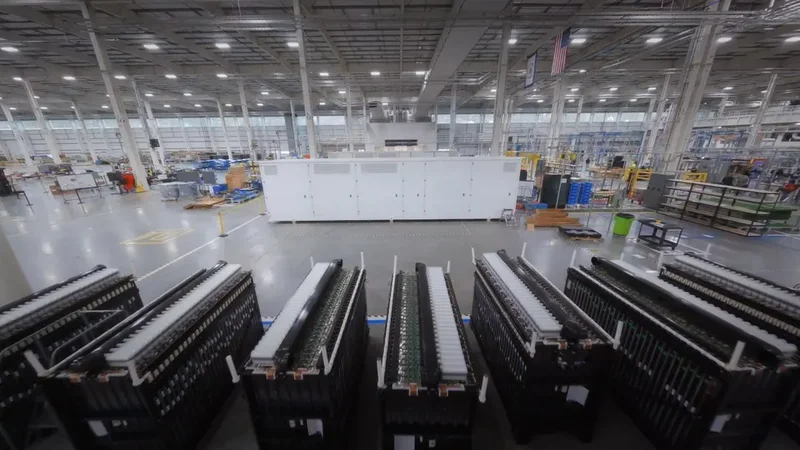
Form Energy, which makes iron-based batteries to hold electricity for days, said it raised $750 million to expand production. That follows a $550 million raise by rival Antora, which snagged the same amount to accelerate production of its thermal batteries made from carbon blocks that also hold power for at least 100 hours. Unsurprisingly, data center power demand underpins the investment spike.
Form, which began shipping its iron-air batteries this year built at its Weirton, West Virginia, plant, said the latest round, led by T. Rowe Price, boosts its total funding to $2 billion. The company didn’t immediately provide a valuation figure with the latest funds, though Pitchbook estimates the deal values the Somerville, Massachusetts-based company at $4.3 billion. Sunnyvale, California-based Antora has raised $1 billion so far and is seeking a second assembly facility beyond its current factory in Silicon Valley.
Both companies are focused on making batteries out of cheap, domestically available materials that can store power at much lower cost than shorter-term lithium-based battery chemistries, and that also have little to no risk of catching on fire. The technology is also ideal when paired with large-scale solar or wind farms, ensuring a steady supply of cheap, carbon-free energy.
“Solar is the cheapest form of energy in history, but the challenge has been that you can't use it to solve all of our problems because it's intermittent,” said Brook Porter, cofounder of G2 Ventures, which is backing Antora. “Long duration storage is really the unlock to connect this incredibly low-cost intermittent supply to meet the demand of all of these loads. It's been a holy grail for a very long time.”
Form’s goal is to deliver a battery that costs $20/kilowatt or less, a price that, when combined with solar, provides electricity at a lower cost than natural gas.
The company’s technology is essentially rust-based. The way the battery works is that a porous iron plate is submerged in a water-based electrolyte solution. It generates an electrochemical cycle that Form describes as “reversible” rusting. As it discharges electricity, the battery absorbs oxygen from the air and converts iron metal to rust. When charging, the electrical current flowing in converts the rust back to iron and the battery releases oxygen. But the iron itself is never consumed, making the batteries very durable.
Form, led and cofounded by ex-Tesla battery executive Mateo Jaramillo, says it has orders to build more than 80 gigawatts of batteries, enough energy to power 60 million homes. Its projects include data centers in Minnesota and Texas, with customers including Xcel Energy and Crusoe, and a grid project in Ireland with Future Energy Ireland. Jaramillo has said the closely held company may go public next year.
Antora’s battery technology is even simpler than Form’s. The company stacks dozens of blocks of industrial carbon, like those used in steel plants, into semi-truck trailer-sized metal containers containing nitrogen or another inert gas. Electricity flows in from a solar farm, for example, to power a heating coil that heats the carbon blocks to 2400 degrees Fahrenheit. The heat then flows out over days as steam to power a data center or industrial process.
Its first big project is a five-gigawatt-hour system installed near Big Stone City, South Dakota, at a biofuel plant operated by Poet. Its battery is connected to a wind farm to provide steam heat to convert corn into ethanol.
Antora declined to share its target cost for the system, but COO and cofounder Justin Briggs said it will be the cheapest form of long-term battery storage.
“Thermal energy storage has a really tremendous advantage in that you're taking some of the cheapest materials on earth, in our case, solid carbon blocks, and just getting them hot. It’s that system,” Briggs told Forbes. “We can't disclose exact costs because we're in commercial negotiation with a bunch of counterparties, but I can say that the technology was designed to be the cheapest, fastest, most scalable energy on the planet.”
Antora’s San Jose, California, factory that assembles its battery system is only about 100,000 square feet, a fraction of the size of Tesla’s 5.4 million-square-foot Nevada Gigafactory. But it’s already able to produce “double-digit gigawatts” of its carbon block packs, Briggs said.
“We started with an empty building and turned that into one of the larger battery gigafactories in this country in under a year,” he said.