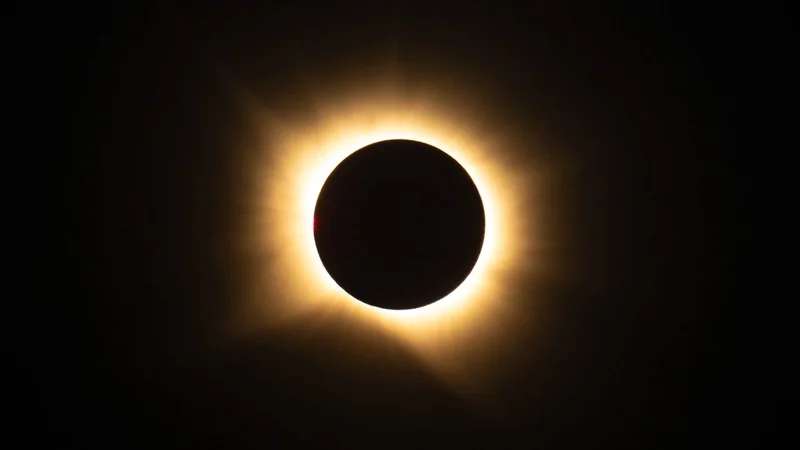
And just like that, it's over.
Total solar eclipses are incredible moments in time, but they are fleeting. As the moon passes directly in front of the sun and its shadow sweeps across Earth's surface, the temperature drops and the light takes on an eerie twilight quality. Birds and other animals go quiet. It's a spectacle unlike any other. And for millions today who were lucky enough to be in the path of totality across Greenland, Iceland and Spain, that's exactly what they experienced.
"I cannot believe what I just witnessed. I knew what to expect — I've seen thousands of photos but nothing compares to that feeling you get when you watch the sun transform before your very eyes," Space.com skywatching editor Daisy Dobrijevic said after watching the eclipse from the deck of the MS Spitsbergen on the HX Expeditions eclipse voyage in Scoresby Sund, Greenland on Aug. 12, 2026.
"It looked so big in the sky with the delicate corona streaming out into the abyss. Jupiter, Mercury and Venus even joined in the show. The huge prominence was the icing on the cake," Dobrijevic added.
"This is something I will never forget and I feel privileged to have experienced it in one of the most remarkable environments on Earth and alongside an incredible group of people aboard HX Expedition's MS Spitsbergen."
The 182 mile-wide (293-kilometer) path of totality — the line "drawn" on the face our our planet by the moon's shadow — began near Siberia over the Arctic Ocean and first arced down into eastern Greenland.
From there, the path stretched across western Iceland and then into northern Spain where millions gathered to witness the spectacle.
"It was the most incredible thing I've seen in my entire life," said Space.com skywatching writer Anthony Wood after witnessing the eclipse from Valoria la Buena, Spain alongside a team of citizen scientists from the Dynamic Eclipse Broadcast initiative. "It feels like it really shouldn't be happening. It strikes the lizard part of your brain that just tells you that this shouldn't be real."
The path then crossed the Balearic Islands just east of Spain before ending over the Mediterranean Sea as the sun set.
Eclipse-watchers inside the narrow path of the moon's shadow were given a rare naked-eye glimpse of the sun's outer atmosphere, known as the corona. Witnessing the crown-like shape of the corona stretching away from the dark shadow of the moon is one of the most breathtaking moments of an eclipse. Photographs don't do it justice, as they rarely do.
Outside of the path of totality, skywatchers throughout Europe and Scandinavia were able to catch a glimpse of a partial solar eclipse — in which the moon appears to take a "bite" out of the sun.
Space.com's Harry Bennett captured the partial eclipse from a hilltop in Somerset, England, shooting the scene with a Unistellar Equinox 2 smart telescope equipped with a solar filter.
The partial solar eclipse was also visible for much of the northeastern United States and as far west as Michigan. Much of Canada got to witness the partial eclipse too, and so did Alaska.
What causes a total solar eclipse?
A total solar eclipse happens when the moon passes directly in front of the sun as seen from Earth. When this alignment happens, the moon casts its shadow along a line known as the path of totality. Only within this stripe will you be able to experience full totality.
Another factor to consider is that the moon has an elliptical, or oval-shaped, orbit. This means that it's sometimes closer to Earth than other times. Total solar eclipses only occur when the moon is at just the right distance from Earth, making it appear the same size in the sky as the sun (or even slightly larger). This obscures the blinding light of the sun, allowing viewers to glimpse our star's outer atmosphere, or corona.
When the moon is a bit farther away from Earth, it appears relatively smaller. And when solar eclipses fall on a date when the moon is at this greater distance from our planet, the moon doesn't completely block the sun. This creates what's known as an annular solar eclipse, or a "ring of fire" in the sky.
When is the next total solar eclipse?
The next total solar eclipse will occur on Aug. 2, 2027 and will be visible throughout a 160-mile-wide (258-kilometer) path that crosses southern Spain, northern Morocco, northern Algeria, northern Tunisia, northeast Libya, central Egypt, the northeastern tip of Sudan, southwest Saudi Arabia, Yemen and the northeastern tip of Somalia.
Outside of this path, a partial solar eclipse will be visible to most of Europe, much of the African continent, the Middle East, Southeast Asia, eastern Canada and parts of Maine.
In North America, the next total solar eclipse will take place on March 30, 2033, and will be visible from Alaska. Looking farther out, the U.S. states of Montana, South Dakota, North Dakota, and areas of Canada will witness a total solar eclipse on Aug. 23, 2044.
Submit your eclipse photos! If you captured a photo of the Aug. 12 total solar eclipse and would like to share it with Space.com's readers, send photos, videos, a brief description of your experience, and your name, location and content usage permission release to spacephotos@space.com.
Brett is curious about emerging aerospace technologies, alternative launch concepts, military space developments and uncrewed aircraft systems. Brett's work has appeared on Scientific American, The War Zone, Popular Science, the History Channel, Science Discovery and more. Brett has degrees from Clemson University and the University of North Carolina at Charlotte. In his free time, Brett enjoys skywatching throughout the dark skies of the Appalachian mountains.