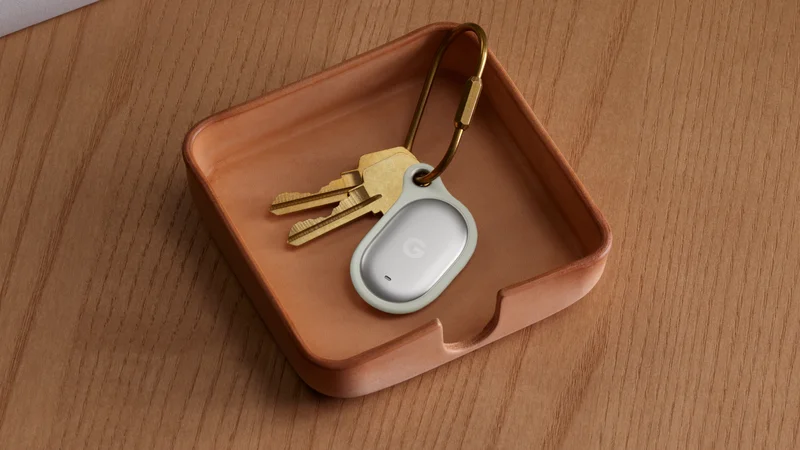
Fellow Android phone owners, our time has come! Google made a Bluetooth tracker that lets us locate our luggage, bike or whatever item we can attach it to.
Ahead of its Made by Google event, the search and AI giant released its Pixel 11 series, Pixel Watch 5 and the Pixel Tag. And it’s that last one that might be one of the most useful new devices that Google has released in years.
Android’s Find Hub, formerly the Find My Device network, has been around in one form or another for a long time and according to Google, it has over 1 billion Android devices on it worldwide. A few years ago, Google added support for Bluetooth trackers with ultra-wideband, which allows Android phones to pinpoint locations within a few feet. The problem is that not every Android phone or Bluetooth tracker supports ultra-wideband, which means most folks can’t take advantage of it.
The iPhone and Apple’s AirTags have used ultra-wideband for years to enable Precision Finding, complete with a clever, large green arrow indicator that counts down the number of feet from the tracker on your iPhone. Apple recently released the AirTag 2, which has a second-generation ultra-wideband chip that, in my testing, doubles the range of Precision Finding.
The Pixel Tag isn’t the first Bluetooth tracker for Android that supports ultra-wideband on Android’s Find Hub network. Motorola’s Moto Tag 2, announced at CES in January, also supports precise location tracking and is available to buy right now. Both the Pixel Tag and Moto Tag 2 cost $30, with a pack of four going for $100, a dollar more than Apple’s AirTag. At the time of writing, you can snag a Moto Tag 2 for $20 ($10 off).
The Pixel Tag is available in one color, Fog, compared to the Moto Tag 2, which comes in Pantone Arabesque and Pantone Laurel Oak – there’s even a Tag 2 with a saucy half-and-half two-tone split between the two hues. Motorola’s tracker also has a key fob slot and a built-in button to locate your phone.
The Pixel Tag, like most Bluetooth trackers, runs on a coin cell battery (CR2032) and should last a year before it needs replacing. It has an IP67 rating for water and dust-resistance, so you shouldn’t worry if it gets caught in the rain or on the wrong end of a split cup of cold brew. Though you may not want to let it sit in water for long – it’s rated for 30 minutes of submersion under a meter (about 3 feet) of water.
The biggest obstacle facing Google’s tracker will be getting one. The Pixel Tag will be available in November and you can’t preorder it like you can the new Pixel phones and watch. There is a “Get notified” button on the Google Store’s product page.
Here’s how it stacks up against the AirTag, Moto Tag 2 and Galaxy Smart Tag 2 from Samsung. Yes, Samsung has a Bluetooth tracker, but it only works on Galaxy phones. I think it’s smart that the Pixel Tag will work on any Android Phone, including Galaxy phones.
Google Pixel Tag vs. Apple AirTag, Motorola Moto Tag 2, Samsung Galaxy Smart Tag 2
| Name | Price | Ultra Wideband | Bluetooth | Weight/IP rating | OS support |
| Apple AirTag | $29/$99 for 4 | Yes | Bluetooth LE | 11.8 grams; IP67 | iOS 14.5 or later (Gen 1); iOS 26 (Gen 2) |
| Google Pixel Tag | $30/100 for 4 | Yes | Bluetooth 6.0+ | 11.8 grams; IP67 | Android 9 or newer |
| Motorola Moto Tag 2 | $30/100 for 4 | Yes | Bluetooth LE | 8.5 grams; IP68 | Android 9 or newer |
| Samsung Galaxy Smart Tag 2 | $30/100 for 4 | Yes | Bluetooth 5.3 | 13.75 grams; IP67 | Samsung phones on Android 9 or newer |