Mexico Says Intentional Homicides Have Halved. Here’s What That Really Means
Mexico · Security
President Sheinbaum’s headline is striking: half as many killings a day. The figure is real, but the fuller picture is more complicated.
Intentional homicides, Claudia Sheinbaum said, have fallen by 51% under her government. Mexico’s president delivered a rare piece of good news this month.
In a country scarred by years of relentless violence, halving the daily death toll is a claim worth examining closely.
What Sheinbaum actually said
The figure came in her morning press conference, the daily ritual known as the mañanera. Between September 2024 and July 2026, she said, intentional homicides fell by 51%.
In plain terms, roughly half. It is the kind of number a government dreams of announcing, and she made sure it was heard.
Coming from a president who campaigned partly on continuity, the emphasis on hard security results was notable.
The intentional homicides numbers, decoded
The 51% refers to a daily average, not a single day or a raw monthly total. That distinction matters.
The national statistics office reported the average fell from 86.9 killings a day to 42.5. That is about 44 fewer people killed each day, a genuinely large drop over less than two years.
Why the baseline is September 2024
The comparison starts in September 2024, the last full month before Sheinbaum took office on October 1. Choosing that starting point is deliberate.
It lets the government measure the change entirely on its own watch. It also means the fall is credited to her administration’s strategy, not inherited trends.
How the government explains the drop
Security Minister Omar García Harfuch is the public face of the strategy, and he is specific about the causes. He credits intelligence and investigation, the arrests of high-impact criminals, and a strengthened National Guard.
Operations against drugs, including fentanyl and methamphetamine, and the destruction of clandestine labs also feature. The government presents these results almost daily, keeping security at the centre of its public message.
The National Guard at the centre
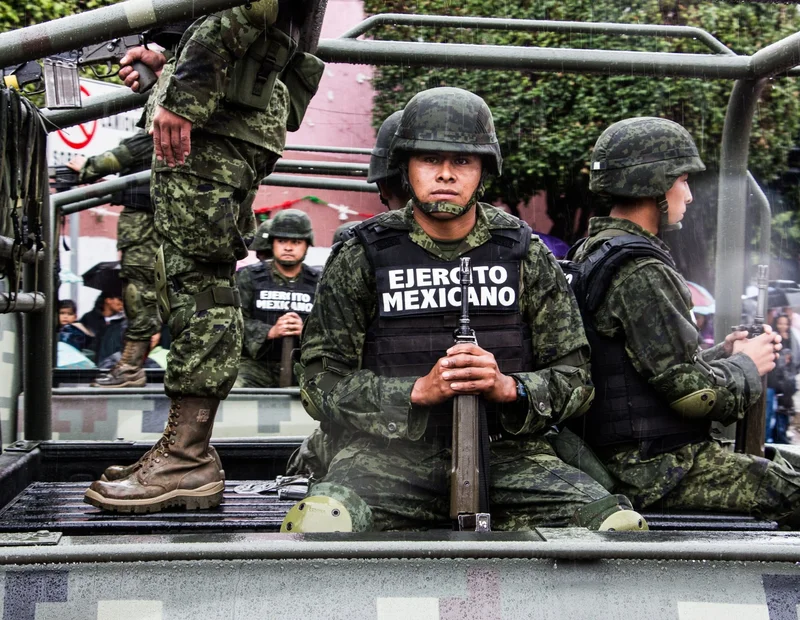
One institution sits at the heart of the strategy: the National Guard, a militarised police force expanded in recent years. The government has poured people and resources into it, using it as the backbone of federal security operations.
Critics worry about the long-term role of the military in policing. Supporters point to the falling numbers as proof it works.
Whether that harder line is the true cause, or one factor among many, is exactly what analysts continue to debate.
A break from ‘hugs, not bullets’
The approach marks a shift in tone from the previous government. Sheinbaum’s predecessor favoured a softer line on cartels.
That earlier strategy was summed up in a famous phrase, ‘abrazos, no balazos’, hugs not bullets. The current government leans harder on enforcement and intelligence, and points to the falling numbers as vindication.
The arrests that back the claim
Numbers on paper are more convincing with action behind them. The government offers plenty of the latter.
It reports more than 63,500 arrests between October 2024 and the end of July 2026. Raids on laboratories and seizures of synthetic drugs have become a staple of official announcements.
Numbers can also shift with how deaths are classified, which is why analysts prefer to watch trends over many months.
Why some caution is warranted
A big, welcome number invites scrutiny, and Mexico’s violence statistics have long been debated. Intentional homicide is only one measure of insecurity.
It does not capture the full picture of harm. Independent analysts often stress the need to check official tallies against other data before celebrating.
The shadow of the disappeared
One reason experts urge care is Mexico’s crisis of disappearances. Tens of thousands of people are missing.
A body never found may never be counted as a homicide, which can flatter the numbers. Falling recorded killings are real progress, but they do not erase that painful, unresolved wound.
For the families of the missing, headline statistics can feel abstract against a loss that has no official number at all.
Progress that is still fragile
Even taken at face value, 42.5 killings a day is a sobering figure. Mexico remains a violent country.
A halving is a major improvement, not a solved problem. The absolute level is still high.
Gains in security can also reverse quickly if pressure on criminal groups eases. Security and the economy are tightly linked here, and a calmer country is a more investable one.
Why it matters beyond Mexico
Security shapes everything from tourism to foreign investment, so the numbers carry economic weight. Companies weighing nearshoring to Mexico watch violence trends as closely as tax rates.
A credible, sustained drop in killings would strengthen Mexico’s pitch as a manufacturing base.
What to watch next
The key test is durability. One or two good years is encouraging; a sustained trend is transformative.
Watch whether the daily average keeps falling, and whether it holds across the most violent states. For now, Mexico has a real improvement to celebrate, tempered by the hard truth of how far there is to go.
Businesses, families and investors are all watching the same question: is this the start of a lasting shift, or a temporary lull.
Frequently Asked Questions
What did Sheinbaum claim?
That intentional homicides fell 51% between September 2024 and July 2026, with the daily average dropping from 86.9 to 42.5.
Where do the figures come from?
From SESNSP, Mexico’s national public-security statistics office, presented at the president’s morning press conference.
How does the government explain it?
Security chief Omar García Harfuch credits intelligence, investigation, arrests of major criminals and a strengthened National Guard.
Why do some urge caution?
Homicide counts are only one measure of insecurity, and Mexico’s crisis of disappearances means some deaths may go uncounted.
Is Mexico now safe?
It is safer than at the start of the administration, but 42.5 killings a day is still high. The improvement is real but fragile.
This article was produced by The Rio Times’ automated newsroom system. How we use AI · Report an error