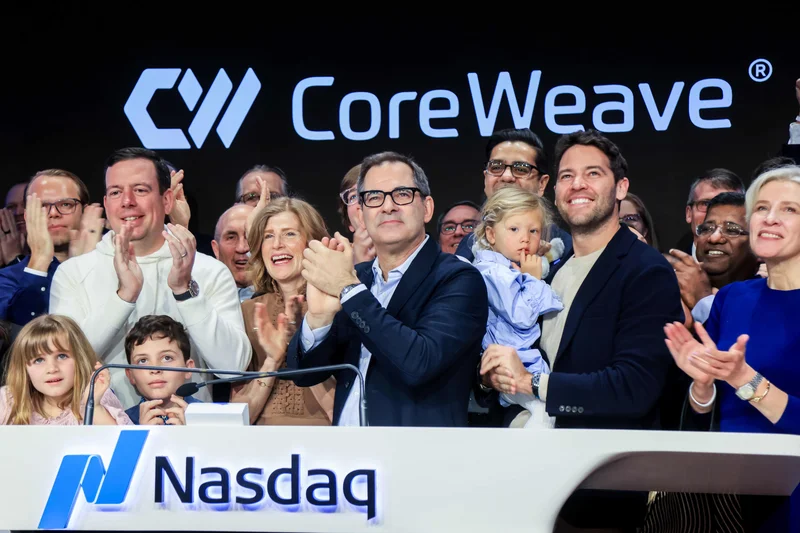
CoreWeave counters a key bear case on the AI trade. What it means for our data center stocks
CoreWeave has delivered a shot in the arm for Club name Nvidia and other data center stocks, offering evidence that AI chips may be an even better investment than previously thought. The AI compute provider's commentary on the longevity of Nvidia's chips — first on Tuesday night's earnings call and again Wednesday morning on CNBC — lends support to the artificial intelligence infrastructure trade in a couple of ways. It starts with giving the data center builders, like Amazon and Microsoft , more confidence in the return on their current spending, likely increasing the sustainability of the capital expenditure cycle. The added sustainability is a good thing for the future revenues of data center suppliers, from chipmakers to electrical and power companies. It also offers validation for Nvidia's splashy, $500 billion financing initiative announced Monday night in partnership with Wall Street's biggest firms. These implications are reflected in Wednesday's trading, with Nvidia shares up 3%, networking cable provider Corning up 5.2%, turbine maker GE Vernova up 2.7%, and memory supplier Micron , our newest position, jumping 4.9%. For its part, CoreWeave's own stock is surging nearly 20%, thanks to what Jim Cramer called "a true breakout quarter." Revenue topped expectations, losses were narrower than expected, and the company increased its top-line outlook for the year. One of the biggest bear cases around the AI trade has been technological obsolescence — the idea that Nvidia's graphics processing units (GPUs) and other AI chips may have much shorter useful lives than operators assume. As a result, the argument goes, today's spending is irrational because the hardware would need to be replaced too frequently to generate an attractive return on investment, known as ROI. CoreWeave suggests the opposite may be true. "Older generations of GPUs are going to have a longer useful life than anyone anticipated," CEO Mike Intrator told Jim and his "Squawk on the Street" co-hosts Wednesday morning. "They are going to contract for a longer term, and they are going to contract at a higher price." Finance chief Nitin Agrawal got into the specifics on Tuesday's earnings call, saying the company "recently signed an A100 contract that extends into 2029 at an attractive price. As a reminder, this SKU was introduced in 2020." That's the same year CoreWeave started renting GPUs in the cloud. The A100 belongs to Nvidia's Ampere generation of hardware — it's the chip that OpenAI used to train the first iteration of ChatGPT , which launched in late 2022 and kicked off this historic AI boom. Nvidia has since followed up Ampere with its Hopper family of GPUs, the Blackwell lineup, and now the Rubin generation, which entered full production earlier this year. CoreWeave was the first cloud computing provider to have a Rubin system online, according to a June 1 announcement . Demand for AI computing is so strong that, despite all these newer Nvidia GPUs in the world, the six-year-old A100s are still a hot commodity. Now consider what we recently learned from Amazon CEO Andy Jassy on the company's earnings call about breakeven times on AI computing hardware. "For servers and networking equipment, on average, it takes a little less than three years to break even on that investment," Jassy said. "The servers currently have a useful life of at least five to six years, and most of our AI capacity these days is being contracted for at least five-year terms." If operators can earn an acceptable return during the initial contract term, every additional year of economically productive life represents upside that wasn't required to justify the original investment — creating a very material "call option" embedded in the infrastructure. This is what CoreWeave is seeing with these A100s now on the books to be used for three more years, at least. Indeed, CoreWeave's business was never designed to rely on customer re-contracting, according to Agrawal. "While we have built a business whose economics do not rely on re-contracting after initial customer term, increasingly we are seeing longer utilization at higher prices, offering the potential for significant further upside." The most cutting-edge models and applications may require the latest and greatest hardware —at this moment, that is Nvidia's Rubin racks. But the reality is, there are still a ton of profitable use cases for older-generation chips, such as the aforementioned Ampere and Hopper generation silicon. We may all use AI one day, but not all of us are going to require a world-class coding model like Anthropic's Fable 5, supported by the world's most advanced hardware, at our every beck and call. This is where the bears' argument on obsolescence comes up short. They also miss that continued innovation in hardware and software is actually extending the economic life of older chips, even as newer generations become considerably more capable. In Wednesday's CNBC interview, Intrator laid out three factors that make the extended useful life possible: The Nvidia hardware, which he referred to as "the best solution in the market." Nvidia's developer software, known as CUDA, which Intrator said enables its chips to be fungible (think the ability to be repurposed from one customer to the next). Delivery via the CoreWeave cloud, which Intrator argued is the best software solution to deliver Nvidia's infrastructure. Intrator is obviously talking his book with that third point. That's not to say he's wrong, but his first two reasons are the most important and carry far-reaching implications for investors in AI names. If CoreWeave can still sign attractive contracts for capacity powered by Ampere chips released roughly six years ago, it stands to reason that so, too, can the hyperscale cloud providers — namely, Amazon, Microsoft and Google parent Alphabet . You can also throw smaller cloud provider Oracle in there, as well as Meta Platforms . The social-media giant doesn't have a cloud business ( at least not yet ) but still spends a ton on AI infrastructure for its own workloads, so we figure it can find some ROI-positive use cases for older-generation chips. Under this assumption, capex being on chips today likely results in years of cash generation beyond what many had thought possible — and what the buyers of those chips thought necessary to justify the purchases. That means the capex benefits will last longer than we thought, giving these big AI spenders a margin of safety of sorts. They will have even more time than previously thought to generate the positive ROIs Wall Street wants to see. As a result, investors may be a bit more understanding (and forgiving) of these high levels of capex, given there is more time to make good on the investments. This translates into good news for the companies on the receiving end of all the capex. We own plenty of them, starting with semiconductor players — Nvidia, Broadcom , Intel , Micron and materials supplier Qnity — and extending into the likes of Corning, Eaton and GE Vernova, which in their own ways keep data centers powered and running smoothly. The more clarity that management teams and investors have on the ROI potential of that spending, the more sustainable it will be. Yes, we will eventually reach a point where supply catches up to demand, but we don't think that's a near-term risk. On the call, Intrator said, "We have excellent visibility to our target of at least 8 gigawatts by 2030. We expect demand to meaningfully exceed supply for years." The longer useful life is going to be a crucial factor — arguably, the most crucial — in selling investors on the idea of compute as an asset class to help finance more data centers. That idea is at the heart of Nvidia's funding partnership with BlackRock, Blackstone, Brookfield Asset Management, Goldman Sachs and KKR — a major development in the AI buildout. Unlike past funding rounds , which were a bit more straightforward in that the goal was simply to raise cash (via debt or equity) and then deploy it, this initiative appears to be working on a new asset-backed security that will leverage data centers as cash-generating collateral that supports new asset-backed securities. These securities can then be sold to a much broader group of investors, making it easier to fund the massive buildout. While there is still a lot we don't know, the roundtable with the executives involved, hosted by CNBC's Becky Quick , made it seem like the idea is to create a financial product similar to a mortgage-backed security (MBS). The reason an MBS works is that the house collateralizing the loan is not expected to decline materially in value; long-term, the value likely increases, if properly maintained. The same needs to be true for a data center. That's not to say that the chips need to last 30 years, but the underlying principle is similar in that investors need confidence that the collateral can continue generating economic value for long enough to support the financing. The longer the chips last inside an individual data center, the less frequently they need to be replaced. As a result, the more revenue and cash flow they can produce for the holders of these new "compute-backed securities." All of that amounts to greater certainty on the part of the lender, which, especially in the earlier days, will be a crucial factor in garnering interest for these yet-to-be released financial products. Bottom line This is a bad day for the bears, and not just because of Wednesday's stock moves are in the bulls' favor. CoreWeave's bullish update on A100 longevity adds to the important insight that Jassy provided this earnings season. It also shows why some of the smartest and most powerful financiers in the world have also come around to the idea of compute as an investable asset class. Putting these together, the AI trade looks like it has plenty of room to run into 2027 and very possibly beyond. (See here for a full list of the stocks in Jim Cramer's Charitable Trust.) As a subscriber to the CNBC Investing Club with Jim Cramer, you will receive a trade alert before Jim makes a trade. Jim waits 45 minutes after sending a trade alert before buying or selling a stock in his charitable trust's portfolio. If Jim has talked about a stock on CNBC TV, he waits 72 hours after issuing the trade alert before executing the trade. THE ABOVE INVESTING CLUB INFORMATION IS SUBJECT TO OUR TERMS AND CONDITIONS AND PRIVACY POLICY , TOGETHER WITH OUR DISCLAIMER . NO FIDUCIARY OBLIGATION OR DUTY EXISTS, OR IS CREATED, BY VIRTUE OF YOUR RECEIPT OF ANY INFORMATION PROVIDED IN CONNECTION WITH THE INVESTING CLUB. NO SPECIFIC OUTCOME OR PROFIT IS GUARANTEED.