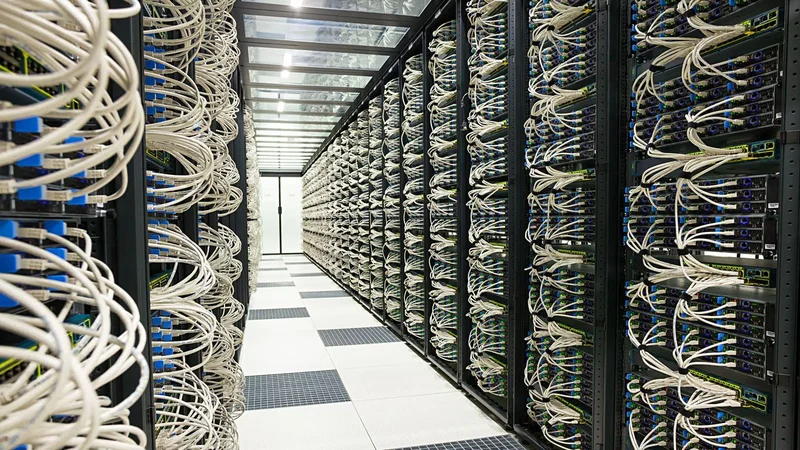
- Congressman Ro Khanna has introduced H. Res. 1471, a "Data Center Bill of Rights"
- It calls for a 2,500-foot buffer around homes, schools, and hospitals
- It also enshrines local veto power protected from state preemption, mandatory impact reports and water disclosure, and clawbacks on subsidies in a bid to control how AI data centers are built
Ro Khanna, the Democratic congressman whose district covers Silicon Valley, has introduced what he calls a "Data Center Bill of Rights".
It would prohibit data centers in residential areas and within 2,500 feet of homes, schools, childcare facilities, hospitals, and nursing homes.
As it is currently worded, it would also let communities reject any proposed data center outright, protect that decision from being overruled by their state, mandate public impact reports on electricity demand, utility bills, health, noise, rents, and housing, force operators to disclose projected water consumption and file semiannual usage reports, and attach labor standards and clawback provisions to any subsidy.
A bill of rights that lacks teeth but sets a blueprint
Rep. Khanna has introduced a simple House resolution, which has been referred to the Energy and Commerce and Judiciary committees. In its current state, it does not go to the Senate or the President, and it carries no legal force.
Despite this, the move is an important stance to take at a time when data center buildouts continue unabated in the country, often in areas suffering from high power costs and water scarcity.
One could argue that the move comes at a time when there is a Republican government in the House and the Senate, and it is unlikely to fly, even if it had legislative wings, with right-wing politicians generally tending to be more business-friendly, doing away with or softening regulations, even as data center buildouts are a key political sticking point in fights that have even gone federal of late.
Irrespective of how it fares in the House, it provides a key legislative blueprint that will assist cities and states, including New York and Nashville, where the latter is attempting to safeguard an iconic zoo from the effects of a potential data center buildout in the vicinity.
One could argue on the flip side that the 2,500-foot number takes things too far; it is nearly half a mile, and compounding it with homes, schools, childcare facilities, hospitals, and nursing homes simultaneously would create a massive exclusion zone that would effectively cut off much of urban and some of suburban America in the process.
It must be noted that Khanna's approach does not solve the problem; it merely relocates it to a more rural geography for now, with a much more aggressive tone being taken by Democrat Senator Bernie Sanders and Rep. Alexandria Ocasio-Cortez (AOC), who seek a moratorium on large AI data centers until other regulations are in place.
While a House resolution expresses sentiment, states and utilities have been doing the hard work of enforcement so far. Apart from the more prolific fights in New York and Nashville, other challenges have also emerged.
Oregon's energy regulator approved a new rate class for large-load data centers. Ohio regulators approved a settlement requiring data centers to cover at least 85% of their power costs. North Carolina and Virginia have proposals in the same direction.
Whether this is enough to stem or regulate a voracious AI buildout is a question that can only be answered in due time, but as it increasingly becomes a contentious political issue, battle lines are already being drawn and might not necessarily be along party lines, given how voters are starting to become vocal about the issue.
Rahim Amir is a UAE-based tech writer who enjoys building PCs as much as he enjoys writing about them. He has been professionally writing about PC hardware since 2023, focusing on buyer’s guides, hardware reviews, and sponsored content and features related to tech.
Having built hundreds of gaming PCs and being an avid gamer in his spare time, Rahim tends to have stronger opinions about hardware than most. This is particularly on display when he gets his way with powerful, but minimalistic RGB builds even as Small Form Factor (SFF) PCs come a close second.