- Published
A man cycled for about three and a half hours so he could watch Wednesday's partial eclipse through specialist viewing glasses.
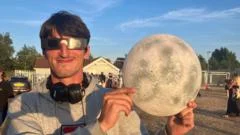
Kian Lodge headed to a watch party at Brough Observatory, East Yorkshire, where he could get hold of the glasses after finding the cost of them "absolutely extortionate" online, with long delivery times.
People were encouraged to enjoy the rare event safely by using certified eclipse glasses or handheld solar viewers.
Lodge described the journey as "some of the happiest miles that I've travelled in my life", and added that it was a "once-in-a-lifetime opportunity".
Up to 95% of the Sun slowly disappeared behind the Moon on Wednesday evening in what was the UK's most dramatic solar eclipse in nearly three decades.
But people were encouraged not to look directly at the eclipse as it could cause damage to their retinas, according to the Royal College of Ophthalmologists.
Most high street stores selling eclipse glasses sold out, leaving hundreds of shoppers queuing for them.
Lodge said he had travelled to Brough specially to get the glasses and watch the eclipse as it had the largest astronomy observatory in the area.
"It just has all the facilities that you could think of," he said.
"I didn't think it would be like this. I didn't think that as many people would have turned up."
He did not travel alone, taking his light-up toy moon he found in a charity shop.
"I put some fresh batteries in it and I popped it in my bag and it came with me all this way!" he said.
Steve O'Dwyer, of Brough Astronomy, said: "It's a fantastic turnout. [I] could've never imagined... that it was going to be like this."
He added: "It's been fantastic. Everybody has had an opportunity to see something."
Brian Davies, also of the astronomy club, said the crowds were "enormous" and far bigger than they expected.
The eclipse coincided with the peak of the Perseids meteor shower, one of the year's best astronomical displays.
The Perseids is active from mid-July to 23 August, but the best time to catch the display is between midnight and dawn on 12 and 13 August.
But Davies said people needed to be in a very dark place â and needed to be very patient â to see the Perseids.
"You won't see many from a town like Brough," he added.
Listen to highlights from Hull and East Yorkshire on BBC Sounds, and watch the latest episode of Look North.