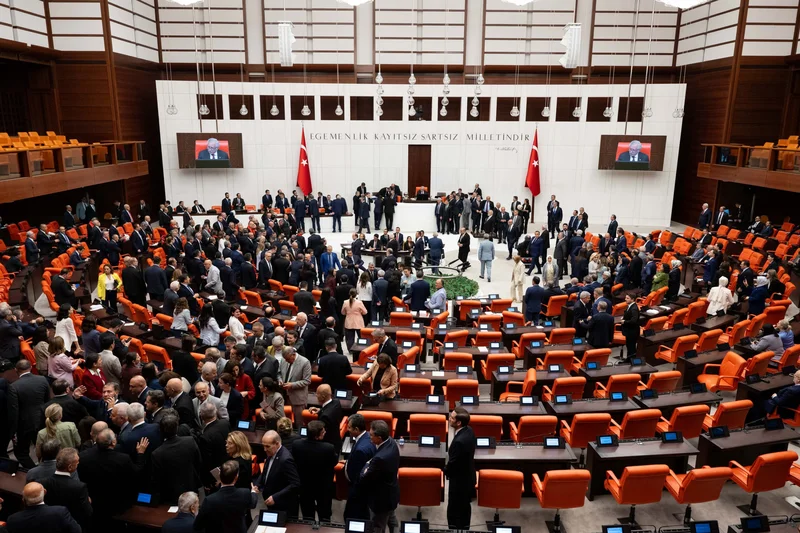
The National Solidarity Law was formulated around the principles of national ethos, social cohesion and a future defined by peace and fraternity. Significant institutional and political capital was invested in the “terror-free Türkiye” process. It was initiated with the objective of resolving a 40-year-old security crisis. Despite the process being vulnerable to provocation, the strategic resolve was maintained throughout, preventing attempts to derail the process through counternarratives and subversion. After nearly two years of intensive legislative work, the law has reached its final stage, with the bill now before Parliament, marking the transition to the most critical phase of the roadmap.
This legislative step serves not only as a point of departure but also as a deterrence strategy against regional actors with adversarial intent, while simultaneously strengthening the institutional capacity of Turkish democracy. The explicit objective is to achieve the total de-escalation and systematic elimination of terrorism, an issue Türkiye has grappled with for decades, from the national agenda.
The process operates under the highest degree of political consensus in contemporary Turkish history. It envisions the total and permanent disarmament of the PKK organization along with all its regional affiliates.
This clause alone constitutes a major strategic paradigm shift. The formal surrender of weapons, rather than their mere decommissioning or concealment, signals a structural and enduring resolution. Following the empirical verification and confirmation of disarmament, the law will be implemented through a decree of the National Security Council. The Parliament will monitor the execution through a dedicated oversight commission, while an executive board chaired by Vice President Cevdet Yılmaz will manage operational tracking.
The progression of the process through an indigenous “national perspective,” deliberately bypassing third-party mediation and international conflict-resolution models, positions the “Turkish Model” as a novel framework. Consequently, the model defies direct comparison with global precedents, standing instead as a unique, self-contained, and potentially precedent-setting approach to international conflict resolution.
The primary divergence from historic counterinsurgency cases, such as FARC in Colombia, ETA in Spain, or the IRA in the U.K., lies in Türkiye’s unilateral and autonomous resolution of its internal security challenge. The structural mechanism of success resides precisely within this domestic ownership.
Addressing the underlying questions regarding the operationalization of the process remains critical, while public skepticism should be viewed as normal. The primary areas of debate concern the structural dissolution of the organization, the protocols for implementation in the field, and the scope and interpretation of the legislative bill.
However, the 12-article draft bill explicitly excludes the incarcerated leader of the organization, Abdullah Öcalan, the terrorist leader of the PKK, and combatants directly implicated in acts of violence against Turkish security personnel. The policy framework strictly rejects a general amnesty or blanket clemency for terror-related offenses. Furthermore, no individual or group is granted special legal status. The statutory provisions are presented to the public with complete institutional transparency, maintaining the legal protections and rights of martyrs and veterans as an absolute normative priority.
The passage of this law will mark a critical strategic threshold. However, the primary operational phase will begin after its enactment, shifting the focus directly to developments on the ground. The initial operational priority will be for combatants to surrender their weapons at designated assembly centers in Erbil and Sulaymaniyah, evacuate military camps, and undergo systematic disarmament within Syrian territory. Current intelligence estimates place the number of active combatants across northern Syria and Iraq at approximately 4,500.
Following the surrender of weapons, a formal “Verification and Confirmation Mechanism” will be established. Once the initial phase has been successfully verified, the process will move into its second operational phase, which will address the legal and operational status of the senior command structure in Qandil. The organization is required to decommission its arsenal completely and irreversibly. The official confirmation of this irreversible disarmament will be validated and certified by relevant state intelligence and security apparatuses.
The Director of the National Intelligence Organization, İbrahim Kalın, will present the comprehensive intelligence assessment report to the National Security Council (MGK). Following the MGK’s formal declaration regarding the de facto termination of the organization's existence, the decision will be published in the Official Gazette. Subsequently, a presidential decree signed by President Recep Tayyip Erdoğan will be promulgated. This operational cycle is mandated for finalization within a maximum timeframe of six months.
Upon the conclusion of this process, the issue of terrorism will cease to exist in Türkiye. The domestic political landscape will undergo a structural shift, eliminating security threats as a volatile vector in political discourse. The strategic imperative emphasized since the inception of the initiative, the fortification of the "internal front," will be realized. Systemic stability and peace will extend beyond national borders into the immediate geostrategic environment. National resources previously allocated to counterterrorism operations will be redirected toward macroeconomic growth and energy infrastructure, as evidenced by initial yields from the Gabar oil field. Crucially, the foundational rationale of the initiative will be achieved: preventing the loss of human capital to political violence.
Reaching this juncture required sustained strategic leverage. Had Türkiye’s counterinsurgency operations on the ground not achieved operational dominance, the organization would not have been strategically constrained into self-dissolution. The absence of bilateral concessions or strategic bargaining is directly attributable to this military and intelligence posture. The security challenge has consistently been defined as an existential threat for the state. Ten previous legislative attempts, historically framed as "Repentance Laws" or "Return Home Acts," suffered from structural attrition and failed to yield permanent outcomes. Consequently, bipartisan cooperation between the governing coalition and parliamentary opposition remains vital for the legitimacy and sustainability of this statutory framework.
In summary, an initiative launched through the strategic declaration of Nationalist Movement Party (MHP) Leader Devlet Bahçeli was elevated into official state policy through the executive leadership and political determination of President Recep Tayyip Erdoğan. The role of leader-level diplomacy throughout this trajectory remains paramount.
Furthermore, interparty engagements within the Parliament, particularly those led by Speaker Numan Kurtulmuş, and the contributions of parliamentary representatives constitute critical components of this institutional consensus. The collective statecraft behind the terror-free Türkiye process represents a historic institutional alignment.