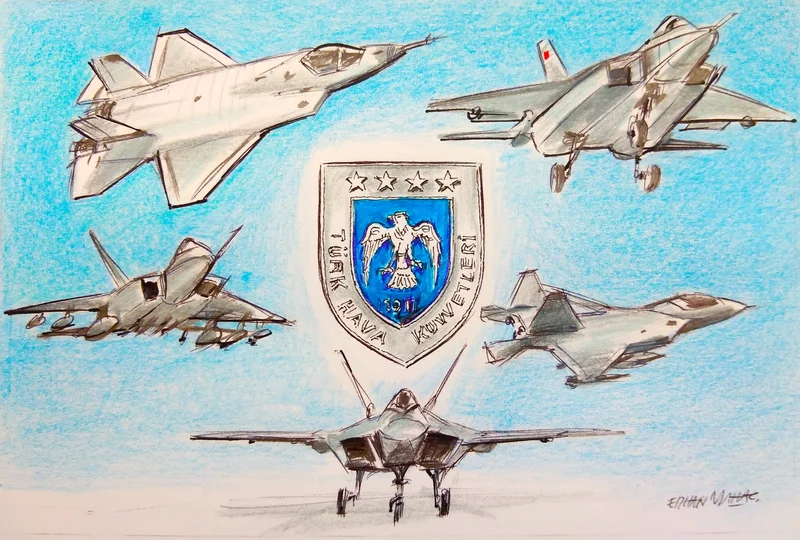
The aviation and aerospace sector is one of the key areas in which global powers are engaged in intense competition for technological and strategic supremacy. Indeed, from a military history perspective, the Allies, who achieved air superiority in World War I and World War II, emerged as the victors. During the Cold War, the competition for air superiority between NATO and the Warsaw Pact marked the beginning of a new era, followed by the Vietnam War, the Arab-Israeli conflicts, and finally the 1991 Gulf War. Today, the competition between fifth- and sixth-generation fighter jets continues at full speed. In this context, the Russia-Ukraine war, the U.S.-Israel-Iran war, the brief Pakistan-India war, and new aerial battles supported by beyond-visual-range missiles and intelligence systems have demonstrated that the wars of the future will be very different.
Türkiye, which possesses NATO’s second-largest military force, faced arms embargoes following the 1974 Cyprus Peace Operation. In response, it adopted a new strategic doctrine and, through its national aerospace industry, including the Turkish Aerospace Industries (TAI), TAI Engine Industries (TEI) aircraft engine factory, Havelsan, Aselsan and others, achieved significant gains in a short period. In this context, TAI produced a total of 308 F-16 fighter jets between 1987 and 2012 and sold 46 units to the Egyptian Air Force.
As a strategic continuation of this accumulated know-how, and in response to evolving aerospace technologies, Türkiye has, on the one hand, joined the F-35 5th-generation fighter jet project as a production partner alongside the United States, placing orders for 100 F-35s and 25 short takeoff/vertical landing (STOVL) F-35s, and commissioning the TCG Anadolu aircraft carrier. Of the 550 aircraft produced for the U.S. military, 7% of the critical mid-fuselage and flight control components were manufactured by Türkiye.
However, due to a dispute with the U.S. Congress over the procurement and co-production licenses for Patriot surface-to-air missile (SAM) systems, which Türkiye needed to meet its urgent air defense requirements, the U.S. imposed an embargo on NATO ally Türkiye under CAATSA sanctions following Türkiye’s purchase of S-400 air defense missiles from Russia. As a result, the delivery of six Turkish F-35 fighter jets has been withheld.
Designed and developed in accordance with the requirements of the Turkish Air Force Command, the national fighter jet project saw Kaan make its maiden flight on Feb. 21, 2024.
The Kaan ensures air superiority through an extended air-to-air combat range enhanced by new weapons, precise and direct hits from internal weapon bays at high and supersonic speeds, and combat power augmented by artificial intelligence and neural network support. Developed with a twin-engine architecture, the aircraft is capable of performing both air-to-air and air-to-ground missions.
Meanwhile, through bilateral negotiations with the Trump administration and the Pentagon, aimed at seeking a legal and military solution to the S-400 crisis while also working toward the lifting of CAATSA sanctions, an agreement was reached at the NATO Summit in Ankara. The agreement includes the sale of 80 F110 jet engines, valued at $700 million, needed to meet Türkiye’s target of receiving the first 20 Kaan aircraft by 2030.
Recently, the Kaan fighter jet completed the preflight taxi test of its latest prototype, marking a significant milestone. The P1 prototype features redesigned air intakes and a nose-mounted active electronically scanned array (AESA) radar, along with domestically produced electronic warfare systems. Radio-frequency band gaps have also been integrated into the vertical tails to enhance the aircraft’s stealth capabilities, while preparing it for network-centric air combat.
In addition, the distance between the two engines has been increased, the landing gear reinforced with a wider stance, and the wing and tail geometries optimized to reduce the aircraft’s radar signature. In this context, it is planned that the Kaan fighter jet will operate alongside domestic unmanned combat aerial vehicles (UCAV) such as the Kızılelma and Anka-3 as part of the “K-Swarm” concept in future phases.
Türkiye is closely monitoring both the changing strategic parameters of air power in the ongoing conflicts in the Black Sea and the Persian Gulf, as well as the efforts of the Israel-Greece-Greek Cypriot administration tripartite alliance to establish air superiority in the Aegean and Eastern Mediterranean regions.
In response to EU-backed Athens’ use of the Iran War as a pretext to deploy fighter jets to the Aegean Islands and Cyprus, Türkiye has deployed six F-16s to the Turkish Republic of Northern Cyprus (TRNC).
Against the backdrop of efforts by Israeli and Greek lobbies in the U.S. Congress to sabotage Türkiye’s return to the F-35 program, the cooperation between President Recep Tayyip Erdoğan and U.S. President Donald Trump, as well as their efforts to maintain a diplomatic balance within NATO, has come to the fore.
However, Türkiye’s second surprise move was brought to life through the Türkiye, Saudi Arabia and Pakistan Mecca Defense Agreement. President Erdoğan stated that the agreement, which also reaffirms the right to self-defense as defined in Article 51 of the U.N. Charter, does not target any specific country and is open to the participation of all brotherly nations aiming to ensure peace, prosperity and stability in the region. Given that the agreement is a defense-focused arrangement aimed not only at the three countries’ commitment to supporting each other’s security but also at developing defense industry cooperation, Pakistan and Saudi Arabia are expected to join the Kaan project following Malaysia’s participation.
My third critical observation is that Türkiye’s NATO membership and its regional partnerships are not alternatives to one another, but rather complementary structures that enable the sharing of the security burden. Indeed, just as Türkiye signed an agreement with NATO member Spain for the Hürjet training aircraft, the joint production of the Kaan fighter jet remains on the table. In this context, the Turkish Air Force’s 181st Pars F-16 Squadron is carrying out important missions in the Baltic region as part of NATO’s air policing mission.
The fourth critical development is that, pursuant to the military agreement Türkiye signed with the United Kingdom, series production has begun for the first batch of 20 + 10 Eurofighter Typhoon fighter jets, and Turkish fighter pilots and noncommissioned officer maintenance crews have begun training in the U.K. Additionally, 20 C-130 transport aircraft are expected to join the Turkish Air Force in the coming months following factory-level maintenance. The Kaan fighter jet is powered by the F110 engine manufactured by General Electric.
As can be seen, Türkiye, as NATO’s second-largest military, is modernizing its air power through a patient, planned, and careful policy in the face of evolving security and defense threats. Indeed, the recent NATO Summit in Ankara highlighted the significant contributions of Türkiye’s defense and aerospace sectors to the Euro-Atlantic security architecture. Ultimately, Türkiye continues to move forward with steady steps toward Mustafa Kemal Atatürk’s vision that “The future is in the skies.”