ST Signature Series
Young Singaporeans on Singapore at 100: Safe, fair, united and offering a better life
Claire Huang
Some things should remain. Some things should change.
Singapore’s first six decades were built on grit, discipline and a belief that a small country could carve its own way in the world. As it looks towards turning 100 in 2065, young Singaporeans say the question is no longer just how far the Republic can go, but what kind of home it wants to remain as.
For them, the answer lies not only in growth, but also in whether people continue to feel safe, whether multiculturalism remains a reality, whether meritocracy still affords Singaporeans a fair shot in life, and whether harmonious living stays on even as society becomes more complex.
Young Singaporeans still see Singapore as safe, stable and worth building a life in, but they want to inherit a country that offers an easier life, is more caring and less defined by the chase for success.
The Singapore Dream
A Straits Times poll on what young people’s hopes for Singapore are at 100 found that 95 per cent of respondents were proud to be Singaporean, while 68 per cent felt hopeful about growing up and building their future here.
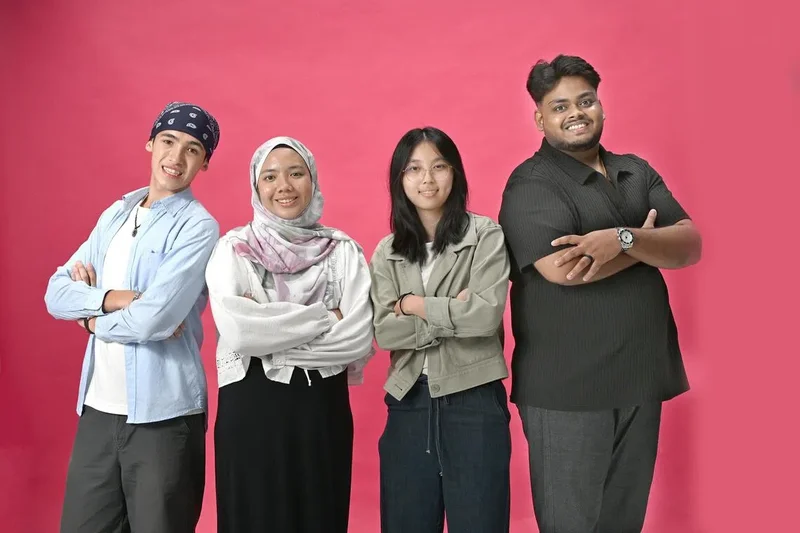
Student Vishnukeshn Sivapragasam, 20, said Singapore gives young people like him the hope that effort can lead somewhere.
“I’m studying, working part-time, and planning for the future at the same time. It’s not always easy, but I know that if I keep putting in the effort, there are opportunities here for me to grow.”
For 19-year-old Alexander Peter Lin-You Burton, the quiet acts of care that occur throughout Singapore’s community are something he has come to better appreciate.
He says it is one of Singapore’s most overlooked yet defining values. “Whether it be in small everyday acts of kindness, such as giving up your seat on the MRT for a passenger in greater need of it, or in larger efforts such as community involvement projects and regular volunteering sessions, acts like these are remarkably common, and collectively shape the society that Singapore strives to be; one that is not only safe and prosperous, but also built on equality and respect for all.”
On the kind of society they want Singapore to be in 2065, half of those polled said they want a country that remains safe, stable and resilient in an uncertain world; 44 per cent want a society that gives every Singaporean the opportunity to pursue their dreams; and 38 per cent said everyone should feel they belong, regardless of background.
But the poll also indicated a shift in the Singapore Dream, particularly among the younger cohorts.
On what areas needed improving the most for Singapore to be the ideal society at 100, 38 per cent picked better work-life balance and mental well-being, 35 per cent said it was about a more affordable cost of living, and 22 per cent voted for more equal opportunities for all, as well as better education and career opportunities.
As for the meaning of the Singapore Dream today, 39 per cent chose achieving work-life balance and prioritising mental well-being, 37 per cent said it was financial security, and 30 per cent picked a fulfilling career.
The poll surveyed 1,109 Singapore citizens and permanent residents aged 13 to 35 from June 15 to July 5. Its findings were echoed by young Singaporeans interviewed by ST, who said Singapore’s next chapter should still be defined by safety, fairness and opportunity, but also by compassion, belonging and room for people to grow at their own pace.
Student Trina Lee, 18, hopes for a Singapore where failure is more accepted, life is not just about coming in first, and curiosity and creativity are not dismissed.
Vishnukeshn believes Singapore at 100 should be a place where people feel they belong, no matter their background, that he will be proud “if young people can still afford to build a life here, families continue to feel safe, and we don’t lose the sense of unity that makes Singapore special”.
Political science undergraduate Humaira Safiya, 22, wants Singapore at 100 to be a place where a young Malay-Muslim girl can feel proud of her identity, while feeling fully part of the larger Singapore story.
“It should be a place where diversity is not just accepted, but valued,” she said. “For future generations, I hope they grow up in a society where they can be proud of their own culture, faith and language, while also learning from others.”
For Burton, Singapore’s future should be culturally vibrant and green, with respect for diversity remaining central to everyday life.
The medical school entrant said Singapore’s commitment to building sustainable communities is a value that inspires him. More than that, he hopes future generations can grow up in a country that retains compassion and unity.
Role model on the world stage
Lawyer Loh Tian Kai, 35, said Singapore must continue to be a role model on the world stage, whether in sociopolitical stability or economic strategy.
But to do so, it must reinforce its commitment to meritocracy and mobility across society. Loh said intergenerational transfers of resources and networks need to be balanced, so that Singaporeans who are able and hungry still have the chance to succeed on their own.
“We must be careful about entrenching privileges and opportunities, so that we can be confident that Singaporean society remains dynamic over the years and exceptional over the ages,” he said.
Among the issues young people think Singapore must focus on over the next 40 years are: cost of living and housing affordability, jobs and economic opportunities, mental health and holistic well-being, and social inclusion.
In June, Prime Minister Lawrence Wong said Singapore must become more cohesive as the world turns more fractured.
Open economies like Singapore are often among the first to feel the impact of global changes such as technological shifts and geopolitical tensions.
So what is one key risk Singapore needs to watch for in a more divided world? Chew Han Ei, associate director at the Singapore Management University’s Office of Impact, told ST that the risk is weakening social trust.
Singapore imports not only talent, technology and ideas, but also ideologies, anxieties and grievances, he said. Respect and harmony therefore have to be actively renewed and strengthened, online and in person.
Chew cautioned that some forms of divisiveness are not always the kind that can be corrected as falsehoods or taken down as online harms.
“They can be lawful but corrosive – narratives that travel through derisive humour, influencers, online communities and algorithmic feeds, and slowly change what people feel allowed to dismiss or dehumanise,” he said.
Founding director of the Dialogue Centre Mohamed Imran Mohamed Taib said one silver lining is that there is now greater awareness that social identities are becoming more complex and fragmented.
This is a natural state of affairs as inter-ethnic, inter-religious and transnational marriages become more common, he said. Official data shows that the proportion of inter-ethnic marriages among citizen marriages rose from 17 per cent in 2022 to 19.3 per cent in 2025.
Transnational marriages also rose from 33.2 per cent to 36.6 per cent over the same period. Imran said Singaporeans have to be vigilant, adding that “we must inculcate good values that can guide the moral compass of our nation”.
“The fundamental aspects of justice and equality that govern our citizenry in the pursuit of happiness, prosperity and progress as found in our Pledge must be internalised,” he said.
This means Singapore has to narrow inequality and guard against attempts to sow xenophobic attitudes, he added.
Commitment to the National Pledge
The poll found that 81 per cent of respondents agreed that the values reflected in Singapore’s National Pledge – multiculturalism, democracy, justice and equality – remain relevant today.
About 86 per cent agreed that every Singaporean has a responsibility to live out these values in daily actions.
Some young Singaporeans are already thinking about how they can contribute. At the top of the list, youth here believe they have a role to play in driving technological advancement and building a future-ready economy. Trailing behind is the goal of reshaping Singapore’s work and study culture so there is less stress and more fulfilment, followed by the need to keep Singapore relevant and respected on the world stage.
Burton sees Singapore’s fast-ageing population as one of the biggest challenges ahead.
Through his medical studies, he hopes to help older people access quality, compassionate and affordable healthcare.
Loh, an international arbitration lawyer, hopes to keep Singapore on the map through thought leadership, innovation and top-notch client service.
For Humaira, progress can also come through small, consistent efforts. Besides telling stories and building spaces where people feel seen, she hopes to contribute through Satura, a modest fashion brand she started last year that focuses mainly on hijabs.
“While it began as a business, I hope it can grow into something more meaningful, as a platform that celebrates identity and giving back to the community,” she said.
-
Elevated insights from seasoned perspectives. Crafted by journalists. Powered by Purpose:
-
This article is part of a special collaboration between The Straits Times and Nexus – the lead agency that drives Singapore’s national education and Total Defence efforts – to spotlight national issues.
-
The writer was a journalist at The Straits Times’ business desk.