HUNTSVILLE, Ala. — U.S. Space Command has ranked offensive space capabilities and systems for countering proliferated low Earth orbit constellations as its two highest priority needs for fiscal years 2029 through 2033, signaling where the combatant command sees some of the biggest gaps in preparing for a future conflict in space.
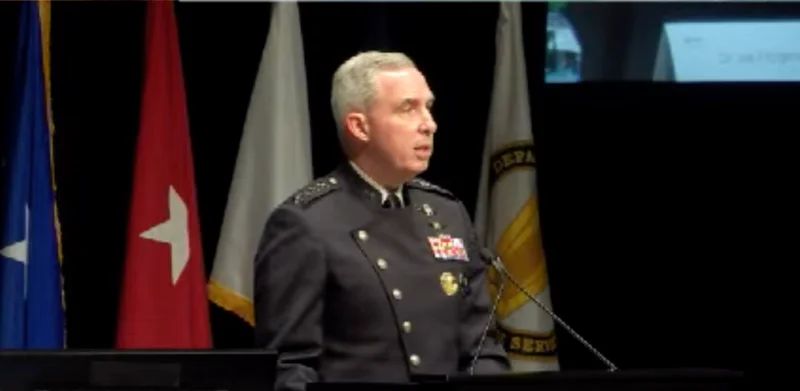
Gen. Stephen Whiting, head of U.S. Space Command, unveiled these priorities Aug. 12 at the Space and Missile Defense Symposium and discussed them during a news conference at Redstone Arsenal.
The list puts what Whiting called “integrated space fires” and “counter-pLEO” capabilities first and second. Those are followed by joint integrated space command and control; dedicated space domain awareness for space engagements; and sustained space maneuver.
“This isn’t just a wish list. It’s a clear demand signal to several audiences describing the warfighting capabilities we need to meet our mission,” Whiting said.
The Integrated Priorities List is Space Command’s assessment of capability gaps based on emerging threats, planned Pentagon investments and technologies under development. Whiting said the list is intended to direct the attention of the military services, government laboratories, research organizations and industry toward problems the command believes are not being adequately addressed.
“We’re a combatant command and we fight to win wars,” Whiting said in his keynote address. “To win, we need credible, acknowledged, kinetic and non-kinetic fires. They are a key component of how we establish space superiority and restore credible deterrence.”
Integrated Space Fires refers broadly to the ability to produce military effects against adversary space capabilities. Whiting declined to identify particular weapons or programs, but said the command believes some U.S. capabilities must be publicly acknowledged if they are to contribute to deterrence.
He described deterrence as having three elements: making clear what the United States intends to protect, denying an adversary the benefits of an attack through resilient systems, and being able to impose costs in response.
“That’s why we say we need acknowledged capabilities,” Whiting said. “We want to have a credible deterrent force so that we don’t have a war that starts in space, for instance.”
Whiting did not specify what kinetic capabilities the command wants. He also said existing U.S. policy against testing debris-producing direct-ascent anti-satellite weapons remains in force and that Space Command would operate within those restrictions.
Proliferated LEO challenges
Proliferated low Earth orbit constellations consist of hundreds or thousands of satellites operating as a distributed network. Their scale makes them more resilient than traditional architectures built around a small number of spacecraft — an advantage the United States itself is exploiting for communications, missile warning and other military missions.
But Whiting said the same technology poses a problem when used by an adversary.
“When you have 1000s of satellites in a constellation, just trying to affect an individual satellite at a time is not going to be a winning hand, most likely,” he said. “And so we’re going to have to figure out how we can affect the critical nodes of such a constellation to make sure they can’t be used against us.”
Whiting did not identify what those critical nodes might be or what technologies would be used against them. But suggested Space Command is looking for ways to disrupt the function of an entire satellite network rather than attacking large numbers of spacecraft individually.
“The reason we’re highlighting counter proliferated low Earth orbit is because we see a gap right now,” Whiting said. “So we are asking industry, we are asking research and development firms, the government labs, to please put their time, effort and attention into this problem area.”
The concern is more acute for constellations capable of detecting and tracking forces on the ground.
“I don’t want any U.S. forces to be put at risk because somebody else might have a proliferated low Earth orbit constellation that could find, fix a track and target them, for example,” Whiting said. He said the threat exists now and that the Pentagon is seeking to invest in counter-pLEO capabilities in coming years.
Whiting also emphasized that countering space-enabled targeting will not be exclusively a Space Force mission. Army, Navy, Air Force and Marine Corps units may need their own capabilities to prevent hostile satellite systems from locating and targeting forces in the field.
“If we are going to prevent another opponent, an opponent from tracking us, targeting us from space — that is not a problem that the Space Force will solve alone,” Whiting said. He said capabilities will need to move with Army, naval and other forces to protect them from space-enabled surveillance and targeting.
Other items on the list
Joint integrated space command and control is aimed at allowing commanders to understand what is happening in orbit and direct military responses fast enough for a conflict in which satellites and other systems may be maneuvering or under attack.
“We must enhance machine-to-machine connectivity to support decision-making and battle management of the global space fight on tactically relevant timelines,” Whiting said in his keynote.
Dedicated space domain awareness is the ability to track spacecraft with significantly greater precision than is required simply to maintain a catalog of objects in orbit.
“We must adopt a ‘target-quality track’ mindset to everything we do in space, just like the missile defense community has done for decades,” Whiting said.
Sustained space maneuver addresses the finite propellant carried by most military satellites.
“Today, our satellites are limited by the fuel they launch with, which leads to a psychology of scarcity,” Whiting said. “Husbanding that fuel often overrides desired warfighting maneuvers. That must change. We must be able to actively avoid threats and maneuver to gain a position of advantage on our adversaries.”
Sustained maneuver would require satellites capable of changing their orbits more frequently without exhausting their useful lives, potentially supported by in-space refueling, servicing and other logistics capabilities.
Whiting compared that requirement with the infrastructure that allows conventional military forces to keep moving during a prolonged conflict: aerial tankers for the Air Force, at-sea replenishment for the Navy and large fuel-distribution networks for ground forces.
“Our space assets need to shoot, move, and communicate just like the rest of the Joint Force,” he said.
Space Command does not procure the systems on its wish list. Its role is to identify operational requirements. The Space Force and other military services must then determine what programs, technologies and funding are needed to meet them.