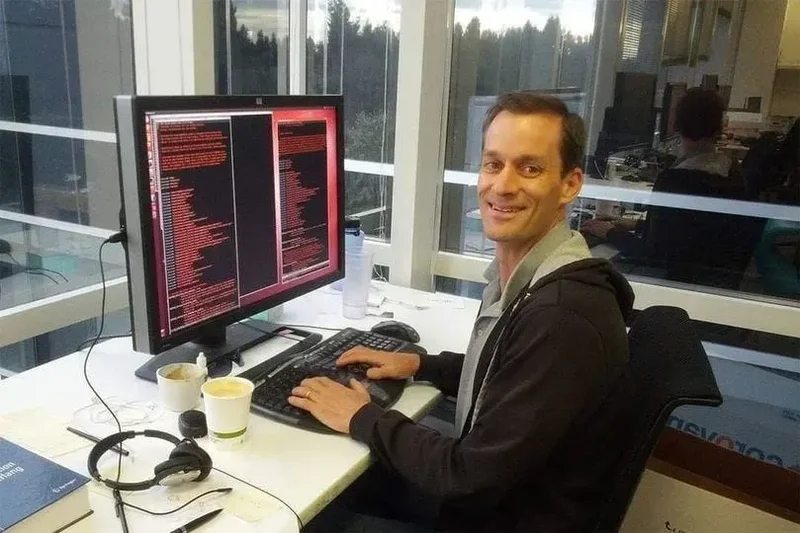
On August 5, Google announced that Jeff Dean is leaving after 27 years. He’s co-founding Discovery Loop, a public benefit corporation, with Sanjay Ghemawat, Oriol Vinyals, and Quoc Le. Sundar Pichai’s note put it plainly: “After an incredible 27-year run, Jeff Dean is at a moment where he wants to try something new” (
I’ve spent most of my career in and around distributed systems infrastructure, and there’s a genre of engineering influence that never shows up in an org chart. Dean’s work is the substrate a whole generation of us built on, usually without knowing whose ideas we were standing on. If you’ve written a MapReduce job, tuned a p99, used an embedding, or shipped a distilled model, you’ve used his output.
So here’s the canon instead of a tribute. Everything below is a primary source with a link I verified. Roughly a day of reading and watching, grouped by era.
The “Jeff Dean Facts” are real, and the story behind them is better than any of the jokes. Kenton Varda built the site as a Chuck Norris-style gag for April Fool’s Day around 2008, running it on an early internal build of the platform that later shipped as App Engine. He posted it anonymously to a company-wide mailing list on a Sunday morning. Dean tracked him down in an hour or two by working backward through internal status pages and Borg logs. Varda’s
Era one: making a datacenter behave like one computer (2003–2013)
** Web Search for a Planet: The Google Cluster Architecture** (2003, with Luiz Barroso and Urs Hölzle). Six pages that explain warehouse-scale computing before the term existed. Commodity hardware plus aggressive replication beats big iron, an argument now so completely absorbed into how we build that it’s hard to remember anyone had to make it.
** MapReduce: Simplified Data Processing on Large Clusters** (2004, with Ghemawat). If you read one thing on this list, read this. It’s short, it’s plain, and it created an industry; Hadoop and everything downstream of it descend directly from this paper. It’s also the clearest example of what makes Dean’s writing unusual. He states the design, gives the numbers, and stops.
** Bigtable** (2006). The wide-column data model that became the template for HBase, Cassandra, and most of the NoSQL era.
** Spanner: Google’s Globally-Distributed Database** (2012). TrueTime remains one of the genuinely surprising ideas in distributed systems: treat clock uncertainty as a first-class API instead of assuming it away.
** The Tail at Scale** (2013, with Barroso). The most immediately useful item here for anyone operating a service. Hedged requests, tied requests, the whole vocabulary of tail-tolerant design. I still hand this to people.
** Challenges in Building Large-Scale Information Retrieval Systems** (WSDM 2009 keynote). A cult favorite: a twelve-year architectural retrospective on Google Search, with real numbers, showing every index redesign and what forced it.
** Building Software Systems at Google and Lessons Learned** (Stanford, 2010). The canonical Dean lecture and the best single hour for understanding how he thinks. Back-of-the-envelope design made explicit. The “numbers everyone should know” latency table originates in
Era two: the pivot to AI (2012–2018)
** Large Scale Distributed Deep Networks** (DistBelief, 2012). The hinge. First system to train billion-parameter networks across thousands of machines, and the moment scaling stopped being a research question and became an engineering one. Google Brain’s practical birth.
** word2vec** (2013, with Tomas Mikolov, Kai Chen, and Greg Corrado). Made dense embeddings cheap and universal.
** Distilling the Knowledge in a Neural Network** (2015, with Geoffrey Hinton and Oriol Vinyals). Eight pages, three authors, and it’s how essentially every fast production model ships today.
** Outrageously Large Neural Networks: The Sparsely-Gated Mixture-of-Experts Layer** (2017, with Noam Shazeer, Quoc Le, Hinton, and others). Revived mixture-of-experts and established conditional computation at scale. The architectural ancestor of the sparse frontier models we’re all using right now.
** A New Golden Age in Computer Architecture** (IEEE Micro, 2018, with David Patterson and Cliff Young). The manifesto for domain-specific accelerators as the answer to the end of Dennard scaling and the intellectual case for TPUs. Pairs well with his
** The Case for Learned Index Structures** (2017). The most fun contrarian idea in the catalog: replace your B-trees and Bloom filters with learned models. Launched a subfield.
Era three: frontier scale (2022–2026)
** Pathways: Asynchronous Distributed Dataflow for ML** (2022, with Ghemawat, Paul Barham, and others). The orchestration substrate under PaLM and Gemini-scale training.
** Gemini: A Family of Highly Capable Multimodal Models** (2023). Worth opening for the contributor appendix alone, which lists “Overall Gemini Technical Leads (equal contribution): Jeffrey Dean, Oriol Vinyals.”
** That Chip Has Sailed** (2024). Dean personally answering critics of the AlphaChip work, and the item here that says the most about his temperament: he showed up and argued the evidence.
** Jeff Dean and Noam Shazeer on the Dwarkesh Podcast** (2025). Two and a half hours of Dean narrating 25 years of Google’s technical history himself. The richest long-form interview that exists, by a wide margin.
** Jeff Dean: The 1% Rule for Building in AI** (Y Combinator, July 2026). The bookend. His last major public talk as a Googler, given while Discovery Loop was still a secret.
Two more, for range
** The Friendship That Made Google Huge** (The New Yorker, 2018). James Somers on Dean and Ghemawat and their decades of literal pair programming. Send this to non-engineers. It’s the reason most people outside the field have heard of either of them, and it reads differently now that the two of them are founding a company together.
** AI isn’t as smart as you think, but it could be** (TED, 2021). Twelve minutes, general audience.
For everything else, his
What the list actually shows
Read chronologically, the throughline is narrower than “great engineer does great things for a long time.” Dean repeatedly identified the specific place where the systems layer had become the binding constraint on progress and then fixed it: batch processing, structured storage, global consistency, tail latency, distributed training, sparse computation, accelerator co-design. Same move every time. Find where the infrastructure caps ambition, and go remove the cap.
Which makes
All links verified August 8, 2026. Two notes for the pedantic: The Google File System is a Ghemawat, Gobioff, and Leung paper, and Dean is not an author, though it’s often attributed to him. And there is no Jeff Dean episode of the Lex Fridman podcast, despite what several roundups claim.