What it takes to recreate a Dior haute couture dress from the archives
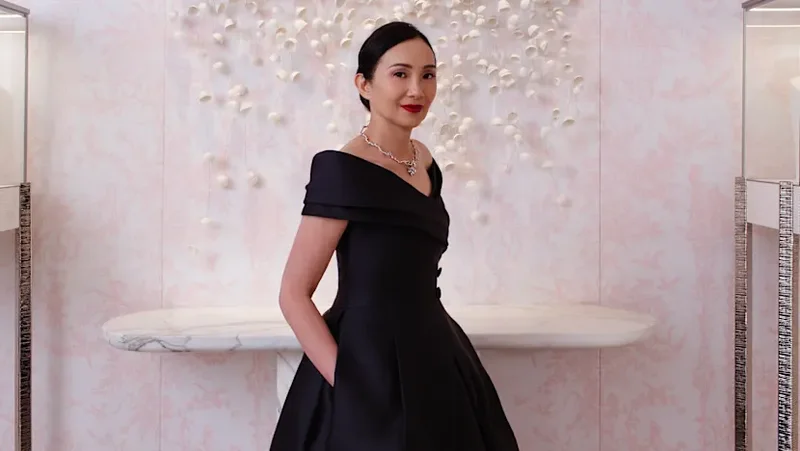
For Singapore medical practitioner Dr Caroline Heah, the process began with a 1957 Christian Dior design and unfolded through fittings in Paris and Singapore over almost a year.
In an age of next-day delivery and instant gratification, haute couture feels almost radical – one of the last luxuries that refuses to be hurried. A legally protected designation in France, it is reserved for fashion houses that meet strict criteria governing craftsmanship, personalisation and atelier expertise. Dior is one of them. Some clients go a step further, looking beyond the latest collection to the house’s archives, where celebrated designs can be brought to life once more.
Most haute couture commissions begin with the house’s latest collection, with a design serving as the starting point for conversations with the atelier. An archival creation follows a different path. The client chooses from Dior’s archives, with the silhouette, proportions and embellishments remaining faithful to Christian Dior’s original vision. The atelier’s task is not to reinterpret the design, but to recreate it for a new wearer.
A PROMISE MADE, A DREAM FULFILLED
Long before she stepped inside a Dior salon in Paris, Singapore medical practitioner Dr Caroline Heah had imagined what owning a haute couture dress might feel like. While studying in England, she immersed herself in old MGM films and the glamour of classic Hollywood, falling in love with the romanticism of a bygone era. She was particularly drawn to the hyper-feminine silhouettes of the post-war years, including Christian Dior’s revolutionary New Look, with its cinched waists and voluminous skirts. Cocktails were served at six, dinner at seven, and dressing was both ritual and expression.
It was during these years that she discovered Mrs. ’Arris Goes to Paris, the 1992 television adaptation starring Angela Lansbury, based on Paul Gallico’s novel. The story of an ordinary woman who dreams of owning a Dior haute couture dress struck a deeply personal chord. Heah made herself a promise: One day, she too would own one. More than four decades later, as she prepared to celebrate her 60th birthday, that dream would finally become reality.
When the time came to choose her dress, Heah was drawn not to Dior’s latest haute couture collection but to the Caracas, a design from Christian Dior’s Spring/Summer 1957 Libre collection. Worn by Sophia Loren and later recreated for Mrs Harris Goes to Paris (2022), the dress connected directly with the story that had first inspired Heah decades earlier. Choosing it brought a promise she had made to herself in her youth full circle.
EVERY DRESS BEGINS WITH CONVERSATION
Before a single needle pierces fabric, the process begins with an intimate conversation. The atelier considers not simply the garment, but the client, the occasion and what has drawn her to a particular creation. Even with an archival design, where the silhouette is already defined, that dialogue shapes what follows.
For Heah, that first conversation took place at Dior’s haute couture salon in Paris. The questions went beyond the garment itself, encompassing the occasion, the setting and how she imagined wearing it.
“They weren’t just asking about a dress,” Heah recalled. “They were imagining the entire occasion – where I would be, how I would move, how the dress would live.”
Only after that conversation were Heah’s measurements taken, capturing not just her proportions but the subtleties of her posture, shoulder line and natural stance. The aim was to make the dress feel as though it had been conceived for her alone.
MADE TO MEASURE
Before the final fabric is cut, the atelier first creates a toile – a full-scale cotton prototype used to refine the proportions, seams and balance of the garment. Once the toile is approved, the final dress begins to take shape.
Hours of work then follow in Dior’s ateliers, where specialist artisans handle the construction, embroidery, finishing and pressing. For an archival commission, each pleat, line and embellishment must remain faithful to Christian Dior’s original design while meeting contemporary couture standards.
THE DRESS COMES TO LIFE
The dress took shape over three fittings across almost a year. The first was held at Dior’s historic 30 Avenue Montaigne address in Paris; for the subsequent fittings, the atelier travelled to Heah in Singapore. With each one, the archival design came closer to becoming her own.
The first fitting marked an emotional turning point.
“I wasn’t expecting to see the dress just yet,” Heah recalled. “But when I saw it – that was the moment when all the emotions came. I burst into tears.”
Months of conversations, sketches and measurements had finally become something tangible. The dream she had carried for more than four decades was taking shape before her eyes.
A MOMENT WORTH WAITING FOR
By the second fitting, which CNA Luxury was invited to observe, the Caracas was approaching its final form. As Heah emerged from the fitting room, there was a collective intake of breath. The moment recalled the fitting-room scene in Mrs Harris Goes to Paris, when Mrs Harris first sees herself in Dior. This time, however, it was unfolding before us.
Watching the atelier team at work offered a glimpse of the precision involved. The artisans circled Heah, pinning, stepping back and reassessing the silhouette from every angle. Nothing was hurried. Even the slightest adjustment could alter the way the dress sat on her body.
The dress would then return to the Paris atelier for further adjustments. Unlike conventional alterations, sections of the gown could be dismantled and recut entirely if the atelier felt the silhouette could be improved.
THE FINAL REVEAL
If the second fitting was about perfecting the dress, the third was about celebrating it.
Heah laughed as she recalled Dior inviting her to the boutique for what she assumed would be a casual Sunday meeting. She arrived in shorts and a T-shirt, unaware that the house had something else planned.
As the lift doors opened onto the salon floor, Heah found a corridor illuminated with fairy lights. Waiting inside were family and close friends whom Dior had secretly invited to see the finished Caracas for the first time. Months of fittings and anticipation culminated in an intimate celebration of the dress she had waited decades to own.
Days later, the Caracas arrived at Heah’s home in a bespoke Dior shipping crate, accompanied by a miniature mannequin bearing her name – a keepsake from a journey that had begun months earlier with a conversation in Paris.
Wearing the Caracas is itself a ceremony. With 25 buttons, three zips and three layers, it is not a gown Heah can simply slip into.
“It’s not a dress you can put on by yourself,” Heah said. “You need someone to help you into it.”
To Heah, that was precisely the point. The dress evoked an era when getting dressed could itself be a ritual – the world of Grace Kelly and Audrey Hepburn that had captivated her since she was young.
MORE THAN A DRESS
For Heah, the Caracas was more than a couture dress. It fulfilled a promise she had made to herself decades earlier and reflected a lifelong fascination with fashion history and the elegance of another era.
“I am a collector of silhouettes, a collector of stories. I worked very hard to buy that dress – my first couture dress. It’s been a dream since I was 19. I finally made it happen when I turned 60. I waited a long time for the opportunity to have the dress.”
Heah acknowledged that not everyone would understand such an emotional attachment to a couture gown. But to her, haute couture belonged in the same realm as fine art, vintage cars, rare timepieces and antiques – objects collected as much for their craftsmanship and history as for their beauty.
Wearing the Caracas was “transcendental”, Heah said. “When you put it on, it transports you back in time.”
Created by Christian Dior in 1957, worn by Sophia Loren and rediscovered by a new generation through Mrs Harris Goes to Paris, the Caracas now begins another chapter with Heah. Archival haute couture may preserve the past, but it does so by allowing these designs to be worn again in the present.