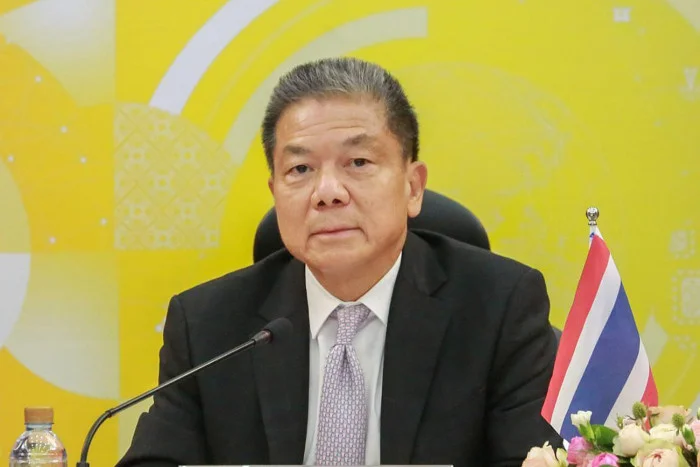
A dispute over the National Broadcasting and Telecommunications Commission (NBTC) chairman Dr Sarana Boonbaichaiyapruck's eligibility has escalated, with Prime Minister Anutin Charnvirakul signing a submission seeking a Royal Command for his removal.
Mr Anutin said Tuesday he had signed the submission for Dr Sarana to leave his positions as chairman and commissioner of NBTC, adding the government had followed the law.
The move follows a July 17 ruling by the NBTC selection committee that Dr Sarana possessed a prohibited characteristic under Section 8(2) of the NBTC Act. Dr Sarana, however, maintains he remains legally entitled to perform his duties until a Royal Command removing him is issued.
Who is Dr Sarana?
Dr Sarana is a cardiologist and former assistant professor at Ramathibodi Hospital, Mahidol University. He entered politics during the National Council for Peace and Order period, serving as a member of the National Legislative Assembly from 2014 to 2019.
His first attempt to join the NBTC in 2018 was unsuccessful. He reapplied in 2021 in the consumer protection field and was selected as one of five candidates.
The Senate approved his appointment as an NBTC commissioner in December 2021, with 210 votes in favour, six against and seven abstentions. The commission subsequently elected him chairman. The Royal Command appointing him was issued on April 13, 2022.
Sarana's key decision?
One of the defining episodes of Dr Sarana's chairmanship was the NBTC's consideration of the proposed merger between True Corporation and Total Access Communication, or DTAC, in 2022.
The meeting lasted more than 11 hours and came amid strong opposition from consumer groups and academics concerned about market concentration.
The initial vote was split, with two commissioners supporting the merger, two opposing it and one abstaining. As chairman, Dr Sarana exercised his casting vote, producing a 3-2 decision in favour.
The decision triggered prolonged legal and regulatory debate over the NBTC's powers and the conditions attached to the merger.
Another major challenge ahead for the commission is the expiry of digital television licences in 2029, as the broadcasting sector undergoes structural change.
Eligibility dispute origin
Questions about Dr Sarana's eligibility intensified after a House committee led by People's Party MP Rangsiman Rome petitioned the prime minister to review his status.
The Ombudsman subsequently examined whether Dr Sarana had continued receiving payments from Ramathibodi Hospital after becoming an NBTC commissioner.
Dr Sarana says he resigned from his position as an employee of Mahidol University and Ramathibodi Hospital on Jan 8, 2022.
The key question is whether the medical services he provided after his resignation constituted employment or another prohibited position under the law.
Section 8(2) of the NBTC Act requires commissioners to work full-time and restricts them from holding other positions or employment that could create conflicts of interest.
Dr Sarana said he had already resigned from government employment and later worked as an independent doctor when necessary, including to complete medical procedures and facilitate patient transfers.
What did the panel decide?
The NBTC selection committee voted unanimously, 4-0, on July 17 that Dr Sarana possessed a prohibited characteristic under Section 8(2). The committee concluded that his circumstances did not meet the legal requirements for an NBTC commissioner.
The ruling followed consideration of documents relating to his employment and income, including information obtained during the Ombudsman's examination. Dr Sarana rejected the finding and has challenged both the interpretation of the evidence and the process used to reach the decision.
The ruling became the basis for the subsequent process seeking his removal from the NBTC.
Sarana's latest defence?
After another failed NBTC meeting on Aug 11, Dr Sarana presented new evidence from Mahidol University in support of his position.
He said he had received a letter from the university dated Aug 8 confirming that he had resigned as an employee of Mahidol University and Ramathibodi Hospital on Jan 8, 2022.
He said that from Jan 8 to April 12, 2022, he provided specialist medical services independently when necessary, and did not receive a salary or wages directly from the university or hospital.
He also cited his 2022 tax records, which he said classified his income from January to June as income from independent professional services under Section 40(6) of the Revenue Code, rather than salary or wages under Section 40(1).
Dr Sarana questioned why the selection committee had not waited for the university's clarification before ruling.
Why is NBTC paralysed?
The controversy has moved beyond Dr Sarana's personal status and is now affecting the NBTC's ability to conduct its work.
The seven-member commission requires at least four members to form a quorum.
On Aug 11, the board failed to hold a scheduled meeting for the fourth time.
Three commissioners -- Prof Pirongrong Ramasoota, AM Thanapant Raicharoen and Suphat Suphachalasai -- left the meeting room when Dr Sarana entered, leaving the board without enough members to form a quorum.
The latest failure followed three earlier attempts that were also disrupted by the disagreement over Dr Sarana's status.
Dr Sarana said he had called the Aug 11 meeting because there were matters that all commissioners needed to know, including the Central Administrative Court's decision and the new evidence from Mahidol University.
He was disappointed that some commissioners did not remain for the meeting, saying they might reconsider their position if they heard the evidence and explanations.
The repeated breakdowns have raised concerns about the NBTC's ability to perform its regulatory duties while the dispute remains unresolved.
What did the court decide?
Dr Sarana filed a case with the Central Administrative Court on Aug 3 challenging the selection committee's ruling.
He asked the court to revoke the decision and sought temporary protection while the legal dispute was being considered.
His requests included suspending enforcement of the selection committee's decision, stopping the submission of the matter for Royal consideration and halting the process of selecting a replacement. On Aug 8, the Central Administrative Court refused to accept the lawsuit because no Royal Command removing Dr Sarana from office had yet been issued.
The court found that he had therefore not suffered an injury that could be legally challenged at that stage.
The ruling was procedural and did not determine whether Dr Sarana had breached the legal requirements applying to NBTC commissioners.
It therefore did not settle the underlying dispute over his eligibility, while the July 17 selection committee ruling remained in place.
What happens next?
The central issue remains whether Dr Sarana's medical work and income around the time of his appointment breached the restrictions imposed on NBTC commissioners.
His latest evidence from Mahidol University supports his argument that his employment had ended before he joined the NBTC and that his subsequent medical work was performed independently.
The outcome of the removal process will determine whether Dr Sarana remains in office. It will also have direct implications for the NBTC, which has already been unable to complete four consecutive board meetings because of the dispute.
The case has developed from a question over one commissioner's eligibility into an institutional problem for the broadcasting and telecommunications regulator.
Until the dispute is resolved, the NBTC faces uncertainty over its leadership and its ability to make decisions requiring a functioning board.