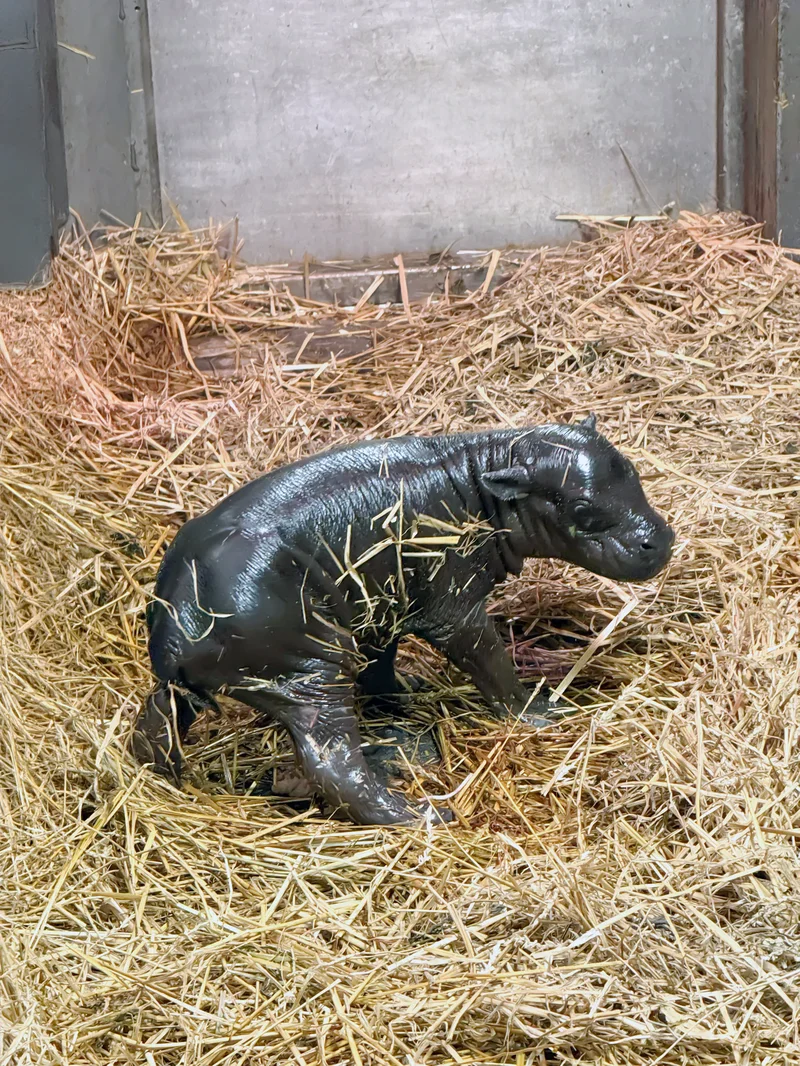
At first, the only sign of life from the newborn calf was the occasional wiggle and nuzzle into its bed of straw.
But 15 minutes after she was born, the female pygmy hippopotamus, the size of a loaf of bread, was on her feet. While workers at the Toronto Zoo looked on anxiously, the calf’s mother paced near the baby, shielding her from their watchful eyes.
One week after the Aug. 2 birth, those at the zoo who have been monitoring the new calf said she’s growing stronger, a rarity for the endangered species, which has a low birth survival rate both in captivity and nature.
Grant Furniss, Toronto Zoo’s director of wildlife operations, said the birth is a small, but important step in furthering the zoo’s ultimate goal of reinforcing the species’ population in the wild.
Since the new addition, the energy among staff at the zoo has been contagious, he said.
“It’s fantastic to come to work every single day. People are excited and happy,” he said in a Tuesday interview.
“This little calf is hitting milestones on a daily basis. It’s not just the birth, but its seeing her develop with her mom each and every day, so we get massive highlights and big serotonin shots out of that.”
Native to West Africa, the mature pygmy hippopotamus population is around 2,500, down from an estimated 29,000 in the 1980s. The species is at risk of dwindling further due to deforestation and excessive hunting, according to the International Union for Conservation of Nature, a non-profit membership group of government and civil society organizations.
There are only three pygmy hippopotamuses in Canada, all housed at the Toronto Zoo. The calf is the third from 20-year-old mother, Kindia, since she joined the zoo in 2016.
Her first calf, born a year after she arrived, didn’t survive 24 hours. Zoo staff said she needed space alone to grieve after losing the calf. Her second, Penelope, was born in 2018 and now lives at the John Ball Zoo in Grand Rapids, Mich. with a calf of her own.
While researchers don’t yet know why newborn calves struggle, Mr. Furniss said some reasons could be anxiety, vulnerability to diseases or lack of nutrients in the mother’s milk. But, he said, the survival rate rises with the number of calves a mother has, although researchers haven’t discovered why.
Calves usually stay with their mother for up to three years. Pygmy hippos feed on vegetation and spend most of their time on land. They tend to be shy and nocturnal in nature and live to be between 30 and 50 years old.
Pygmy hippo calves have become viral sensations in recent years. In 2024, videos newborn calf Moo Deng at a Thailand zoo became an instant internet favourite.
Mr. Furniss said the goal of breeding endangered species such as pygmy hippopotamuses, isn’t to bring more visitors but instead to have a “genetically-safe insurance population” if the wild species is lost.
When Kindia was chosen for breeding, he said the zoo consulted an international zoo animal database, similar to a matchmaking program, to ensure any calves from her and her mate would help diversify the species’ genetics.
She was matched with a 31-year-old pygmy hippopotamus, Harvey, that also lives at the Toronto Zoo. The two animals spent eight days together in January. But breeding isn’t a simple task, Mr. Furniss said, because the species is very skittish and solitary.
He likened the animals to lions because both species’ males and females rarely tolerate each other unless they’re mating.
“For three or four days, they will tolerate one another, and then as soon as Harvey realizes, ‘Oh geez, Kindia is not cycling anymore,’ He’ll go and stand at his door and basically tell us, ‘Listen, it’s time for me to be separated again,’” he said.
Once zoo staff learned that Kindia was pregnant, they monitored her in a climate-controlled area, with a thick layer of straw on the floor and multiple heat sources installed on the walls to keep the animals at roughly 25 C. The gestation period for pygmy hippopotamuses is between 180 to 210 days.
She began labour just after 8 a.m. on Aug. 2, and roughly 1.5 hours later, Kindia delivered the healthy calf.
Amanda Carroll, a wildlife care keeper at the zoo, said once the calf was born, she noticed that Kindia became more protective and alert compared to her usual easygoing nature.
The calf weighed roughly four kilograms when born, but after a week, she doubled her weight, a positive sign, Ms. Carroll said. The main focus in the first few weeks is on allowing the mother and calf to bond and spend time together.
The calf will soon be introduced to water, brush and mud puddles as it continues growing, she said.
Zoo staff said visitors will be able to see the new calf in about a month, but that could change depending if the animal is ready and not anxious or stressed around people.
While no name has been selected yet, they advised people to check social media for updates.
Ms. Carroll said the birth was a career highlight for her since the animals are rare and vulnerable.
“This is part of why we’re doing our job,” Ms. Carroll said. “We get to be this direct and have hands-on experience. It’s very exciting to see how many people are excited about this baby.”