Clusters are the largest gravitationally bound things in the universe, thousands of galaxies held together in a vast reservoir of hot gas, gas so hot it glows in X-rays rather than visible light. But they do not stop at a tidy, neat edge. They taper away into the surrounding darkness, and they are still being fed, drawing in fresh material along enormous threads of gas that run between them like the strands of a web. Those outskirts are the interesting part, because they are where the universe is still assembling itself. They are also very faint, which is why so little is known about them.
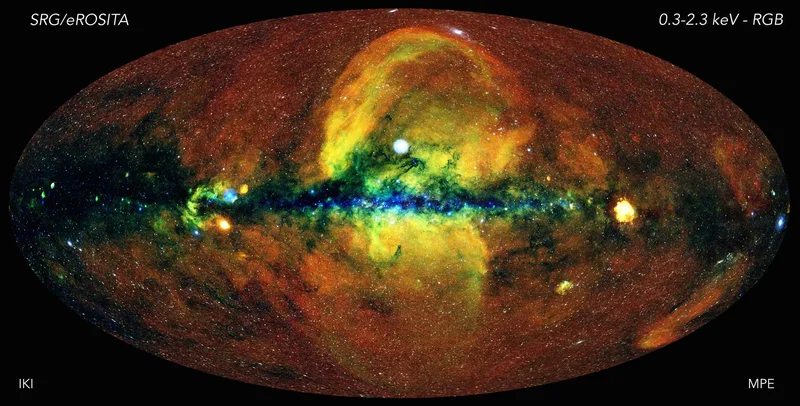
The eROSITA telescope, launched in 2019 aboard the joint Russian and German Spektrum-RG mission, has now published its second major data release. Built from three complete surveys of the sky, DR2 contains close to two million X-ray sources across the western half of the sky, about twice as many as the first release. Roughly 1.9 million are point like, mostly stars and feeding supermassive black holes. Some 64,000 are extended: galaxy clusters, nearby galaxies and the shredded remains of supernovae.
Galaxy cluster A3266 in X-rays, linked by a filament of hot gas to a neighbouring galaxy group. The Bonn team measured the faint outer glow for the first time and found gas hotter and denser than the models predict (Credit : Jakob Dietl/Uni Bonn/eROSITA-DE)
Within that haul, Thomas Reiprich and Jakob Dietl at Bonn's Argelander Institute went after a single object. A3266 is a massive cluster connected by a filament of gas to a neighbouring group of galaxies, and their team became the first to measure the faint X-ray glow in its outer reaches.
Our current theories of how cosmic structure formed match what eROSITA sees, thatâs reassuring. The interesting news is in the detail, where they don't quite match. The gas in the outskirts and in the filament runs hotter and denser than predicted, and contains comparatively little in the way of heavy elements.
The Perseus cluster, one of the brightest X-ray objects in the sky. The diffuse glow is gas hot enough to shine in X-rays, and it holds more mass than all the cluster's stars together (Credit : X-ray: NASA/CXC/SAO/V. Olivares et al.; Optical/IR: DSS; H-alpha: CFHT/SITELLE; Image Processing: NASA/CXC/SAO/N. Wolk)
Heavy elements, anything past hydrogen and helium, are manufactured inside stars and flung out when those stars die. Gas that is short of them has therefore never spent much time near a galaxy, which marks it as relatively pristine material arriving from the wider cosmic web rather than something expelled from the cluster itself. Yet itâs warmer and denser than models predict for gas of that kind. The two facts pull against each other, and reconciling them means adjusting our picture of how matter actually falls into a cluster: how quickly it heats, how thoroughly it mixes with what is already there and how much enriched gas the galaxies push back out to meet it.
Before eROSITA, the only X-ray survey of the whole sky came from ROSAT in 1990, so astronomers waited the best part of three decades for a successor. And eROSITA itself has been in safe mode since February 2022, with no return to science operations. There is a lesson in that about the value of surveying everything, whether or not you know yet what you are looking for.
Source : Homing In on the X-Ray Sky