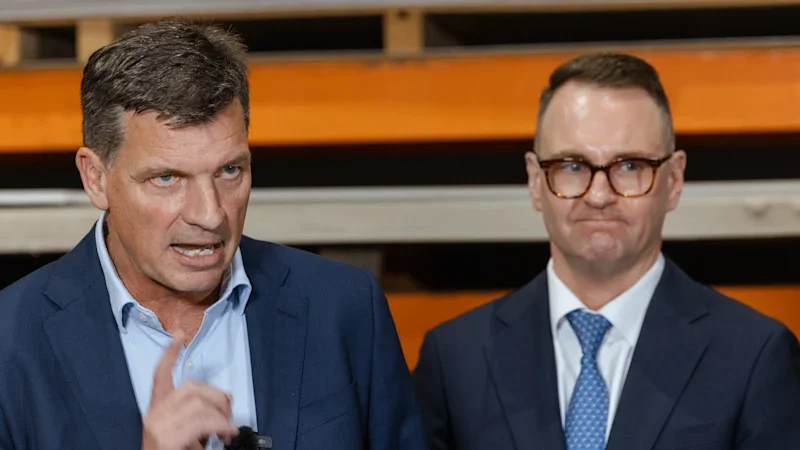
Liberal frontbencher Andrew Bragg has said low-income Australians should accept living in substandard housing to ensure they have a roof over their head, a day after calling for an “economic revolution” and challenging his party to capture voters’ attention in a wide-ranging speech at the National Press Club.
After John Howard called for bold policies to counter One Nation, the leading moderate ruffled feathers in the opposition’s top brass by freelancing on economic policy and announcing a new migration target that Opposition Leader Angus Taylor did not repeat in a radio interview.
Bragg, the Coalition’s housing spokesman, tacitly acknowledged he was not following party processes, but argued it was important to put out ideas to “move the debate on” and generate a hopeful political message as Taylor searches for relevance and desperately seeks to shift the spotlight off One Nation leader Pauline Hanson.
Asked on Thursday about the Coalition’s plan to slash the National Construction Code to 10 per cent of its current size, and whether that meant some low-income Australians would have to accept substandard housing, Bragg told ABC radio: “Yes, definitely … it’s more important to have a house than to not have a house. And so, given the affordability crisis we have in the housing system, we need to just build more houses.”
Bragg on Thursday would not say whether Taylor signed-off on his speech to the press club.
“I’m not going into personal interactions with colleagues,” he said. “I thought it was important to give a detailed speech on housing, but it’s very hard to disconnect the housing malaise from the nation’s malaise.”
Opposition defence spokesman James Paterson on Thursday refused to say whether Bragg was attempting to “destabilise” Taylor’s leadership, and said it was a matter for the leader whether the senator would be disciplined.
The opposition housing spokesman tore strips off the establishment during Wednesday’s speech to the press club, declaring that “vested interests rule the roost” and described former prime minister Scott Morrison’s COVID lockdowns as “illiberal madness”.
Bragg admitted the nation’s leadership during the Rudd-Gillard and nine years of Coalition years had “too often been indolent”.
“I get that people are over the two-party system, and it is a tough ask to say to Australians, we buggered it up, but please vote for us again,” he said while calling for a restoration of free-market, liberal ideals.
“Consequently, Australian politics is now more fragmented. As someone who was a backbencher in the Morrison government, I am sorry I didn’t do more to stop the madness.”
His frank comments demonstrate Coalition MPs’ frustration over their policy agenda and a sense of desperation about the economy after Labor raised taxes in its budget at a time when private sector leaders were pleading for productivity-enhancing measures and tax relief. Even after Taylor revealed an ambitious policy on indexing tax brackets in his budget reply speech in May, MPs are worried their agenda is not cutting through.
Bragg’s freelancing also displays Taylor’s challenge to maintain control of his party room. Bragg’s speech frustrated some MPs close to Taylor but was welcomed by others who appreciate his zeal. Policy splits have also emerged this week on gambling advertising and foreign-owned lotteries.
The NSW senator said that the top marginal rate of income tax should be reduced from 47 per cent to somewhere in the 30s. Australia relies heavily on income taxes and the top rate kicks in at a comparatively low rate.
To fund the massive reduction in income taxes, which would hit the budget bottom line, Bragg said that over the medium term the GST could be broadened or increased. He also floated reversing Howard-era laws handing states all GST revenue; some critics say this creates a disincentive for states to become more efficient because underperforming states receive more money.
“I wouldn’t take anything off the table … It’s not necessarily the case that all the consumption tax will flow back to the states either,” he said.
“We need to get to a much flatter income tax system for people and all businesses. Otherwise we can forget about generating the next Afterpay or Canva.”
In Wednesday’s question time, Treasurer Jim Chalmers said Bragg was effectively calling for hundreds of billions in cuts by citing the Hawke-Keating government’s spending reduction as the gold standard.
“This is another reason why the divisive and dangerous anti-worker agenda shared by the Liberals, the Nationals and One Nation would make cost-of-living pressures worse, not better,” he said.
Housing Minister Clare O’Neil said the speech was a “crazed, almost manic, ideological fever dream”, criticising Bragg’s repeated use of the term communist to describe Labor.
“It was genuinely unhinged,” she said on Wednesday’s edition of the ABC’s Afternoon Briefing.
Bragg also said Australia should raise billions from Netflix, Meta and others by forcing them to pay tax in Australia. He acknowledged this may amount to a form of “digital services tax”, which is fiercely resisted by the Trump administration.
Bragg said that under the Coalition’s policy tying migration to home building, the opposition would cut net overseas migration from 300,000 to about 180,000. Labor is preparing policies to bring the rate down to 225,000.
Taylor did not cite the 180,000 figure on Wednesday when talking at length about migration. Instead, he nominated a figure of around 200,000.
Later on News24, formerly Sky News, Taylor said the number may need to be much lower than 180,000 if housing completions fell.
Bragg’s number was not agreed by shadow cabinet; instead, it represented Bragg’s calculation of the migration rate that would exist if the Coalition’s housing policies were put in place. Nationals leader Matt Canavan also said the Coalition would not cut working holiday visas, even though Bragg nominated cuts in this area.