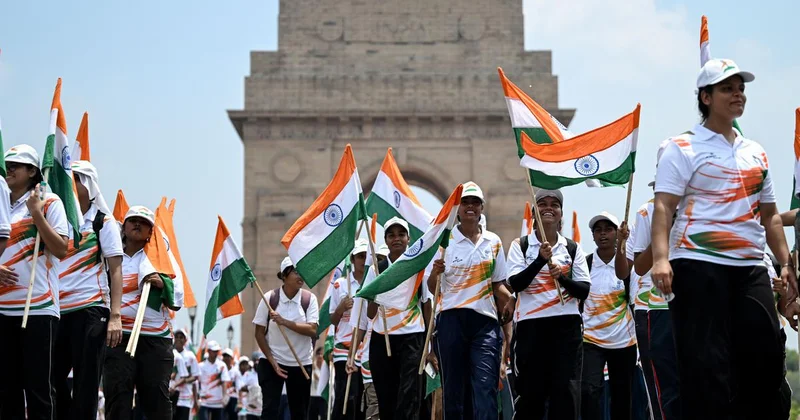
The Prevention of Insults to National Honour (Amendment) Act, 2026, which received the assent of the president on Tuesday, makes it a crime to insult or stop the singing of Vande Mataram.
It asks a much more critical question: in a democracy, should loyalty to the nation be determined by adherence to constitutional principles or should it be judged by performing actions legally deemed to be patriotic?
On Tuesday, the government announced that Vande Mataram will be sung at the Independence Day celebrations at the Red Fort on August 15.
The new law amends the Prevention of Insults to National Honour Act of 1971 by offering legal protection to Vande Mataram. The song, written in 1875, has long been an inspiration for Indians. No one has suggested that Vande Mataram does not deserve respect. But should respect for Vande Mataram be legislated?
In January 1950, the Constituent Assembly that had been appointed to frame India’s Constitution resolved to adopt Jana Gana Mana as the national anthem while recognising Vande Mataram as the National Song in view of its historic role in the freedom movement.
The Assembly consciously distinguished between the National Anthem and the National Song.
Assembly members acknowledged that while Vande Mataram is important for nationalism, parts of the song contain religious imagery that some communities could find it difficult to relate to. Rather than demanding uniformity, the assembly chose flexibility.
The new law seems likely to disrupt that balance with criminal penalties for the National Song similar to that for other national symbols.
During the Constituent Assembly debates, chairperson BR Ambedkar had anticipated the situation that India is now facing. “Constitutional morality is not a natural sentiment,” he observed. “It has to be cultivated.”
He implied that authorising punishment for the absence of such morality is not an ideal way to create it. Instead, it grows through education and reasoning on the public level. Laws can make people follow them, but this does not create a true belief in the Constitution.
For the last 10 years, public discussion has increasingly focused on displaying patriotism and how that is evidence of constitutional loyalty. This was demonstrated, for instance, when the Supreme Court in 2016 ordered cinemas to play the National Anthem before movies started. (Two years later, it made this optional.)
There has been a shift from the responsibility of the authorities to protect people’s rights to the state demanding that citizens overtly display their patriotism.
Here, India is not alone. According to Steven Levitsky and Daniel Ziblatt in * How Democracies Die*, and Tom Ginsburg and Aziz Huq in
, democratic degeneration is a gradual process that uses law to enlarge executive power and to shrink the space available for dissent. Symbolic nationalism is often deployed as a tool of enforcing democratic conformity in many parts of the world.
__How to Save a Constitutional Democracy__On paper, the Indian Supreme Court has ruled to protect against national symbols being deployed as a tool of coercion. The court’s decision in Bijoe Emmanuel v State of Kerala (1986) demonstrated the value of the principle of freedom of conscience. The case involved students belonging to the Jehovah’s Witness religious group who had been expelled from school for declining to sing the National Anthem, but standing respectfully as it was being sung.
They contended that their faith permitted them to worship only Jehovah and did not allow the symbolic praise of any other entity.
The court determined that love for one’s country cannot be measured by forced actions. Its ruling emphasised that that loyalty to the Constitution is, in fact, the ultimate dissent.
The Prevention of Insults to National Honour (Amendment) Act, 2026, raises concerns not just about its objectives but also about how it has been drafted.
The amendment criminalises a person who “intentionally prevents” the singing of Vande Mataram or “causes disturbance” to an assembly engaged in such singing, but does not define what constitutes such prevention or disturbance. This leaves it unclear about whether liability extends only to physical disruption or could also encompass non-participation, protest, speech or other forms of expression. Would a person’s silent refusal to sing Vande Mataram amount to intentionally preventing it being sung? Would peaceful protest during its rendition constitute a disturbance?
In the case of Shreya Singhal vs Union of India, the Supreme Court in 2015 struck down Section 66A of the Information Technology Act for, among other reasons, vagueness and being overly broad, holding that unclear criminal standards can confer excessive discretion on enforcement authorities and have a chilling effect on protected speech.
A similar concern arises here: without a clear statutory threshold for what constitutes “intentionally prevent[ing]” or “caus[ing] disturbance” to the singing of Vande Mataram, the law leaves citizens and enforcement authorities uncertain about the boundaries of criminal liability.
The Prevention of Insults to National Honour Act, 1971 reflects legislative restraint. Parliament recognised that protecting national honour need not come at the expense of legitimate democratic expression.
Its Statement of Objects and Reasons expressly clarifies that it is not intended to prohibit “honest and bona fide criticism” of national symbols. This law even allows people to change the Constitution and National Flag as long as those changes are made through legal means.
The new law contains no equivalent safeguard. In the absence of such limiting language, the breadth of the offence is left largely to executive interpretation.
Vande Mataram should certainly be honoured, but should criminal law be used to enforce that honour? In a constitutional democracy, the primary loyalty is to the Constitution with its values of liberty, equality, fraternity and justice. When a commitment to national symbols is made under the threat of a penal sanction, it is most likely to be a compelled gesture of civic conformity.
A constitutional democracy does not derive its strength from prescribing how citizens must express their allegiance to the nation, but from protecting their freedom to do so, or not, within constitutional limits. The Constitution is worthy of allegiance because it protects all of its citizens, even those whose expressions of patriotism are less than enthusiastic.
Samanvi Narang is Assistant Professor of Law at Jindal Global Law School, OP Jindal Global University.
We welcome your comments at letters@scroll.in.