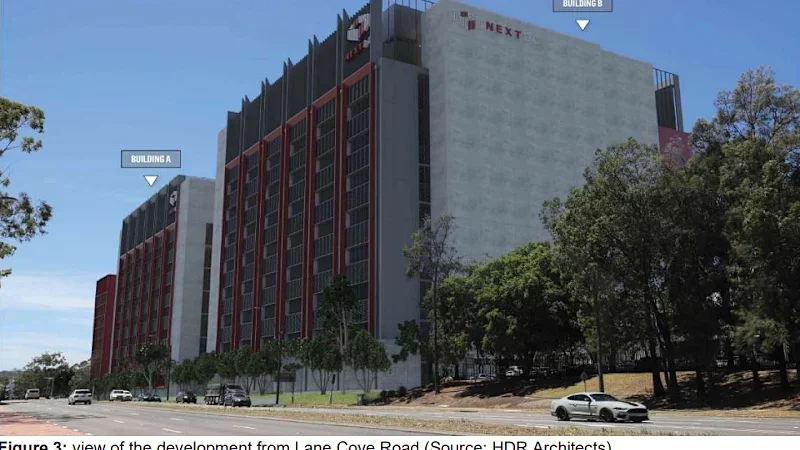
The chief executive leading the push to install data centres across Australia has defended plans to install a huge facility directly next to the entrance of a major northern Sydney metro station.
The state government is assessing plans by industry giant NextDC to build a 65-metre-high, 46,935 square metre data centre at 269 Lane Cove Road, next to the Macquarie Park metro station. If approved, the facility will have a maximum power consumption of 90 megawatts.
The plan has attracted strong criticism from the City of Ryde council, which warned Macquarie Park was on the verge of becoming a “data centre wasteland” and said the site would be better used for housing or jobs.
But in an interview with ABC Sydney, Data Centres Australia chief executive Belinda Dennett refused to say whether she thought NextDC’s plans were in the community’s interest, and compared the installation of data centres to the government’s bailout of Tomago aluminium smelter because of their ability to underwrite renewable energy.
“If you look at that railway station that you’ve just talked about, not many people work in the railway station, but the railway enables a lot of economic activity,” she said on Thursday morning. “It moves people from workplace to workplace. And data centres are very much the same thing.”
Host Hamish McDonald replied: “Are you seriously trying to make the case that it’s in the interests of the Sydney community that a data centre is built for a metro station? Are you seriously making that argument?”
After a discussion about whether the site would be beneficial to residents and the community, Dennett said: “I don’t think it’s my personal view that is particularly relevant here … I’m also not a Sydney resident, so I’m not particularly familiar with the specific site you’re talking about. What I think we need to have is more engagement at a planning level to decide what we think works and what doesn’t work.”
In its application to the planning department, NextDC said its data centre would play “a pivotal role in enhancing the local economy by creating significant job opportunities within the community”. The centre would “contribute up to” 942 jobs during construction and 490 “specialist and operational” jobs after completion. It also highlighted the fact the location was “highly accessible” to both public transport and road users.
But the City of Ryde, in a scathing submission, wrote that building a data centre immediately next to a metro station undermined the government’s policy of building dense housing around transport hubs.
The data centre would not contribute to economic growth, the council argued, and would not maximise jobs – but would instead result in the “underutilisation” of infrastructure for which the government and utility providers had already paid a “considerable cost”.
There are multiple data centres within the Ryde and Macquarie Park corridor, one of Sydney’s major business districts, as 45 per cent of land in the tech-intensive district is zoned for productivity support. While this promotes jobs and industrial activity close to transport hubs, it also prevents sites such as the one at Macquarie Park from being used for housing.
Dennett said the land was zoned industrial, meaning it could never be turned into housing.
The state government has repeatedly stressed the importance of balancing supply of land for housing with land for jobs and industry. For years, the government had a “retain and manage” approach to industrial land – used for depots, distribution centres and warehouses – in Sydney, which has notoriously little space for such businesses: the government would not remove any land zoned for industrial to be turned into housing.
However, in January last year it released a new plan that allowed for a more flexible approach to industrial zoning, especially in smaller parcels of land located in areas close to transport and employment hubs.
In May, powerful companies seeking to invest billions of dollars in data centres in NSW refused to appear at a NSW parliamentary inquiry into the controversial industry. The government also did not make a submission, and Treasurer Daniel Mookhey, Housing Minister Rose Jackson, and Energy Minister Penny Sharpe all declined to appear.
NextDC and Planning Minister Paul Scully were contacted for comment.