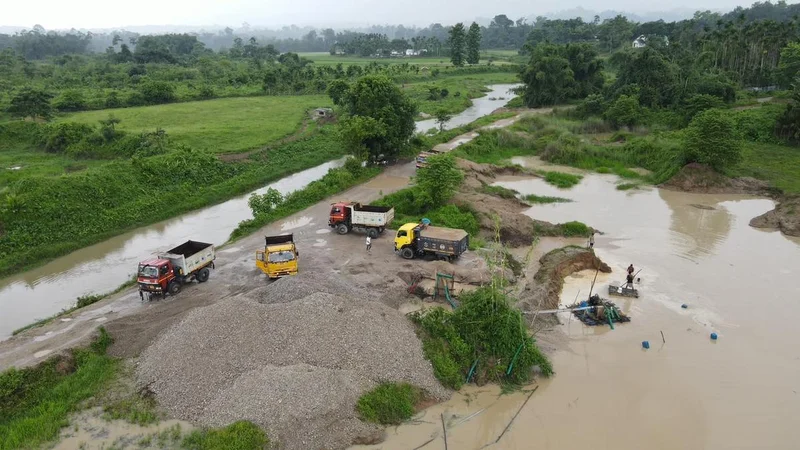
GUWAHATI Seven years after the Supreme Court ordered a complete ban on mining and related activities along its southern boundary, Assam’s Kaziranga National Park and Tiger Reserve faces a threat from renewed riverbed excavation within its proposed Eco-Sensitive Zone (ESZ).
Mohajon Kro, a resident of Diphu in Karbi Anglong district, petitioned the National Green Tribunal (NGT) and the Ministry of Environment, Forest, and Climate Change on August 5, alleging large-scale and mechanised sand mining in the Deihori River. He said that excavators, earthmovers, and dumpers are being used to extract sand from the river channel, causing ecological damage to the river and affecting the Scheduled Tribe population dependent on it.
The hilly Karbi Anglong, governed by a tribal council, forms Kaziranga’s southern boundary. The hills become a refuge for rhinos, tigers, deer, and other animals whenever the national park is flooded during the monsoon months.
Seeking an immediate halt to mechanised mining, pending an investigation into alleged violations of environmental norms, Mr. Kro said the local authorities failed to enforce the regulatory safeguards governing sand mining and monitor the extraction activities in Deihori.
“The Deihori River is not merely a source of sand but a living ecosystem that sustains biodiversity, fisheries, groundwater recharge, livestock, and daily domestic needs of the local tribal population. For generations, the indigenous communities have depended upon this river for drinking, bathing, washing, irrigation, fishing, and various cultural and traditional practices,” he wrote to the NGT.
Mr. Kro said sand extraction was being carried out against the principles laid down under India’s sustainable sand-mining framework, which seeks to prevent indiscriminate removal of riverbed material and protect river morphology and aquatic ecosystems. He claimed that the use of heavy machinery destabilised Deihori’s riverbed, altered the waterway’s natural morphology, and damaged fish breeding grounds.
He alleged that the excavation and continuous movement of machinery increased sediment disturbance and water turbidity, affecting the quality of water used by nearby communities. He also raised concerns over the possibility of contamination from diesel, lubricants, grease, and hydraulic fluids associated with heavy machinery operating within or near the river.
Mr. Kro named Songja Terang as the lease or permit holder for the Deihori River sand and gravel mahal (quarry lease area) issued under an order of the Divisional Forest Officer, Karbi Anglong East Division.
He urged the NGT to order an immediate stay on all mechanised sand mining activities in the Deihori River; prohibit the entry and operation of excavators, earthmovers, heavy machinery, and dumpers within the active river channel; and direct an urgent spot inspection by a joint committee for submission of a factual report to the tribunal within a time-bound period.
The Karbi Anglong district authorities are yet to verify the allegations.
A Golaghat district-based conservationist said that the Deihori riverbed mining, along with illegal stone quarrying and hill-cutting in Karbi Anglong, could spell doom for Kaziranga National Park. Many rivers and streams flow into the key wildlife habitat from the Karbi Anglong hills.
The administrative headquarters of the national park is in Golaghat district’s Bokakhat town.
“It appears that the Supreme Court’s April 2019 order has had no impact. If such quarrying and mining continue, Kaziranga could be in for a disaster more severe than what Sivasagar and Charaideo districts further east experienced due to stone and coal mining along the Assam-Nagaland border,” the conservationist said, declining to be quoted.
Published - August 13, 2026 09:17 am IST