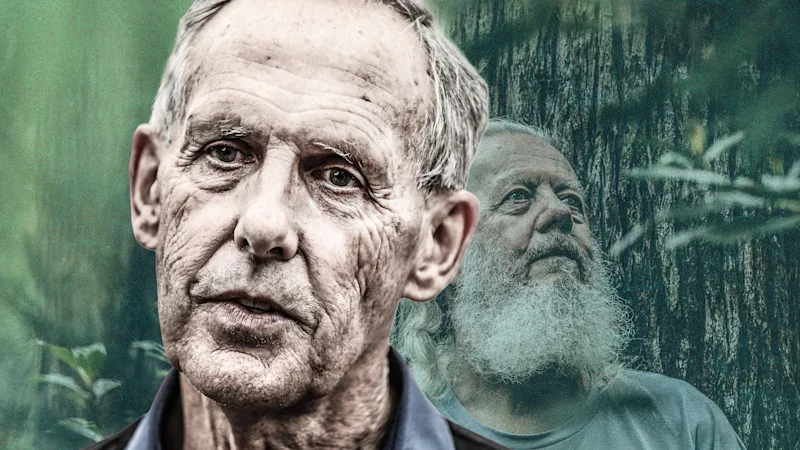
Dailan Pugh has fought on the frontlines of Australia’s forest wars since the 1970s. In all that time, he says, he never expected to see one of the movement’s elders, Bob Brown, take a position alongside the Nationals, One Nation and loggers, and against a coalition of forest conservation activists.
But here we are. A deep division has opened up in the environment movement over a new carbon accounting method proposed by the NSW Labor government and approved by the Albanese government last month that allows state governments to extract a stream of revenue from publicly owned native forests, such as the proposed Great Koala National Park in northern NSW.
As the environment movement does battle over the method, known as the Improved Native Forest Management Method (INFM), old alliances have collapsed, and hate mail has been dispatched.
The method’s champions, which include a raft of scientists and environment groups, believe that if this new method is adopted, it will not only generate hundreds of millions of dollars that can be used to restore publicly owned native forests, it could lead to the end of logging across the country.
“This is the best chance we’ve ever had to save what’s left of native forests,” says Professor David Lindenmayer, a world-leading expert in forest ecology and resource management at the Australian National University. “To shift the industry fully into plantations in Australia, just like New Zealanders did 23 years ago.”
Its opponents include the logging industry, forestry unions, One Nation and the Nationals, as well as other prominent environmentalists. Nationals leader Matt Canavan says the method would see “damage to Australia’s sustainable native forestry industry, sovereign timber supply capability, agricultural land and regional communities – locking up productive forest land for 100 years.”
Opposition from loggers and the Nationals does not surprise Lindenmayer, nor Professor Andrew MacIntosh, who designed the method. But he is baffled by Brown’s opposition, and by the savagery of the dispute that has erupted over the issue.
MacIntosh says some critics from the environment sector came from organisations he did not know existed until they began to attack him. “I hadn’t heard them of them. You know, I just hadn’t heard them. And they come out with us with a fierce venom about this, which I can’t understand. I don’t understand.”
At the heart of the matter are Australian Carbon Credit Units, or ACCUs, which are financial instruments issued by the federal government. Each unit represents one tonne of carbon dioxide equivalent removed or avoided through eligible environmental, agricultural, or industrial projects. The accounting methods have to be approved by the government.
If, say, a coal mine or cement factory wants to avoid a financial penalty for pumping out too much greenhouse-causing carbon dioxide, they can buy ACCUs to offset their emissions. Over time the price of the credits goes up, encouraging businesses to cut their pollution.
Over the years the system’s reputation as a method for reducing carbon pollution has been battered due to revelations of dodgy ACCUs being issued. Some projects, says MacIntosh, an ANU environmental lawyer and researcher who blew the whistle on faults in the system, were laughable. He describes ACCUs being issued for phantom forests allegedly growing in deserts, of others which were little more than carbon accounting tricks.
When the new NSW government decided to go ahead with the Great Koala National Park, it determined to create more credible ACCUs, that way it could extract an income stream from protecting forests that would otherwise be logged in order to fund forest rehabilitation. It signed up MacIntosh to design a new set of rules for credits born of carbon locked up in forests.
His job was to close the loopholes he had identified in the dodgy carbon projects. But much of the environment movement’s old guard, including Bob Brown and his successor as Greens leader Christine Milne, is unmoved by MacIntosh’s efforts.
Brown believes forest should be protected for their inherent value, and that carbon trading is used by Labor to allow dirty industries to keep polluting. “I think if a cement factory wants to offset its carbon, it should go out and plant the trees, or in other ways find the carbon savings, but that should not be the job of publicly owned forests, which deserve protection as national parks.
Further, he accuses the Minns government of breaking an election promise to create the park unencumbered by carbon credits. “It’s immoral in itself, the whole process of a broken election promise, and I would stand up to it. What they’re saying here is simply, ‘if we aren’t allowed to offset our pollution, the koalas can go to hell in a handbasket’.”
Milne agrees. “I philosophically oppose monetising forests. We are out of time. We have to stop emitting carbon pollution now, not find new ways of allowing it to go on.”
Geoff Cousins, who over his life has juggled the roles of corporate leader and policy adviser to John Howard with being a forestry activist, agrees with Milne and Brown. He points out that the Forestry Corporation is a notoriously loss-making enterprise wholly owned by the NSW government. “If the government wants to save some money, they can stop cutting down the trees.”
Bob Debus, a former NSW Labor environment minister and chair of the group Wilderness Australia, has published a statement arguing that though it is an improvement on other methods, INFM will perpetuate carbon emissions rather than reduce carbon pollution. He suggests it is being backed by a group called the Australian Climate and Biodiversity Foundation, which he says has “especially deep influence within Labor governments”.
Ken Henry, the former treasury secretary who is now chair of that Foundation, says that if it survives, the INFM would generate enough revenue over 15 years to fund forest restoration in NSW for 100 years.
According to Paul Sheridan, a project director with Pew Charitable Trusts, protection and restoration of Australia’s degraded landscapes is woefully underfunded. At present, government funding is about 0.6 of a per cent of what is needed, according to an analysis by the Wentworth Group of Scientists. A reliable stream of funding from properly designed ACCUs would be invaluable, he says.
Henry says the money would allow state governments to fund an end to all native forest logging, expand national parks and support and industry transition packages, forest restoration projects, and engage in pest and weed suppression. NSW Environment Minister Penny Sharpe says the government would also direct funding to indigenous ranger programs.
Later this month the Nationals will move a motion in federal parliament to kill off the new method, and the Greens are likely to have the deciding vote. If Brown and Milne have their way, the Greens will vote in line with One Nation, which wants to abolish all climate action, and the Nationals, who want to abandon Australia’s efforts to reach net zero.
The federal Greens are yet to arrive at a position on the issue, though NSW Greens MP Sue Higginson is sceptical, but has not taken a position.
“I hate Labor for doing this to our movement, it doesn’t have to be this way,” she says.
“I’ve spent my life fighting to end native forest logging, including from the impacts of climate change. Like many, I locked onto bulldozers, I took the fight into the courts as a lawyer of our movement, and now Labor is trying to hand our precious public forests from one exploiter, the loggers, to the next exploiter, the climate polluters.”
Lindenmayer says: “If it stays in place, governments can earn money protecting forests rather than lose money cutting them down. If it gets knocked on the head, it’s bad for biodiversity, it’s bad for the climate, it’s bad for fire, bad for the economy, and really, it’s bad for the poor old, long-suffering Australian taxpayer.”
Pugh, the president of the North East Forest Alliance, who spent decades battling for the creation of the Great Koala National Park, is baffled and saddened to have confronted opposition from such significant figures in the movement he has dedicated his life to, and by the viciousness of the debate over the method. He is among those who have received hate mail for his support of INFM.
The NSW Nature Conservation Council has publicly backed the new method, as have South East Forest Rescue, the North Coast Environment Council, the National Parks Association of NSW and WWF Australia. Sharpe has said that the Great Koala National Park cannot be gazetted unless the INFM survives.
Milne is unrepentant. She says she believes the logging sector is “already on its knees” and to establish carbon credits to help shrink the industry would be to “snatch defeat from the jaws of victory”. She says Lindenmayer is a fine forest scientist, who has “left his lane” in entering the debate.
Brown too dismisses Lindenmayer’s argument that the new method represents the best way to move loggers from native forests into plantations across the country since the forest wars began. “It’s not the best way. It’s the second best. The best would be for Minns to do what he said he would do.”
He says his argument is not with Lindenmayer, who he says has a “very keen mind and a very strong penchant for saving forests” or the environmentalists who back the method, but with Labor leaders and the very idea of carbon trading. “I’m not about to say future national parks should depend on money changing hands in the marketplace. That’s never been the case in history, and it shouldn’t be the case into the future.
“I appreciate those who feel crushed and anxious about this, but the fault is not with them or with me. It’s with Minns and Albanese, and I think what they’re doing is despicable.”
And can the environment movement survive the fight? “The movement has had differences of opinion. It’s big. It’s flexible. It’ll continue into the future.”