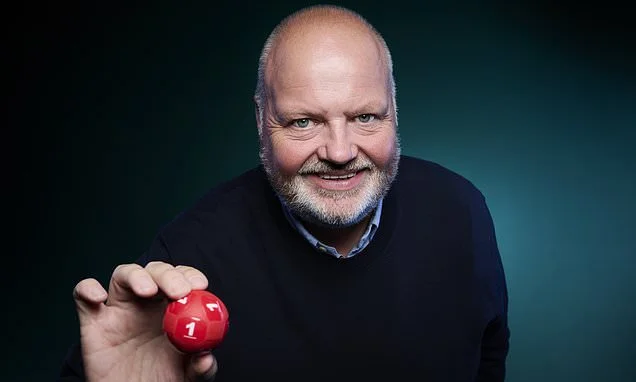
As a married father-of-two from Wales who has worked in the lottery industry for two decades, he may at first seem a relatively unremarkable man.
But you can bet your bottom dollar that there is no one you would rather see walking up the pathway to your front door than Mr Andy Carter.
For he is the National Lottery's 'fixer', an instantly likeable and cheery adviser who has helped guide more than 2,500 winners on how to manage a total of £4billion worth of sudden wealth.
Since starting out in 2006, Andy has helped teenagers, centenarians and everyone in between following a win of anything between £50,000 and £195million.
The 54-year-old who lives in Cardiff is part of a team of nine advisers at lottery operators Allwyn UK guiding the lucky few who pick the correct numbers.
Moving into the role after a stint in human resources at the BBC, Andy tells the Daily Mail he has seen huge changes in how winners spend their money which he puts down to people being more financially sensible in the modern age.
While winners might have blown their fortunes on fast cars and lavish holidays in years gone past, nowadays it is far more common to work out how to pay off a mortgage first - before perhaps spending the cash on experiences or VIP tickets.
Andy compares his role to that of a midwife - trying to give sensible guidance when winners are being given conflicting advice on what to do by everyone else.
Andy Carter is the National Lottery's 'fixer', an adviser who has helped guide 2,500 winners
He says the level of follow-up support for winners has changed significantly since he first began the job - with a raft of financial advisers, solicitors and wellbeing gurus now on hand to guide winners through their newfound wealth.
Reactions to the win can vary. Andy says some have vomited upon hearing the news while others jump around to celebrate - but most are normally quiet and in shock when he first speaks to them.
He generally goes to visit winners in their homes where they feel a 'bit more comfortable' - rather than coming into the Watford offices of Allwyn.
World's biggest jackpot game Powerball has launched in UK
The UK version of the world's biggest jackpot game Powerball has launched this week.
The National Lottery's Powerball sees UK players pay £4 per line to compete with their US counterparts to win the shared jackpot of more than £1billion, which will be paid out over 30 years.
Operator Allwyn said players could buy into the game from Tuesday.
As the Powerball jackpot – currently estimated at £300million – has continued to roll until the UK launch, Brits were in with a chance to win it in the opening draw on Thursday.
This marks the first time the game has operated outside of the US and will offer UK players uncapped jackpots starting at £12million, which can grow into the hundreds of millions and even billions.
The UK game features an extra 'match two main numbers' prize tier, which is only available to UK players and offers a fixed prize of £8.
The 'match five main numbers' tier also offers a fixed prize of £1 million while all other UK prize tiers will vary depending on the balls drawn and the number of winners.
Andy explains: 'They're nervous anyway. But actually, if you can see someone in their home, they're there surrounded by their things, their friends, their family around them and it's just a more pleasant experience.'
The company also has a 'Winners' Lounge' at its headquarters where about 10 per cent of people visit to claim their prize – often because they want to avoid a home visit to keep their win a secret.
The lounge acts as a kind of museum including 'Hall of Fame' of winners, the original draw machines and white gloves worn by 'Voice of the Balls' Alan Dedicoat.
Andy claims people's attitudes towards money have changed significantly over the years, with winners generally much more open to advice since the 2008 financial crash.
He adds that the pandemic has changed society and how people communicate – with winners nowadays far more interested in ensuring they make the right decisions.
Andy says: 'Now people are much more conservative, much more sensible, much more open to advice than they were back in 2006.
'In 2006 when you won the lottery, it was about big flashy purchases. It was about the Porsche, it was about the speedboat, it was about the sort of status stuff.
'Now, it's not. It's about planning. If people treat themselves, it's around experiences, holidays, meeting someone you've always wanted to meet, doing something wacky you've always wanted to do.
'But what hasn't changed is people's reaction to shock, because people are still shocked and they still react in different ways. Most people go very numb, very quiet, some people jump up and down.'
Looking back at winners two decades ago, he says they did not have the wealth of online information that exists nowadays to help ensure they make more sensible decisions – and would therefore be more likely to blow the cash on flashy cars.
Andy explains: 'They didn't have access to such a wide range of advice. Twenty years ago, they wouldn't have seen what other people do as far as social media is concerned. They had no point of reference. They had to imagine what people would do.'
Andy gives advice to winners who have scooped anything between £50,000 and £195million
Nowadays the focus for winners appears to be rather more sensible - considering how to pay off their mortgage, look after their children and invest their money wisely.
Many are also concerned about the impact upon their death of inheritance tax, which is charged at 40 per cent and can therefore be a huge burden.
Others go for experiences such as taking their family away on holiday on a private jet or buying VIP tickets for major sports events. One simply wanted the chance to play Sir Elton John's piano.
Top ten National Lottery winners
- Anonymous, £195,707,000 - July 19, 2022
- Joe and Jess Thwaite, £184,262,899.10 - May 10, 2022
- Anonymous, £181,073,415.70 - March 10, 2026
- Anonymous, £177,033,699.20 - November 26, 2024
- Anonymous, £171,815,297.80 - September 23, 2022
- Anonymous, £170,221,000 - October 8, 2019
- Colin and Chris Weir, £161,653,000 - July 12, 2011
- Adrian and Gillian Bayford, £148,656,000 - August 10, 2012
- Anonymous, £123,458,008 - June 11, 2019
- Anonymous, £122,550,350 - April 2, 2021
But Andy adds: 'Actually there are lots of people who want to maintain normality at the start. So they will say, I'll take the family but we're all on easyJet.
'Two or three years later when they actually get their head round it, there will be someone to take you to the airport and there's no security, a little airfield somewhere. That's nice, but it just takes a while.'
He says he was advising a winner the day before the interview, and their biggest immediate concern was about the paperwork they would need to go to their bank and pay off the mortgage 15 years early.
He explains: 'I think it's just a reflection of just how sensible and switched on our players are. Then what you tend to see is once they get past the initial stage, once they have paid their mortgage, once they have set the children up or once they put the foundations in place, they will then start to move up the ladder a little bit as far as purchasing experience is concerned.
'So, what we know is people don't tend to go from a two-bedroom flat to a six-bedroom, footballer's house. They go to a three-bedroom house and then a few years later, they might move up again - the same with cars.'
Andy notices how it often takes people a long time for their win to settle.
He says: 'If you if you've gone through the last 15 years of your life, all you are thinking about is paying off your mortgage because this house is the biggest thing you've ever paid for ever bought in your life.
'Then you've got the whole emotion of moving away from that as well. It's not always straight away.'
Joe and Jess Thwaite, from Gloucester, are the second biggest winners - having scooped a then record-breaking £184,262,899 with a Lucky Dip ticket for the draw on May 10, 2022
The reactions of winners can be a mixture of 'guilt, shock and fear', and Andy compares his role to being a midwife - given all the different advice mothers of newborn babies receive.
He says: 'Your baby comes along and you have you have one grandmother in one ear saying, 'do it like this' and the other, 'don't do it like this', right?
'There's lots of advice in your ear. So it's a bit like that with lottery winners I think, and we would say 'take your time'. People do take their time, there's no doubt about that.'
Asked whether he can become friends with winners outside of his work, Andy adds: 'It's a bit like being a midwife, right? You've got to understand that.
'You're with these people, you're getting through this, some people want to send you pictures of their child when they're six or seven and others just move on very, very quickly.
'You have some people who ring up all the time I get invited to weddings and bar mitzvahs and big parties and all that.'
Andy says he has never come across any winners whom he already knows – although there is occasionally a 'very distant connection' to someone in common.
But he points out that sometimes he is the only person that an anonymous winner has told about their prize, and he has received calls simply asking: 'Can I buy this car?'
Andy says he has seen some winners in the supermarket but has avoided going up to them because he does not know who they are with – and whether they have told them about their win.
He claims 98 per cent of winners are cautious with their new wealth, adding: 'Remember, we're reflecting the whole of society out there.
'Some people are good with money. Some people are not good, some people are generous and lavish with money.'
He compares the situation to how most people have a friend who will stand back at the pub when it is time to buy a round, in an attempt to get out of paying.
Andy says that many winners feel very generous and might want to give a huge amount of money to a son or daughter, but a solicitor might advise them to consider whether this is wise if they have concerns about their partner.
Colin and Chris Weir, from Largs, North Ayrshire, won £161,653,000 on July 12, 2011, making them the biggest UK winners at the time. Colin died in December 2019, aged 71
'It's all about enabling the winner to do what they want to do,' he adds.
Explaining how the process works when someone wins, Andy says: 'Some people play in a shop, some people play online. They find out they win. They call into our call centre. Their details get passed to us and one of my team, there are nine of us, we call them back.'
He says people who have just become millionaires 'probably want to chat to someone about it', adding: 'We're not going to get someone really dancing up and down at this point.
'Maybe someone is very, very quiet often. So it's not so much people celebrate when they win. It's more like they're just shocked.'
Andy does not think the amount makes much of a difference, given he has seen people win £100,000 and 'cannot function' – while others have got £10million but are 'very blasé about it'.
A major question for many who observe lottery winners is why they want to go public – and Andy says the main reason is because they want some kind of celebration.
He continues: 'I think people are used to feeling almost managing their own brand, a bit in social media, we all know someone who overshares on social media, don't we?
'So actually people are very conscious by and large of what they show and what they don't show. So they do that because they want to celebrate their win.'
'We are in a world where people take pictures of their tea. So actually, if you do anything in your life, you take a photograph of it. If you have a baby, if you buy a house, if you get a new job, if you get married, if you have a birthday, anything.'
Andy concedes that revealing their identities 'isn't for everyone', and only 5 to 6 per cent of people go fully public with the 'champagne moment'.
Others are happy for organisers to share details about their win while staying anonymous - such as why they bought a ticket.
The biggest National Lottery prize for a UK player was £195million which went to an anonymous winner in July 2022.
The second-highest winners were Joe and Jess Thwaite from Gloucester who won £184.3million in May that year with a Lucky Dip ticket.
There are only two other couples in the top ten biggest winners who have gone public - and neither of their marriages lasted.
One of them is Colin and Chris Weir, from Largs, North Ayrshire, who won £161,653,000 on July 12, 2011, making them the biggest UK winners at the time.
Colin invested £2.5million in his beloved Partick Thistle FC, which led to one of the stands at the stadium being named after him. But they said in April 2019 that they were divorcing, and Colin then died that December, aged 71.
The others are Adrian and Gillian Bayford, from Haverhill, Suffolk, who won £148,656,000 in a EuroMillions draw on August 10, 2012.
Adrian and Gillian, from Haverhill Suffolk, won £148,656,000 in a EuroMillions draw on August 10, 2012. They bought a Grade II-listed estate but divorced 15 months after their win
The couple bought a Grade II-listed estate in Cambridgeshire, complete with cinema and billiards room, but it was sold in 2021, some years after the pair divorced.
While Andy did not directly comment on either couple, he says that sudden wealth can 'exaggerate how you are'.
It seems therefore that those who are already having relationship problems before a win can find these get much worse when they come into money.
But on the flip side, he cites the example of Frances and Patrick Connolly from Hartlepool who landed a £115million jackpot in 2019 and donated more than half their winnings.
While there is a suggestion that not going public will avoid people asking you for money, Andy says this is not as common as people may think – and most Brits are 'really sensible and really generous'.
He adds: 'People on day one, day two or day three don't want anyone to know. And actually six months down the line, they are quite happy. They are comfortable.'
Andy also points out that it is easier for someone aged in the 60s to win £1million and keep it a secret - given they can retire early, pass on some money to their children and not make any drastic changes to their life.
For someone in their teens who still lives with their parents however, it is 'very difficult'.
Andy has previously worked with lottery winners aged just 16 – before the minimum age increased to 18 in 2021.
But he was always impressed by youngsters winning prizes, saying: 'What we found about younger people is actually they are really quite focused actually. They are switched on and they're thoughtful and careful.'
Asked what he would do if he won, Andy says: 'I've got two grown-up children, so I'd look after them. But the one thing I would say is I'm into sport.
'So I would go around the world watching the best sport and the best seats. I'd tick them all off. That's what I would do. I'd go out to travel and go around the world doing it.'
Andy adds that he cannot actually play the lottery himself due to company rules, but describes his job as 'great and just something that people have an opinion on'.
He concludes: 'If you can't win, the next best thing is going through this with them.'