Your support helps us to tell the story
From reproductive rights to climate change to Big Tech, The Independent is on the ground when the story is developing. Whether it's investigating the financials of Elon Musk's pro-Trump PAC or producing our latest documentary, 'The A Word', which shines a light on the American women fighting for reproductive rights, we know how important it is to parse out the facts from the messaging.
At such a critical moment in US history, we need reporters on the ground. Your donation allows us to keep sending journalists to speak to both sides of the story.
The Independent is trusted by Americans across the entire political spectrum. And unlike many other quality news outlets, we choose not to lock Americans out of our reporting and analysis with paywalls. We believe quality journalism should be available to everyone, paid for by those who can afford it.
Your support makes all the difference.
Read more
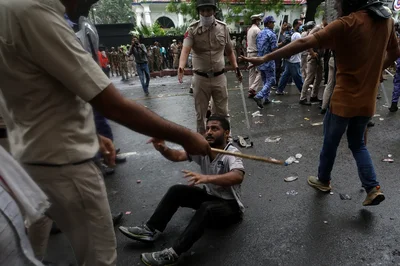
Police and paramilitary forces in the Indian capital are facing mounting criticism for using brute force against Gen Z protesters from the viral cockroach movement during their march to the parliament on Monday.
The Delhi police used teargas and batons as thousands of students and activists breached barriers to march towards the parliament demanding accountability for a series of exam paper leaks, the resignation of education minister Dharmendra Pradhan, and a reform of the education system.
The police said that 118 security personnel and 60 protesters were injured when they clashed near the designated protest site of Jantar Mantar in central Delhi.
Abhijeet Dipke, the founder of the Cockroach Janta Party, which led the protest, said more than 150 people were undergoing treatment in hospitals across the city.
Mr Dipke said he had met a girl who was admitted in hospital in a critical state after being canned by the police.
Hundreds of supporters of the cockroach party, many of them students, have been camping for over a month at Jantar Mantar to protest against the education minister following the leak of the paper for the national medical entrance exam that affected over 2 million students in May and allegedly led to almost 12 students dying by suicide.
The cockroach party has amassed millions of followers online since it was launched earlier this year and has become a major challenge for prime minister Narendra Modi in his third term.
The march to the parliament was the biggest mass protest in years, fuelled by growing youth discontent over the crisis in the education sector and the lack of employment opportunities.
Police officers armed with batons confront protesters during a demonstration organised by the Cockroach Janta Party in Delhi on 20 July 2026 (Getty)
The Jantar Mantar protest grew in strength after Sonman Wangchuk, an innovator and education reformer, launched an indefinite hunger strike there along with members of the All India Students’ Association, a leftist group, on 28 June. The protest was further galvanised when the police forcibly moved Mr Wangchuk, whose health had started deteriorating, to a Delhi hospital on Saturday.
It prompted thousands of people to stay overnight at Jantar Mantar ahead of the march to the parliament, which coincided with the opening of the legislature’s monsoon session.
Mr Dipke ruled out another march to the parliament saying his group did not want more people to be hurt. He also apologised to supporters, especially women, who he alleged were beaten by male police officers.
"We will not march again because the police will hurt the youth again," he told a press conference.
The Delhi police claimed that protesters had "displayed unruly, aggressive and violent behaviour" and "deliberately violated the prohibitory orders in force" despite warnings on Monday.
Sahil Singh, a protester from Uttar Pradesh state, said the police "beat us black and blue and they damaged our protest site”.
"We want accountability to be set with Pradhan's resignation," he said.
Authorities in Delhi had suspended metro services to prevent protesters from assembling for the march, and restricted mobile internet.
The cockroach party said that health minister JP Nadda had sought time to discuss their demands within the government after meeting its representatives on Monday.
The demands include the release of Mr Wangchuk, who is allegedly in hospital against his will, the resignation of the education minister and the announcement of compensation of Rs 10m or about $104,000 each for the families of the student who died by suicide following the paper leak.
Abhijeet Dipke, founder of the Cockroach Janta Party, sits by a portrait of hunger-striking activist Sonam Wangchuk during a protest in Delhi (AP)
Opposition leader Rahul Gandhi condemned the Modi government and its police for using force against students protesting for their rights.
"Dharmendra Pradhan should resign," he told reporters on Tuesday, adding that the police operated on instructions from home minister Amit Shah, who should also resign.
Mr Gandhi also called on prime minister Modi to resign over Monday's violence.
Akhilesh Yadav, chief of the Samajwadi Party, said: "What happened with the students yesterday, nobody could have imagined an incident like this in post-independent India."
Amnesty International's India head also criticised the police action. “The images and reports emerging from the protest at Jantar Mantar show how peaceful dissent is being suppressed in India," Aakar Patel said. "The role of the authorities is to protect and facilitate peaceful protests, not to suppress them. The right to freedom of peaceful assembly is recognized under international human rights law and the Indian constitution."
Human Rights Watch urged Indian authorities to promptly investigate allegations that security forces had used "truncheons and teargas to disperse" the students protesting in Delhi.
Parliamentary affairs minister Kiren Rijiju told reporters that "when the talks are going in a right direction, the atmosphere should not be vitiated".
Meanwhile, the Delhi High Court on Tuesday allowed Mr Wangchuk to be shifted from a government hospital to a private facility. His wife had petitioned the court alleging that he was being held in "illegal detention".
In a handwritten note from hospital that was posted on his X account on Monday, Mr Wangchuk said he would end his fast if the government took accountability for recent failures in the education system and the paper leaks, or if the protesters were allowed to reach the parliament and assured that their issues would be discussed by the lawmakers.
The CJP is a satirical take on Mr Modi’s Hindu nationalist Bharatiya Janata Party. It was so named after India’s chief justice, Surya Kant, made disparaging remarks about young people, likening some of them to cockroaches. He has since said his comments were taken out of context.
Although the CJP’s demands are specific to the education sector, it has found a wider resonance with young Indians who account for more than a quarter of the population but face shrinking job prospects.
Unemployment among Indians aged 15 to 29 stood at 9.9 per cent in 2025, rising to 13.6 per cent in urban areas, according to the Indian government’s Periodic Labour Force Survey.