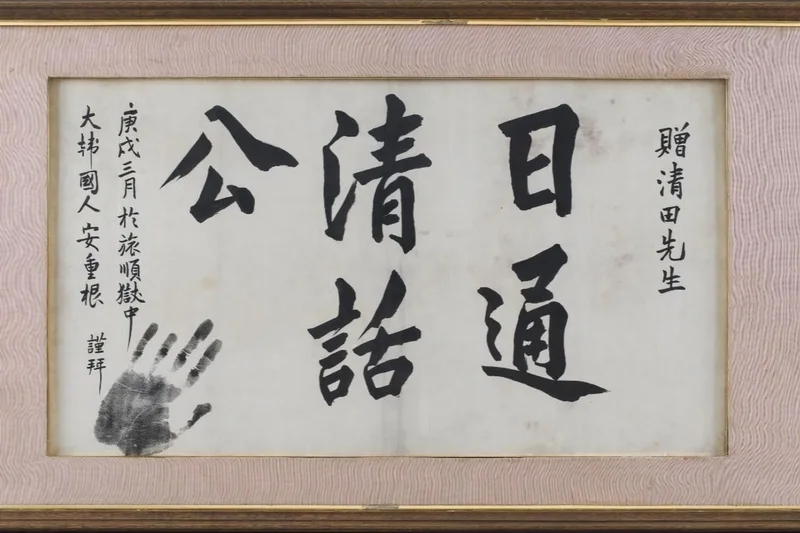
Ahead of Korea's 81st National Liberation Day, a long-lost calligraphic work written in prison by one of the nation's most revered independence activists has finally returned home from Japan.
Unveiled to the public for the first time Thursday at Deoksu Palace’s Jungmyeongjeon Hall in Seoul, the eight-character scroll by Ahn Jung-geun offers a piercing, tragic reflection on the ultimate futility of global legal protocols when confronted by raw imperial aggression.
The calligraphy reads “Man guk gong beop bul yeo dae po” — a stark declaration translating to: “International law is no match for military might.”
At its core, the phrase delivers a bitter, cynical truth about global power politics: Diplomatic treaties and international laws mean nothing when faced with superior firepower. Ahn penned this stinging critique in March 1910 inside Lushun Prison in northeastern China, just days before his execution at age 30 by Japanese colonial authorities. Five months earlier, on Oct. 26, 1909, Ahn had assassinated Ito Hirobumi — Japan’s first prime minister and resident-general of Korea — at the Harbin railway station, striking a decisive blow against Japan's forced annexation of the Korean Peninsula.
Following his arrest, Ahn maintained that his actions were a legitimate act of war executed in his capacity as a lieutenant general of the Korean Righteous Army. He repeatedly demanded to be tried under international law, expecting the world's legal frameworks to protect his status as a prisoner of war.
Instead, Japanese authorities completely ignored international legal protocols, refused to recognize him as a combatant, prosecuted him as a common murderer in a controlled court and sentenced him to death. The eight characters on the scroll capture Ahn's painful realization in his final days: While imperial powers preached global law and order on the surface, the world was ultimately ruled by the law of the jungle, where brute force overrides justice.
The vertical paper scroll, measuring nearly two meters high, displays Ahn's confident brushwork, blending standard, running and cursive scripts in rapid, decisive strokes. Lower down, it bears his signature left handprint — a hallmark of his works, featuring a shortened ring finger that he had amputated years earlier in a pledge of devotion to Korean independence. Beside the print, Ahn inscribed: "Written by Ahn Jung-geun, a citizen of the Great Korean Empire, in Lushun Prison, March of the Gyeongsul Year (1910)."
Beyond its profound philosophical weight, the artifact possesses exceptional historical value because its lineage is fully documented. Inscriptions on the back reveal that Sadakichi Kurihara, the director of Lushun Prison who treated Ahn with human dignity during his confinement, originally acquired the scroll. It was later passed to a Japanese collector who mounted and preserved the work to safeguard its legacy.
The Overseas Korean Cultural Heritage Foundation discovered the masterpiece through its local network in Japan in May 2025. Following delicate negotiations, the foundation secured its repatriated return last November with financial support from Korea's Lottery Fund.
"At a meaningful time just ahead of Liberation Day, it is profoundly moving to present this precious cultural heritage that vividly shows General Ahn’s passion for independence and peace," said Heo Min, head of the Korea Heritage Service. "We hope this unveiling inspires national pride and reminds us of our ancestors' sacrifices."
This article was published with the assistance of generative AI and edited by The Korea Times.