Luxury has spent much of the past five years putting its prices up. DeMellier London has spent them building a business in the increasingly valuable space left underneath.
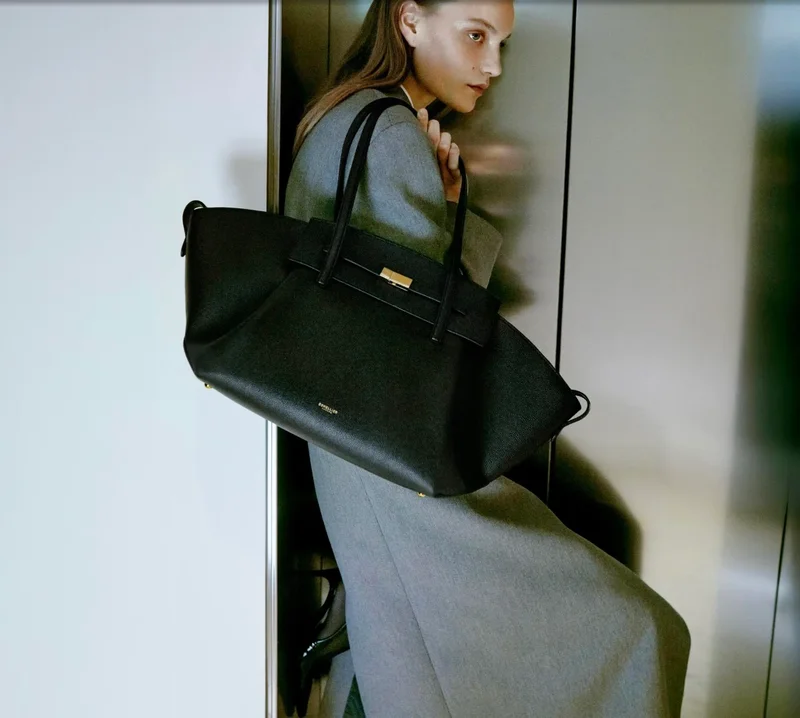
The British handbag brand, based in London, launches its Autumn Winter 2026 collection today with new products - The Brooklyn, a new family developed from its bestselling New York bag. The style is priced at £625 ($835), with the Midi Brooklyn at £540 ($725), while a new £540 ($725) New York Crossbody extends another of the brand’s strongest product families.
Recent research estimates that price increases accounted for more than 80% of luxury-sector growth during the post-pandemic boom. Yet after years of increases, the industry is finding considerably more resistance from aspirational consumers. Further data reported in 2025 put average luxury price increases at around 3% in the first five months of the year, the lowest level since 2019.
At the same time, the price of entry for many recognisable heritage handbags has moved comfortably into four figures, and frequently several thousand dollars.
This has opened up valuable territory for DeMellier and a generation of businesses including Polène, Strathberry and Toteme: consumers still want design, craftsmanship and the pleasure of buying something special, but an established luxury logo is no longer automatically enough to justify the difference in price.
DeMellier founder Mireia Llusia-Lindh sees that consumer recalibration first-hand.
“For a long time, luxury was associated with high prices and logos,” she tells me. “Today’s consumer is incredibly informed and she wants something more. She still wants exceptional design, materials and craftsmanship, but she also values price integrity, responsible production, longevity and purpose.”
Building On A Bestseller
The Brooklyn is a useful illustration of how DeMellier is approaching its next stage.
Rather than chasing an entirely new hero product, the company has taken the design language and consumer learning from The New York, one of its bestselling and most recognisable bags, and developed another style around it.
The Brooklyn retains the elongated proportions and architectural feel, adding a fold-over closure, internal zip and longer top handles. Both sizes are handcrafted in Italy using leather from Leather Working Group Gold-rated tanneries.
“The New York has become such an important part of DeMellier because it really embodies what we try to achieve with our designs: it is sophisticated and timeless, but also incredibly functional and easy to wear,” says Llusia-Lindh.
“With The Brooklyn, we wanted to evolve some of those qualities into a new family that feels related yet distinct in its own right.”
For consumers, functionality is firmly back on the agenda. DeMellier has clearly read that shift: The Brooklyn is deliberately roomy enough for everyday life, while the New York Crossbody adds greater capacity and an adjustable strap.
There is sound business in stretching a recognisable design language rather than continually starting again. A successful handbag can create demand; a successful family can create repeat customers.
The Space Between High Street And Heritage Luxury
DeMellier’s growth has coincided with a broader recalibration of what consumers expect from luxury. The brand is popular with Royalty and a raft of celebrities, but has also become a coveted brand for many shoppers awaiting each of the brand’s release dates.
The company manufactures in Europe, uses relatively restrained branding and says its leathers are sustainably sourced. Through its A Bag, A Life programme, every bag sold also funds vaccines and medical treatments for children.
But price remains an increasingly important part of the equation.
A £625 handbag is unquestionably a luxury purchase. It also looks rather different when the same consumer is being asked to consider £3,000, £4,000 or considerably more elsewhere.
The gap between high street and heritage luxury has become valuable territory. DeMellier has claimed a growing share of it with another advantage: visibility without obvious branding.
Catherine, Princess of Wales has carried the label repeatedly, including its Nano Montreal and Hudson styles, while Beyoncé, Anne Hathaway and other high-profile customers have helped extend its recognition internationally.
Llusia-Lindh says customers themselves have played a significant role in DeMellier’s growth.
“Our customers have always been our greatest ambassadors, and much of our growth has come through word of mouth and women discovering the brand through other women whose style they admire.”
That “where did you get your bag?” effect has considerable value in a market where ubiquity can eventually work against exclusivity.
DeMellier Moves Onto Sloane Square
DeMellier is stocked by retailers including Selfridges, Harrods, Liberty and Harvey Nichols in the U.K., alongside Nordstrom and Bloomingdale’s in the U.S. and international luxury retailers across Europe, Asia, Australia and the Middle East.
This autumn, the brand will open its first flagship at 35–37 Sloane Square in London, surrounded by premium lifestyle neighbours such as Tiffany & Co and Aesop.
It is an important step for a business that has built much of its recognition through digital discovery, wholesale and word of mouth. Its own store gives DeMellier control over a part of the customer relationship previously handed to other retailers, while putting it physically alongside businesses charging multiples of its prices.
Lindh says the company has been deliberately selective as it has expanded.
“Whether that is choosing wholesale partners, entering a new market or opening our first flagship, every decision has to feel right for DeMellier rather than simply being an opportunity to become bigger. We say no a lot!”
Maintaining that discipline becomes more complicated with scale.
There is another useful measure of desirability. DeMellier has developed a meaningful resale presence, with some styles being offered relatively close to retail: a New York Midi was recently listed at $535 against an estimated $670 retail price, while a Montreal Midi was $485 against $630.
It plays into a wider consumer shift. There is still status in owning an established luxury name, but increasingly there is cachet in being the discoverer, the person asked, “Where is your bag from?”
DeMellier sits neatly between the two: recognisable, helped by some very famous women carrying it, but not ubiquitous.
With a first Sloane Square flagship and The Brooklyn extending one of its bestselling designs, the brand is entering its next stage of growth. As luxury becomes both more ubiquitous and more expensive, being desirable without being everywhere could prove a valuable position to hold.