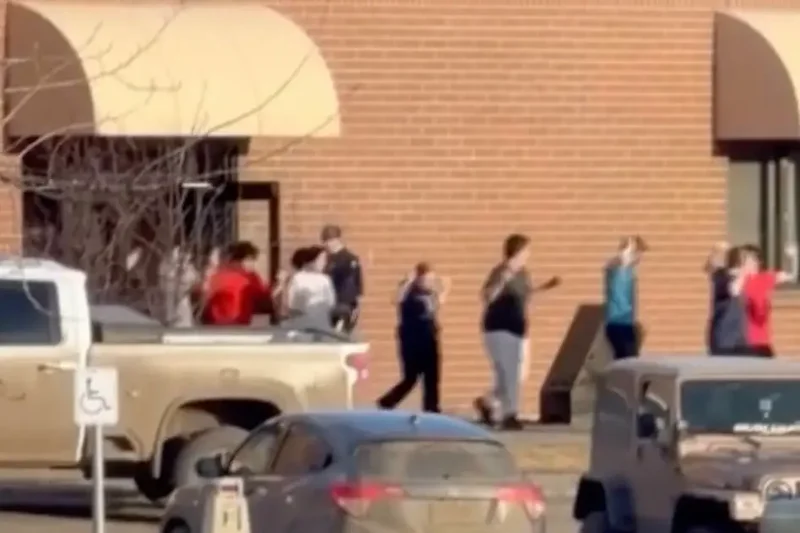
Hundreds of pages of court documents detailing what happened during the Tumbler Ridge mass shooting on Feb. 10 have finally been released.
Media outlets from across the country fought for transparency on behalf of the victims’ families, the community of Tumbler Ridge, and the nation.
The files reveal chilling new details about the killer, but a lot of information is still being withheld from the public.
Fascinated by firearms
The Tumbler Ridge killer—18-year-old Jesse Van Rootselaar—was a known name to local officers.
A sworn police document known as an ITO, written by RCMP Const. Jonathan Paquin, confirms: “Jesse had mental health problems and was fascinated by firearms.”
The shooter, a male who identified as female, was the eldest child and the records note they were “obsessed with guns.”
Safety shattered
On Feb. 10, five innocent children and an educator were gunned down in the safety of their school.
The victims included 12-year-old Kylie May Smith, 12-year-old Ticaria Lampert, 12-year-old Zoey Benoit, 12-year-old Abel Mwansa, 13-year-old Ezekiel Schofield and educator Shannda Aviugana-Durand.
Get daily National news
The horror that unfolded inside Tumbler Ridge Secondary was captured on the body camera of a responding officer.
The shooting was recorded on CCTV from inside the school.
“I have watched CCTV footage from Tumbler Ridge Secondary School,” Paquin writes, but pages and pages of potential context and crucial details – scrubbed clean by authorities – leaving only the confirmation that Van Rootselaar acted as a lone wolf.
The particulars of 80 witness statements – buried under black ink.
The firearms
The savagery of Feb. 10 began at home.
Van Rootselaar killed their mother and stepbrother first – 39-year-old Jennifer Strang and 11-year-old Emmett Jacobs.
Police discovered insecure firearms at the family home, but those details in the document are redacted.
Records show a trace on four guns, but the specifics are blacked out from public view.
Disturbing questions linger about how the young killer, with a history of mental health issues, obtained the firearms, why RCMP seized guns from Van Rootselaar’s home, why were the guns returned after the rightful owner went to court and were any of the seized guns used in one of the worst mass shootings in Canadian history?
Following the shooting police obtained five search warrants, hunting for electronics, digital clues, suicide notes and manifestos. But Van Rootselaar’s social media and phone records are also blacked out.
It is entirely unknown to the public if anything was found to help make sense of the tragedy.
Online threats
The investigation of what happened in Tumbler Ridge is of international interest as governments grapple with how to fight hidden online threats before they turn deadly.
The FBI notified the RCMP that OpenAI located two ChatGPT accounts believed to be used by the killer. OpenAI banned the accounts but failed to notify the RCMP at the time.
The details of what was said on those accounts are completely hidden from public view.
In July, the B.C. government announced that it has retained counsel to pursue legal action against OpenAI for its failure to notify law enforcement of threats made on its platform before the shooting.
The province said it has retained CFM Lawyers in Vancouver and Stranch, Jennings & Garvey, a California-based law firm, to explore all legal avenues to hold OpenAI and its decision-makers accountable.
In June, Prime Minister Mark Carney and Artificial Intelligence Minister Evan Solomon unveiled Canada’s new AI strategy which includes proposals for the building of “large-scale” data centres, restrictions on controversial surveillance pricing, and a plan to ramp up use across industry, government and individuals.
The Canadian government also introduced online harms legislation in June that would require social media companies to restrict children under 16 years old from their platforms, but will not force AI chatbot platforms to do the same.
This comes as governments around the world have begun banning social media for users under 16 years old, including Australia, Malaysia, Indonesia, Brazil, France and Turkey.
In the case of the Tumbler Ridge mass shooting, the RCMP’s reasoning for keeping the public in the dark, even though there will be no criminal trial, is that they claim the information could inspire copycats and without a complete criminal investigation, coroner’s inquest or public inquiry, it could put the public at risk.
However, there was no substantive information provided to the public as to how being transparent would do so.
-with files from Rumina Daya and Sean Boynton